| Content | Guidance, clarification and syllabus links |
|---|---|
|
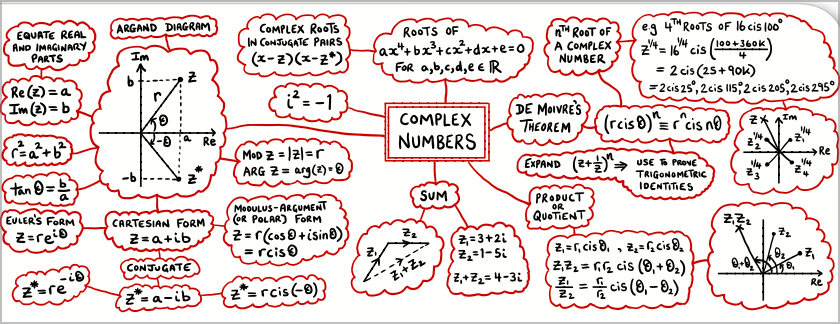
De Moivre’s theorem: \((r(\cos \theta + i \sin \theta))^n = r^n(\cos n\theta + i \sin n\theta)\).
Extension to rational exponents: \(n\)th roots of complex numbers. Complex conjugate root theorem for polynomials with real coefficients. Solving polynomial equations with complex roots. Geometric interpretation of complex roots and conjugates. Applications to trigonometric identities and Chebyshev polynomials. |
Culmination of AHL 1.12 (Cartesian form) and AHL 1.13 (polar form).
Emphasis on theoretical understanding and practical applications. Connection to advanced trigonometry and polynomial theory. Use of technology for complex calculations and verification. Applications to physics: oscillations, waves, quantum mechanics. Links to advanced mathematics: Fourier analysis, complex analysis. Historical context: De Moivre’s contributions to complex number theory. Preparation for university-level complex analysis and advanced calculus. |
📌 Introduction
De Moivre’s theorem represents the pinnacle of complex number theory at the secondary level, providing a powerful synthesis of algebra, trigonometry, and geometry that extends far beyond computational convenience into profound theoretical insights. Named after French mathematician Abraham de Moivre, this theorem transforms the challenging problem of raising complex numbers to arbitrary powers into elegant trigonometric manipulations, while simultaneously revealing deep connections between polynomial roots, geometric transformations, and periodic phenomena throughout mathematics and physics.
The theorem’s significance extends far beyond mere computational efficiency, embodying fundamental principles of mathematical symmetry and periodicity that appear throughout advanced mathematics. From generating trigonometric identities through binomial expansion to understanding the geometric structure of polynomial roots, De Moivre’s theorem serves as a gateway to sophisticated mathematical concepts including Fourier analysis, quantum mechanics, and complex analysis. The complementary theory of complex conjugate roots provides essential insights into polynomial equations with real coefficients, establishing the theoretical foundation for understanding how complex solutions always appear in conjugate pairs, reflecting the inherent symmetry of real polynomial systems.
📌 Definition Table
| Term | Definition |
|---|---|
| De Moivre’s Theorem |
For complex number \(z = r(\cos \theta + i \sin \theta)\) and integer \(n\): \(z^n = r^n(\cos n\theta + i \sin n\theta)\) |
| Extended De Moivre’s |
For rational exponent \(n = p/q\) where \(p, q\) are integers: \(z^{p/q}\) has \(q\) distinct values (multi-valued function) |
| Complex Conjugate |
For \(z = a + bi\), the conjugate is \(\overline{z} = a – bi\) Geometric: reflection across the real axis |
| Conjugate Root Theorem |
If polynomial \(P(x)\) has real coefficients and \(a + bi\) is a root, then \(a – bi\) is also a root |
| nth Roots of Unity |
The \(n\) solutions to \(z^n = 1\): \(e^{2\pi i k/n}\) for \(k = 0, 1, …, n-1\) Form a regular \(n\)-gon on the unit circle |
| Primitive nth Root |
An \(n\)th root of unity \(\omega\) such that \(\omega^k \neq 1\) for \(1 \leq k < n\) Generates all other \(n\)th roots: \(\omega^0, \omega^1, …, \omega^{n-1}\) |
| Principal nth Root |
For \(z = re^{i\theta}\), the principal \(n\)th root is \(r^{1/n}e^{i\theta/n}\) Uses principal argument \(-\pi < \theta \leq \pi\) |
| Chebyshev Polynomials |
Polynomials \(T_n(x)\) defined by \(T_n(\cos \theta) = \cos(n\theta)\) Generated using De Moivre’s theorem and binomial expansion |
| Multiple Angle Formulas |
Trigonometric identities for \(\cos(n\theta)\) and \(\sin(n\theta)\) Derived by expanding \((\cos \theta + i \sin \theta)^n\) |
📌 Properties & Key Formulas
- De Moivre’s Theorem: \((r(\cos \theta + i \sin \theta))^n = r^n(\cos n\theta + i \sin n\theta)\)
- Exponential Form: \((re^{i\theta})^n = r^n e^{in\theta}\)
- nth Roots: \(z^{1/n} = r^{1/n} e^{i(\theta + 2\pi k)/n}\) for \(k = 0, 1, …, n-1\)
- Conjugate Properties: \(\overline{z_1 z_2} = \overline{z_1} \cdot \overline{z_2}\), \(\overline{z^n} = \overline{z}^n\)
- Root Theorem: Real polynomials have complex roots in conjugate pairs
- Unity Roots Sum: \(\sum_{k=0}^{n-1} e^{2\pi i k/n} = 0\) for \(n > 1\)
- Geometric Series: \(1 + \omega + \omega^2 + … + \omega^{n-1} = 0\) for primitive \(n\)th root \(\omega\)
- Binomial Connection: \((\cos \theta + i \sin \theta)^n = \sum_{k=0}^{n} \binom{n}{k} \cos^{n-k}\theta (i\sin\theta)^k\)
Multiple Angle Formula Generation:
(cos θ + i sin θ)ⁿ = cos(nθ) + i sin(nθ)
Example for n = 3:
(cos θ + i sin θ)³ = cos³θ + 3i cos²θ sin θ – 3 cos θ sin²θ – i sin³θ
= (cos³θ – 3 cos θ sin²θ) + i(3 cos²θ sin θ – sin³θ)
Equating real and imaginary parts:
cos(3θ) = cos³θ – 3 cos θ sin²θ
sin(3θ) = 3 cos²θ sin θ – sin³θ
Using sin²θ = 1 – cos²θ:
cos(3θ) = 4cos³θ – 3cos θ
sin(3θ) = 3sin θ – 4sin³θ
nth Roots Algorithm:
- Step 1: Express \(z\) in polar form: \(z = r e^{i\theta}\)
- Step 2: Apply root formula: \(z^{1/n} = r^{1/n} e^{i(\theta + 2\pi k)/n}\)
- Step 3: Generate all \(n\) roots using \(k = 0, 1, 2, \ldots, n-1\)
- Step 4: Ensure arguments are in principal range \((-\pi, \pi]\)
- Step 5: Verify: all roots should satisfy \(((z^{1/n})^n = z)\)
Remember: The geometric interpretation shows roots as vertices of a regular polygon on a circle.
📌 Common Mistakes & How to Avoid Them
Wrong: Finding only one solution to \(z^3 = 8i\)
Right: Finding all 3 cube roots using \(k = 0, 1, 2\) in the formula
How to avoid: Always remember that \(z^{1/n}\) has exactly \(n\) distinct values.
Wrong: Directly applying the theorem without considering the definition
Right: For \(z^{-n} = \frac{1}{z^n}\), first find \(z^n\) then take reciprocal
How to avoid: Remember that \(z^{-n} = \frac{1}{z^n} = \frac{1}{r^n}e^{-in\theta}\).
Wrong: Finding \(z = 2 + 3i\) as a root and not considering its conjugate
Right: If \(2 + 3i\) is a root of a real polynomial, then \(2 – 3i\) is also a root
How to avoid: Always apply the conjugate root theorem for polynomials with real coefficients.
Wrong: Not adding \(2\pi k\) properly or using wrong range for \(k\)
Right: Systematically use \(k = 0, 1, 2, …, n-1\) for \(n\)th roots
How to avoid: Double-check that all arguments are distinct and in correct range.
Wrong: Stating that \(\sqrt[3]{8} = 2\) is the only cube root
Right: \(\sqrt[3]{8}\) has three values: \(2\), \(2\omega\), \(2\omega^2\) where \(\omega = e^{2\pi i/3}\)
How to avoid: Distinguish between principal root (calculator value) and all complex roots.
📌 Calculator Skills: Casio CG-50 & TI-84
Powers and Roots:
1. Enter complex numbers in a+bi or r∠θ format
2. Use ^ key for powers: (2∠60°)^5
3. Use x^(1/n) for nth roots: (8∠90°)^(1/3)
4. [OPTN] → [CMPLX] for complex-specific functions
Multiple Root Finding:
1. Calculate principal root first
2. Use polar form to find other roots manually
3. Store intermediate values for systematic calculation
4. Verify each root by raising to original power
Trigonometric Identities:
1. Use De Moivre’s theorem for multiple angle formulas
2. Expand (cos θ + i sin θ)^n using binomial theorem
3. Compare real and imaginary parts
4. Store common angles as variables for efficiency
Polynomial Root Problems:
1. Use equation solver for polynomial equations
2. Verify conjugate pairs for real coefficient polynomials
3. Graph complex roots when possible
4. Use substitution to check solutions
De Moivre Calculations:
1. Set mode to a+bi and Radian
2. Enter polar form using r*e^(i*θ)
3. Use ^ for integer powers
4. For roots, use fractional exponents: z^(1/3)
Root Finding Strategy:
1. Find principal root using calculator
2. Manually calculate other roots using formula
3. Store results in list variables
4. Verify all roots satisfy original equation
Conjugate Root Verification:
1. Use conj() function for complex conjugates
2. Verify polynomial evaluations at conjugate pairs
3. Use MATH → CPX menu for complex operations
4. Graph real polynomials to visualize root behavior
Advanced Applications:
1. Generate trigonometric identities systematically
2. Verify roots of unity properties
3. Explore geometric patterns of complex roots
4. Connect algebraic and geometric perspectives
Systematic Root Finding:
• Always start with polar form for root calculations
• Use the formula methodically for each value of k
• Verify results by substitution back into original equation
• Check geometric pattern – roots should form regular polygon
De Moivre Applications:
• Recognize when De Moivre’s theorem simplifies calculations
• Use for generating multiple angle trigonometric formulas
• Apply to solve polynomial equations with complex coefficients
• Connect to geometric transformations and rotational symmetry
Verification Techniques:
• Check that conjugate pairs appear for real polynomials
• Verify that nth roots multiply to give original number
• Confirm geometric arrangement of roots in complex plane
• Use alternative methods to cross-check complex results
📌 Mind Map
📌 Applications in Science and IB Math
- Quantum Mechanics: Wave function analysis, probability amplitudes, quantum state superposition
- Signal Processing: Discrete Fourier transforms, frequency analysis, filter design
- Electrical Engineering: AC circuit analysis, resonance phenomena, impedance calculations
- Crystallography: Crystal structure analysis, symmetry operations, X-ray diffraction
- Mechanical Vibrations: Modal analysis, resonance frequencies, damped oscillations
- Computer Graphics: 3D rotations, geometric transformations, animation algorithms
- Number Theory: Cyclotomic polynomials, primitive roots, algebraic number theory
- Chaos Theory: Strange attractors, fractal geometry, complex dynamical systems
Excellent IA Topics:
• Trigonometric identity generation: systematic derivation using De Moivre’s theorem
• Chebyshev polynomials: mathematical properties and engineering applications
• Roots of unity applications: cryptography, digital signal processing, quantum computing
• Polynomial root patterns: visualizing complex roots and their geometric relationships
• Fractal mathematics: using complex iteration and De Moivre’s theorem
• Musical harmony analysis: frequency ratios and complex exponential representations
• Crystal structure modeling: symmetry operations and complex coordinate transformations
• Quantum mechanics foundations: complex probability amplitudes and wave functions
IA Structure Tips:
• Begin with historical context: De Moivre’s contributions to mathematics
• Establish theoretical foundations: build from basic complex numbers to advanced theorems
• Include substantial practical applications with real data and measurements
• Demonstrate both algebraic manipulation and geometric visualization
• Connect to multiple mathematical areas: algebra, trigonometry, geometry, calculus
• Use technology effectively for complex calculations and pattern visualization
• Explore both computational and theoretical aspects of complex root theory
• Address real-world limitations and practical considerations in applications
• Include original investigation or novel application of De Moivre’s theorem
• Connect to advanced topics: Fourier analysis, group theory, complex analysis
📌 Worked Examples (IB Style)
Q1. Use De Moivre’s theorem to find \((\sqrt{3} + i)^{10}\).
Solution:
Step 1: Convert to polar form
\(|\sqrt{3} + i| = \sqrt{(\sqrt{3})^2 + 1^2} = \sqrt{3 + 1} = 2\)
\(\arg(\sqrt{3} + i) = \arctan(1/\sqrt{3}) = \pi/6\) (Quadrant I)
So \(\sqrt{3} + i = 2(\cos(\pi/6) + i\sin(\pi/6))\)
Step 2: Apply De Moivre’s theorem
\((\sqrt{3} + i)^{10} = 2^{10}(\cos(10\pi/6) + i\sin(10\pi/6))\)
\(= 1024(\cos(5\pi/3) + i\sin(5\pi/3))\)
Step 3: Evaluate trigonometric functions
\(5\pi/3 = 300°\) is in Quadrant IV
\(\cos(5\pi/3) = \cos(-\pi/3) = \cos(\pi/3) = 1/2\)
\(\sin(5\pi/3) = \sin(-\pi/3) = -\sin(\pi/3) = -\sqrt{3}/2\)
Step 4: Calculate final result
\((\sqrt{3} + i)^{10} = 1024\left(\frac{1}{2} – i\frac{\sqrt{3}}{2}\right) = 512 – 512i\sqrt{3}\)
✅ Answer: \((\sqrt{3} + i)^{10} = 512 – 512i\sqrt{3}\)
Q2. Find all cube roots of \(-8i\) and represent them geometrically.
Solution:
Step 1: Express \(-8i\) in polar form
\(|-8i| = 8\), \(\arg(-8i) = -\pi/2\) (negative imaginary axis)
So \(-8i = 8e^{-i\pi/2}\)
Step 2: Apply cube root formula
\((-8i)^{1/3} = 8^{1/3} e^{i(-\pi/2 + 2\pi k)/3}\) for \(k = 0, 1, 2\)
\(= 2e^{i(-\pi/6 + 2\pi k/3)}\)
Step 3: Calculate each root
\(k = 0\): \(z_1 = 2e^{-i\pi/6} = 2(\cos(-\pi/6) + i\sin(-\pi/6)) = 2(\sqrt{3}/2 – i/2) = \sqrt{3} – i\)
\(k = 1\): \(z_2 = 2e^{i(\pi/2)} = 2i\)
\(k = 2\): \(z_3 = 2e^{i(7\pi/6)} = 2(-\sqrt{3}/2 – i/2) = -\sqrt{3} – i\)
Step 4: Geometric representation
The three roots form vertices of an equilateral triangle on a circle of radius 2, centered at origin, with angles \(-\pi/6\), \(\pi/2\), and \(7\pi/6\).
✅ Answer: \(z_1 = \sqrt{3} – i\), \(z_2 = 2i\), \(z_3 = -\sqrt{3} – i\)
Q3. Use De Moivre’s theorem to derive the formula for \(\cos(3\theta)\).
Solution:
Step 1: Apply De Moivre’s theorem
\((\cos\theta + i\sin\theta)^3 = \cos(3\theta) + i\sin(3\theta)\)
Step 2: Expand left side using binomial theorem
\((\cos\theta + i\sin\theta)^3 = \cos^3\theta + 3\cos^2\theta(i\sin\theta) + 3\cos\theta(i\sin\theta)^2 + (i\sin\theta)^3\)
\(= \cos^3\theta + 3i\cos^2\theta\sin\theta + 3\cos\theta(i^2\sin^2\theta) + i^3\sin^3\theta\)
\(= \cos^3\theta + 3i\cos^2\theta\sin\theta – 3\cos\theta\sin^2\theta – i\sin^3\theta\)
Step 3: Separate real and imaginary parts
Real part: \(\cos^3\theta – 3\cos\theta\sin^2\theta\)
Imaginary part: \(3\cos^2\theta\sin\theta – \sin^3\theta\)
Step 4: Equate real parts and simplify
\(\cos(3\theta) = \cos^3\theta – 3\cos\theta\sin^2\theta\)
Using \(\sin^2\theta = 1 – \cos^2\theta\):
\(\cos(3\theta) = \cos^3\theta – 3\cos\theta(1 – \cos^2\theta) = \cos^3\theta – 3\cos\theta + 3\cos^3\theta\)
✅ Answer: \(\cos(3\theta) = 4\cos^3\theta – 3\cos\theta\)
Q4. A polynomial \(P(x) = x^4 – 6x^3 + 14x^2 – 14x + 5\) has real coefficients. If \(2 + i\) is a root, find all other roots.
Solution:
Step 1: Apply conjugate root theorem
Since \(P(x)\) has real coefficients and \(2 + i\) is a root, then \(2 – i\) is also a root.
Step 2: Form quadratic factor
\((x – (2 + i))(x – (2 – i)) = (x – 2)^2 – (i)^2 = x^2 – 4x + 4 + 1 = x^2 – 4x + 5\)
Step 3: Perform polynomial division
\(P(x) = (x^2 – 4x + 5)(x^2 – 2x + 1)\)
Note: \(x^2 – 2x + 1 = (x – 1)^2\)
Step 4: Find remaining roots
From \((x – 1)^2 = 0\), we get \(x = 1\) (with multiplicity 2)
✅ Answer: All roots are \(2 + i\), \(2 – i\), \(1\) (double root)
Q5. Find the 6th roots of unity and show that their sum is zero.
Solution:
Step 1: Find the 6th roots of unity
Solutions to \(z^6 = 1\): \(z_k = e^{2\pi i k/6}\) for \(k = 0, 1, 2, 3, 4, 5\)
\(z_0 = 1\), \(z_1 = e^{i\pi/3}\), \(z_2 = e^{i2\pi/3}\), \(z_3 = e^{i\pi} = -1\), \(z_4 = e^{i4\pi/3}\), \(z_5 = e^{i5\pi/3}\)
Step 2: Convert to Cartesian form
\(z_0 = 1\)
\(z_1 = \cos(\pi/3) + i\sin(\pi/3) = 1/2 + i\sqrt{3}/2\)
\(z_2 = \cos(2\pi/3) + i\sin(2\pi/3) = -1/2 + i\sqrt{3}/2\)
\(z_3 = -1\)
\(z_4 = \cos(4\pi/3) + i\sin(4\pi/3) = -1/2 – i\sqrt{3}/2\)
\(z_5 = \cos(5\pi/3) + i\sin(5\pi/3) = 1/2 – i\sqrt{3}/2\)
Step 3: Calculate the sum
\(\sum_{k=0}^{5} z_k = 1 + (1/2 + i\sqrt{3}/2) + (-1/2 + i\sqrt{3}/2) + (-1) + (-1/2 – i\sqrt{3}/2) + (1/2 – i\sqrt{3}/2)\)
Step 4: Group real and imaginary parts
Real parts: \(1 + 1/2 – 1/2 – 1 – 1/2 + 1/2 = 0\)
Imaginary parts: \(0 + \sqrt{3}/2 + \sqrt{3}/2 + 0 – \sqrt{3}/2 – \sqrt{3}/2 = 0\)
✅ Answer: 6th roots are \(e^{2\pi i k/6}\) for \(k = 0,1,2,3,4,5\); their sum is 0
Key strategies for success:
• Master both algebraic manipulation and geometric visualization
• Use the conjugate root theorem systematically for real polynomials
• Remember that nth roots form regular polygons in the complex plane
• Connect De Moivre’s theorem to trigonometric identity generation
• Always verify your complex roots by substitution
• Understand the relationship between algebraic and geometric perspectives
📌 Multiple Choice Questions (with Detailed Solutions)
Q1. Using De Moivre’s theorem, \((\text{cis } 45°)^8\) equals:
A) \(\text{cis } 360°\) B) \(\text{cis } 0°\) C) \(1\) D) All of the above
📖 Show Answer
Solution:
Using De Moivre’s theorem: \((\text{cis } \theta)^n = \text{cis } (n\theta)\)
\((\text{cis } 45°)^8 = \text{cis } (8 \times 45°) = \text{cis } 360°\)
Since \(\text{cis } 360° = \cos 360° + i \sin 360° = 1 + 0i = 1\)
And \(\text{cis } 0° = \cos 0° + i \sin 0° = 1 + 0i = 1\)
All three expressions represent the same value.
✅ Answer: D) All of the above
Q2. If \(z = 2 + 3i\) is a root of a polynomial with real coefficients, which of the following must also be a root?
A) \(-2 – 3i\) B) \(2 – 3i\) C) \(-2 + 3i\) D) \(3 + 2i\)
📖 Show Answer
Solution:
By the complex conjugate root theorem:
If a polynomial has real coefficients and \(a + bi\) is a root, then \(a – bi\) is also a root
For \(z = 2 + 3i\), the conjugate is \(\overline{z} = 2 – 3i\)
✅ Answer: B) \(2 – 3i\)
Q3. How many distinct cube roots does the complex number \(8\) have?
A) 1 B) 2 C) 3 D) 4
📖 Show Answer
Solution:
Every non-zero complex number has exactly \(n\) distinct \(n\)th roots
For cube roots, \(n = 3\), so there are 3 distinct cube roots
These are: \(2\), \(2\omega\), and \(2\omega^2\) where \(\omega = e^{2\pi i/3}\)
In Cartesian form: \(2\), \(-1 + i\sqrt{3}\), \(-1 – i\sqrt{3}\)
✅ Answer: C) 3
📌 Short Answer Questions (with Detailed Solutions)
Q1. Use De Moivre’s theorem to evaluate \((1 – i)^{12}\).
📖 Show Answer
Complete solution:
Step 1: Convert to polar form
\(|1 – i| = \sqrt{1^2 + (-1)^2} = \sqrt{2}\)
\(\arg(1 – i) = -\pi/4\) (Quadrant IV)
So \(1 – i = \sqrt{2}e^{-i\pi/4}\)
Step 2: Apply De Moivre’s theorem
\((1 – i)^{12} = (\sqrt{2})^{12} e^{-i \cdot 12 \cdot \pi/4} = 2^6 e^{-3\pi i} = 64 e^{-3\pi i}\)
Step 3: Simplify using periodicity
\(e^{-3\pi i} = e^{-\pi i} \cdot e^{-2\pi i} = (-1) \cdot 1 = -1\)
✅ Answer: \((1 – i)^{12} = -64\)
Q2. Find all solutions to \(z^4 = -16\).
📖 Show Answer
Complete solution:
Step 1: Express \(-16\) in polar form
\(|-16| = 16\), \(\arg(-16) = \pi\)
So \(-16 = 16e^{i\pi}\)
Step 2: Find fourth roots
\(z = 16^{1/4} e^{i(\pi + 2\pi k)/4}\) for \(k = 0, 1, 2, 3\)
\(z = 2 e^{i(\pi + 2\pi k)/4}\)
Step 3: Calculate each root
k=0: \(z_1 = 2e^{i\pi/4} = 2(\frac{\sqrt{2}}{2} + i\frac{\sqrt{2}}{2}) = \sqrt{2} + i\sqrt{2}\)
k=1: \(z_2 = 2e^{i3\pi/4} = 2(-\frac{\sqrt{2}}{2} + i\frac{\sqrt{2}}{2}) = -\sqrt{2} + i\sqrt{2}\)
k=2: \(z_3 = 2e^{i5\pi/4} = 2(-\frac{\sqrt{2}}{2} – i\frac{\sqrt{2}}{2}) = -\sqrt{2} – i\sqrt{2}\)
k=3: \(z_4 = 2e^{i7\pi/4} = 2(\frac{\sqrt{2}}{2} – i\frac{\sqrt{2}}{2}) = \sqrt{2} – i\sqrt{2}\)
✅ Answer: \(z = \sqrt{2} \pm i\sqrt{2}\), \(z = -\sqrt{2} \pm i\sqrt{2}\)
📌 Extended Response Questions (with Full Solutions)
Q1. Consider the polynomial \(P(z) = z^4 – 4z^3 + 8z^2 – 8z + 4\).
(a) Show that \(z = 1 + i\) is a root of \(P(z)\). [2 marks]
(b) Find all other roots of \(P(z)\). [6 marks]
(c) Express \(P(z)\) as a product of linear factors. [3 marks]
(d) Verify your answer by expanding the factored form. [4 marks]
📖 Show Answer
Complete solution:
(a) Verification:
Substitute \(z = 1 + i\):
\(P(1+i) = (1+i)^4 – 4(1+i)^3 + 8(1+i)^2 – 8(1+i) + 4\)
Calculate powers: \((1+i)^2 = 2i\), \((1+i)^3 = -2+2i\), \((1+i)^4 = -4\)
\(P(1+i) = -4 – 4(-2+2i) + 8(2i) – 8(1+i) + 4 = 0\) ✓
(b) Finding all roots:
Since \(P(z)\) has real coefficients and \(1+i\) is a root, \(1-i\) is also a root
Quadratic factor: \((z-(1+i))(z-(1-i)) = z^2-2z+2\)
Divide: \(P(z) = (z^2-2z+2)(z^2-2z+2) = (z^2-2z+2)^2\)
Therefore, \(1+i\) and \(1-i\) are double roots
(c) Factored form:
\(P(z) = (z-(1+i))^2(z-(1-i))^2\)
(d) Verification by expansion:
\(P(z) = ((z-1)-i)^2((z-1)+i)^2 = ((z-1)^2-i^2)^2 = ((z-1)^2+1)^2\)
\(= (z^2-2z+1+1)^2 = (z^2-2z+2)^2\)
Expanding: \(z^4-4z^3+8z^2-8z+4\) ✓
✅ Final Answers:
(a) Verified by substitution
(b) All roots: \(1+i, 1+i, 1-i, 1-i\) (double roots)
(c) \(P(z) = (z-(1+i))^2(z-(1-i))^2\)
(d) Verified by expansion