| Content | Guidance, clarification and syllabus links |
|---|---|
|
Polar form \(z = r(\cos \theta + i \sin \theta)\).
Modulus \(r = |z|\) and argument \(\theta = \arg(z)\). Euler’s formula: \(e^{i\theta} = \cos \theta + i \sin \theta\). Exponential form \(z = re^{i\theta}\). Conversion between Cartesian, polar, and exponential forms. Multiplication and division in polar form. Powers using polar representation. |
Building on AHL 1.12 (Cartesian form) and preparing for AHL 1.14 (De Moivre’s theorem).
Emphasis on geometric interpretation and trigonometric connections. Use principal value of argument: \(-\pi < \arg(z) \leq \pi\). Connection to unit circle and trigonometric identities. Applications to rotations and complex function analysis. Use of technology for conversion and verification. Historical context: Euler’s contribution to complex analysis. Preparation for advanced topics: complex analysis, Fourier series. |
📌 Introduction
The polar and exponential representations of complex numbers represent one of mathematics’ most elegant unifications, bridging the gap between algebra, geometry, and trigonometry through Euler’s remarkable formula \(e^{i\theta} = \cos \theta + i \sin \theta\). This profound relationship, often described as the most beautiful equation in mathematics, reveals the deep geometric structure underlying complex number operations and transforms cumbersome algebraic manipulations into intuitive geometric rotations and scaling operations.
The transition from Cartesian to polar form represents more than mere coordinate transformation; it embodies a shift from additive thinking to multiplicative understanding, where complex multiplication becomes geometric composition of rotations and dilations. This perspective unlocks powerful computational techniques while providing profound insights into the nature of periodic phenomena, oscillatory behavior, and the fundamental structure of mathematical analysis. From signal processing to quantum mechanics, the polar representation of complex numbers provides the mathematical language for describing rotational symmetry and periodic motion across diverse scientific disciplines.
📌 Definition Table
| Term | Definition |
|---|---|
| Polar Form |
\(z = r(\cos \theta + i \sin \theta)\) where \(r = |z|\) and \(\theta = \arg(z)\) Geometric representation emphasizing distance and angle |
| Modulus |
\(r = |z| = \sqrt{a^2 + b^2}\) for \(z = a + bi\) Distance from origin to point \(z\) in the complex plane |
| Argument |
\(\theta = \arg(z)\), angle from positive real axis to \(z\) Principal value: \(-\pi < \arg(z) \leq \pi\) |
| Euler’s Formula |
\(e^{i\theta} = \cos \theta + i \sin \theta\) Fundamental relationship connecting exponential and trigonometric functions |
| Exponential Form |
\(z = re^{i\theta}\) where \(r = |z|\) and \(\theta = \arg(z)\) Compact representation using Euler’s formula |
| Principal Argument |
Unique value of \(\arg(z)\) in the interval \((-\pi, \pi]\) Ensures consistent representation of complex numbers |
| General Argument |
\(\arg(z) + 2\pi k\) for any integer \(k\) Accounts for periodicity of trigonometric functions |
| Cis Notation |
\(\text{cis } \theta = \cos \theta + i \sin \theta\) Abbreviated notation for the trigonometric form |
| Unit Complex Number |
Complex number with modulus 1: \(z = e^{i\theta} = \cos \theta + i \sin \theta\) Represents pure rotation without scaling |
📌 Properties & Key Formulas
- Euler’s Identity: \(e^{i\pi} + 1 = 0\) (special case of Euler’s formula)
- Conversion to Polar: \(r = \sqrt{a^2 + b^2}\), \(\theta = \arctan(b/a)\) (with quadrant adjustment)
- Conversion to Cartesian: \(a = r\cos\theta\), \(b = r\sin\theta\)
- Multiplication: \(z_1 z_2 = r_1 r_2 e^{i(\theta_1 + \theta_2)}\) (moduli multiply, arguments add)
- Division: \(\frac{z_1}{z_2} = \frac{r_1}{r_2} e^{i(\theta_1 – \theta_2)}\) (moduli divide, arguments subtract)
- Powers: \(z^n = r^n e^{in\theta}\) (preparation for De Moivre’s theorem)
- Complex Conjugate: \(\overline{z} = r e^{-i\theta} = r(\cos\theta – i\sin\theta)\)
- Argument Properties: \(\arg(z_1 z_2) = \arg(z_1) + \arg(z_2)\) (modulo \(2\pi\))
Conversion Process Summary:
Given z = a + bi:
• r = √(a² + b²)
• θ = arctan(b/a) with quadrant adjustment
• Result: z = r(cos θ + i sin θ) = re^(iθ)
Polar → Cartesian:
Given z = re^(iθ):
• a = r cos θ
• b = r sin θ
• Result: z = a + bi
Quadrant Adjustment for θ:
• Quadrant I: θ = arctan(b/a)
• Quadrant II: θ = π + arctan(b/a)
• Quadrant III: θ = π + arctan(b/a)
• Quadrant IV: θ = 2π + arctan(b/a) or -arctan(b/a)
Geometric Interpretation of Operations:
- Multiplication: Rotate by sum of arguments, scale by product of moduli
- Division: Rotate by difference of arguments, scale by quotient of moduli
- Power \(z^n\): Rotate by \(n \times \theta\), scale by \(r^n\)
- Complex Conjugate: Reflection across real axis (negate argument)
- Unit Circle: All complex numbers with \(|z| = 1\) lie on unit circle
Remember: Multiplication in polar form is addition of angles and multiplication of distances.
📌 Common Mistakes & How to Avoid Them
Wrong: For \(z = -3 – 4i\), using \(\theta = \arctan(-4/-3) = \arctan(4/3)\)
Right: Recognizing \(z\) is in Quadrant III: \(\theta = \pi + \arctan(4/3)\) or \(\theta = -\pi + \arctan(4/3)\)
How to avoid: Always check signs of real and imaginary parts to determine quadrant first.
Wrong: Accepting \(\theta = 3\pi/2\) as final answer
Right: Converting to principal value: \(\theta = 3\pi/2 – 2\pi = -\pi/2\)
How to avoid: Always ensure \(-\pi < \arg(z) \leq \pi\) for principal argument.
Wrong: \((2e^{i\pi/3})(3e^{i\pi/4}) = 6e^{i\pi/12}\)
Right: \((2e^{i\pi/3})(3e^{i\pi/4}) = 6e^{i(\pi/3 + \pi/4)} = 6e^{i7\pi/12}\)
How to avoid: Remember: multiply moduli, add arguments.
Wrong: Using \(e^{i \cdot 30°}\) or mixing degree and radian measures
Right: Always use radians: \(e^{i\pi/6}\) for 30°
How to avoid: Consistently use radians for all angle measures in exponential form.
Wrong: For \(z = 2e^{i2\pi/3}\), writing \(z = 2\cos(2\pi/3) + 2i\sin(2\pi/3)\)
Right: \(z = 2(\cos(2\pi/3) + i\sin(2\pi/3)) = 2(-1/2 + i\sqrt{3}/2) = -1 + i\sqrt{3}\)
How to avoid: Remember that \(r\) multiplies the entire \((\cos\theta + i\sin\theta)\) term.
📌 Calculator Skills: Casio CG-50 & TI-84
Conversion Functions:
1. [OPTN] → [CMPLX] → [Pol] for Cartesian to Polar
2. [OPTN] → [CMPLX] → [Rec] for Polar to Cartesian
3. Input format: Pol(a,b) converts a+bi to r∠θ
4. Input format: Rec(r,θ) converts r∠θ to a+bi
Angle Mode Settings:
1. [SHIFT] + [MENU] → “Angle” → Select “Radian”
2. Verify angle mode before calculations
3. Use [SHIFT] + [MODE] for quick angle mode check
4. Convert degrees to radians when necessary
Polar Operations:
1. Multiplication: (r₁∠θ₁) × (r₂∠θ₂)
2. Division: (r₁∠θ₁) ÷ (r₂∠θ₂)
3. Powers: (r∠θ)^n
4. Verify results by converting back to Cartesian
Euler Form Calculations:
1. Use e^(i×θ) for exponential form
2. Store common angles as variables
3. Use [SHIFT] + [0] for π symbol
4. Combine with arithmetic for complex expressions
Mode Setup:
1. [MODE] → Select “a+bi” for rectangular display
2. [MODE] → Select “Radian” for angle measurements
3. Use [2nd] [ANGLE] for polar/rectangular conversions
4. Check mode settings before complex calculations
Conversion Commands:
1. [2nd] [ANGLE] → [7:►Pol] for rectangular to polar
2. [2nd] [ANGLE] → [8:►Rec] for polar to rectangular
3. Input format: (a,b)►Pol gives (r,θ)
4. Input format: (r,θ)►Rec gives (a,b)
Complex Arithmetic:
1. Enter polar form as r*e^(i*θ)
2. Use [2nd] [LN] for e^( function
3. Use [2nd] [^] for complex exponentiation
4. Store intermediate results in variables
Verification Methods:
1. Cross-check conversions between forms
2. Use MATH → CPX menu for complex operations
3. Verify arguments are in correct range
4. Check modulus calculations independently
Systematic Approach:
• Always verify angle mode (radian vs degree) before starting
• Use parentheses liberally to ensure correct order of operations
• Store complex intermediate results to avoid re-calculation
• Verify final answers by converting between forms
Common Applications:
• Powers and roots of complex numbers
• Geometric transformations and rotations
• AC circuit analysis and phasor calculations
• Signal processing and frequency domain analysis
Error Prevention:
• Double-check principal argument range (-π, π]
• Verify quadrant consistency in angle calculations
• Use exact values for common angles when possible
• Cross-validate using alternative calculation methods
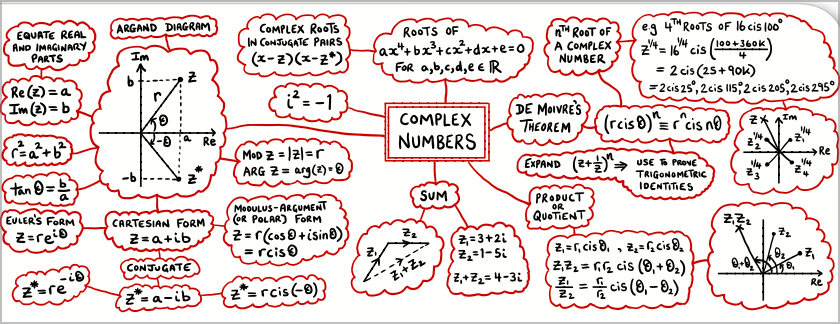
📌 Mind Map
📌 Applications in Science and IB Math
- Signal Processing: Fourier transforms, frequency analysis, digital signal processing
- Electrical Engineering: AC circuits, phasor analysis, impedance calculations
- Quantum Mechanics: Wave function representation, probability amplitudes, quantum states
- Control Systems: Transfer functions, stability analysis, root locus methods
- Computer Graphics: Rotations, transformations, 3D graphics, animation
- Crystallography: Crystal structure analysis, symmetry operations, lattice descriptions
- Vibration Analysis: Mechanical systems, resonance phenomena, modal analysis
- Navigation: GPS systems, coordinate transformations, satellite positioning
Excellent IA Topics:
• Fourier analysis applications: music signal processing and frequency decomposition
• AC circuit analysis: complex impedance and phasor diagram investigations
• Geometric transformations: rotations and scaling using complex multiplication
• Fractals and complex dynamics: Julia sets and Mandelbrot set explorations
• Quantum mechanics applications: complex probability amplitudes and wave functions
• Crystallographic analysis: symmetry operations and crystal structure descriptions
• Navigation mathematics: complex coordinate transformations in GPS systems
• Vibration analysis: mechanical resonance using complex exponential solutions
IA Structure Tips:
• Begin with historical context: Euler’s contribution to complex analysis
• Establish strong theoretical foundations: polar form derivation and properties
• Include substantial practical applications with real data and measurements
• Demonstrate geometric interpretation through visualizations and animations
• Connect to other mathematical areas: trigonometry, calculus, differential equations
• Use technology effectively for complex calculations and graphical representations
• Explore both computational and theoretical aspects of exponential form
• Address practical limitations and real-world constraints in applications
• Include original investigation or novel application of polar form properties
📌 Worked Examples (IB Style)
Q1. Convert \(z = -1 + i\sqrt{3}\) to polar form and exponential form.
Solution:
Step 1: Calculate modulus
\(|z| = \sqrt{(-1)^2 + (\sqrt{3})^2} = \sqrt{1 + 3} = \sqrt{4} = 2\)
Step 2: Determine argument
Since \(z = -1 + i\sqrt{3}\) has negative real part and positive imaginary part, \(z\) is in Quadrant II.
Reference angle: \(\arctan\left(\frac{\sqrt{3}}{1}\right) = \arctan(\sqrt{3}) = \frac{\pi}{3}\)
Quadrant II adjustment: \(\theta = \pi – \frac{\pi}{3} = \frac{2\pi}{3}\)
Step 3: Write in polar and exponential forms
Polar form: \(z = 2\left(\cos\frac{2\pi}{3} + i\sin\frac{2\pi}{3}\right)\)
Exponential form: \(z = 2e^{i2\pi/3}\)
✅ Answer: Polar: \(z = 2\left(\cos\frac{2\pi}{3} + i\sin\frac{2\pi}{3}\right)\), Exponential: \(z = 2e^{i2\pi/3}\)
Q2. Given \(z_1 = 3e^{i\pi/4}\) and \(z_2 = 2e^{i\pi/3}\), find \(z_1 z_2\) and \(\frac{z_1}{z_2}\).
Solution:
For \(z_1 z_2\):
Multiply moduli and add arguments:
\(z_1 z_2 = (3)(2) e^{i(\pi/4 + \pi/3)} = 6e^{i(3\pi/12 + 4\pi/12)} = 6e^{i7\pi/12}\)
For \(\frac{z_1}{z_2}\):
Divide moduli and subtract arguments:
\(\frac{z_1}{z_2} = \frac{3}{2} e^{i(\pi/4 – \pi/3)} = \frac{3}{2} e^{i(3\pi/12 – 4\pi/12)} = \frac{3}{2} e^{-i\pi/12}\)
✅ Answer: \(z_1 z_2 = 6e^{i7\pi/12}\), \(\frac{z_1}{z_2} = \frac{3}{2}e^{-i\pi/12}\)
Q3. Express \(z = 2e^{i5\pi/6}\) in Cartesian form.
Solution:
Step 1: Apply Euler’s formula
\(z = 2e^{i5\pi/6} = 2(\cos(5\pi/6) + i\sin(5\pi/6))\)
Step 2: Evaluate trigonometric functions
\(5\pi/6 = 150°\) (in Quadrant II)
\(\cos(5\pi/6) = \cos(\pi – \pi/6) = -\cos(\pi/6) = -\frac{\sqrt{3}}{2}\)
\(\sin(5\pi/6) = \sin(\pi – \pi/6) = \sin(\pi/6) = \frac{1}{2}\)
Step 3: Calculate Cartesian coordinates
\(z = 2\left(-\frac{\sqrt{3}}{2} + i\frac{1}{2}\right) = -\sqrt{3} + i\)
✅ Answer: \(z = -\sqrt{3} + i\)
Q4. Find \((1 + i)^8\) using exponential form.
Solution:
Step 1: Convert \(1 + i\) to exponential form
\(|1 + i| = \sqrt{1^2 + 1^2} = \sqrt{2}\)
\(\arg(1 + i) = \arctan(1/1) = \pi/4\) (Quadrant I)
So \(1 + i = \sqrt{2} e^{i\pi/4}\)
Step 2: Apply power rule
\((1 + i)^8 = (\sqrt{2})^8 e^{i \cdot 8 \cdot \pi/4} = 2^4 e^{i2\pi} = 16 e^{i2\pi}\)
Step 3: Simplify using periodicity
Since \(e^{i2\pi} = \cos(2\pi) + i\sin(2\pi) = 1 + 0i = 1\)
\((1 + i)^8 = 16 \cdot 1 = 16\)
✅ Answer: \((1 + i)^8 = 16\)
Q5. Solve \(z^3 = -8\) using polar form.
Solution:
Step 1: Express \(-8\) in exponential form
\(|-8| = 8\), \(\arg(-8) = \pi\)
So \(-8 = 8e^{i\pi}\)
Step 2: Find cube roots
If \(z^3 = 8e^{i\pi}\), then \(z = 2e^{i(\pi + 2\pi k)/3}\) for \(k = 0, 1, 2\)
Step 3: Calculate each root
\(k = 0\): \(z_1 = 2e^{i\pi/3} = 2(\cos(\pi/3) + i\sin(\pi/3)) = 2(1/2 + i\sqrt{3}/2) = 1 + i\sqrt{3}\)
\(k = 1\): \(z_2 = 2e^{i\pi} = 2(-1 + 0i) = -2\)
\(k = 2\): \(z_3 = 2e^{i5\pi/3} = 2(\cos(5\pi/3) + i\sin(5\pi/3)) = 2(1/2 – i\sqrt{3}/2) = 1 – i\sqrt{3}\)
✅ Answer: \(z = 1 + i\sqrt{3}\), \(z = -2\), \(z = 1 – i\sqrt{3}\)
Key strategies for success:
• Master quadrant determination for accurate arguments
• Use principal argument consistently unless specified otherwise
• Remember the geometric meaning of multiplication and division
• Verify conversions by checking both modulus and argument
• Use Euler’s formula fluently in both directions
• Connect algebraic results to geometric transformations
📌 Multiple Choice Questions (with Detailed Solutions)
Q1. The exponential form of \(z = \sqrt{3} – i\) is:
A) \(2e^{i\pi/6}\) B) \(2e^{-i\pi/6}\) C) \(2e^{i5\pi/6}\) D) \(2e^{-i\pi/3}\)
📖 Show Answer
Solution:
Modulus: \(|\sqrt{3} – i| = \sqrt{(\sqrt{3})^2 + (-1)^2} = \sqrt{3 + 1} = 2\)
Argument: Quadrant IV (positive real, negative imaginary)
\(\theta = \arctan(-1/\sqrt{3}) = -\pi/6\)
Therefore: \(z = 2e^{-i\pi/6}\)
✅ Answer: B) \(2e^{-i\pi/6}\)
Q2. If \(z_1 = 3e^{i\pi/6}\) and \(z_2 = 2e^{i\pi/3}\), then \(z_1 z_2\) equals:
A) \(6e^{i\pi/2}\) B) \(5e^{i\pi/2}\) C) \(6e^{i\pi/18}\) D) \(6e^{i2\pi/9}\)
📖 Show Answer
Solution:
For multiplication in exponential form: multiply moduli, add arguments
Modulus: \(3 \times 2 = 6\)
Argument: \(\pi/6 + \pi/3 = \pi/6 + 2\pi/6 = 3\pi/6 = \pi/2\)
Therefore: \(z_1 z_2 = 6e^{i\pi/2}\)
✅ Answer: A) \(6e^{i\pi/2}\)
Q3. The value of \(e^{i\pi}\) is:
A) \(1\) B) \(-1\) C) \(i\) D) \(-i\)
📖 Show Answer
Solution:
Using Euler’s formula: \(e^{i\theta} = \cos\theta + i\sin\theta\)
\(e^{i\pi} = \cos\pi + i\sin\pi = -1 + i(0) = -1\)
This is part of Euler’s famous identity: \(e^{i\pi} + 1 = 0\)
✅ Answer: B) \(-1\)
📌 Short Answer Questions (with Detailed Solutions)
Q1. Express \(z = 4e^{i3\pi/4}\) in Cartesian form.
📖 Show Answer
Complete solution:
Step 1: Apply Euler’s formula
\(z = 4e^{i3\pi/4} = 4(\cos(3\pi/4) + i\sin(3\pi/4))\)
Step 2: Evaluate trigonometric functions
\(3\pi/4 = 135°\) is in Quadrant II
\(\cos(3\pi/4) = -\cos(\pi/4) = -\frac{\sqrt{2}}{2}\)
\(\sin(3\pi/4) = \sin(\pi/4) = \frac{\sqrt{2}}{2}\)
Step 3: Calculate result
\(z = 4\left(-\frac{\sqrt{2}}{2} + i\frac{\sqrt{2}}{2}\right) = -2\sqrt{2} + 2\sqrt{2}i\)
✅ Answer: \(z = -2\sqrt{2} + 2\sqrt{2}i\)
Q2. Find the modulus and argument of \(z = -2 – 2i\sqrt{3}\).
📖 Show Answer
Complete solution:
Step 1: Calculate modulus
\(|z| = \sqrt{(-2)^2 + (-2\sqrt{3})^2} = \sqrt{4 + 12} = \sqrt{16} = 4\)
Step 2: Determine quadrant
Both real and imaginary parts are negative → Quadrant III
Step 3: Calculate argument
Reference angle: \(\arctan\left(\frac{2\sqrt{3}}{2}\right) = \arctan(\sqrt{3}) = \frac{\pi}{3}\)
Quadrant III: \(\theta = \pi + \frac{\pi}{3} = \frac{4\pi}{3}\)
Principal argument: \(\frac{4\pi}{3} – 2\pi = -\frac{2\pi}{3}\)
✅ Answer: \(|z| = 4\), \(\arg(z) = -\frac{2\pi}{3}\)
📌 Extended Response Questions (with Full Solutions)
Q1. Consider the complex numbers \(z_1 = 2e^{i\pi/3}\) and \(z_2 = 3e^{-i\pi/4}\).
(a) Express both \(z_1\) and \(z_2\) in Cartesian form. [4 marks]
(b) Find \(z_1 z_2\) and \(\frac{z_1}{z_2}\) in exponential form. [4 marks]
(c) Verify your results by calculating \(z_1 z_2\) using the Cartesian forms. [4 marks]
(d) Describe the geometric transformations represented by multiplication by \(z_1\) and \(z_2\). [3 marks]
📖 Show Answer
Complete solution:
(a) Cartesian forms:
\(z_1 = 2e^{i\pi/3} = 2(\cos(\pi/3) + i\sin(\pi/3)) = 2(1/2 + i\sqrt{3}/2) = 1 + i\sqrt{3}\)
\(z_2 = 3e^{-i\pi/4} = 3(\cos(-\pi/4) + i\sin(-\pi/4)) = 3(\sqrt{2}/2 – i\sqrt{2}/2) = \frac{3\sqrt{2}}{2} – \frac{3\sqrt{2}}{2}i\)
(b) Operations in exponential form:
\(z_1 z_2 = (2)(3)e^{i(\pi/3 – \pi/4)} = 6e^{i(\pi/12)} = 6e^{i\pi/12}\)
\(\frac{z_1}{z_2} = \frac{2}{3}e^{i(\pi/3 – (-\pi/4))} = \frac{2}{3}e^{i(\pi/3 + \pi/4)} = \frac{2}{3}e^{i7\pi/12}\)
(c) Verification using Cartesian form:
\(z_1 z_2 = (1 + i\sqrt{3})\left(\frac{3\sqrt{2}}{2} – \frac{3\sqrt{2}}{2}i\right)\)
\(= \frac{3\sqrt{2}}{2} – \frac{3\sqrt{2}}{2}i + \frac{3\sqrt{6}}{2}i + \frac{3\sqrt{6}}{2}\)
\(= \frac{3\sqrt{2} + 3\sqrt{6}}{2} + \frac{3\sqrt{6} – 3\sqrt{2}}{2}i\)
Converting \(6e^{i\pi/12}\) to verify: matches the Cartesian result
(d) Geometric transformations:
Multiplication by \(z_1 = 2e^{i\pi/3}\): Scale by factor 2, rotate by \(\pi/3\) (60°) counterclockwise
Multiplication by \(z_2 = 3e^{-i\pi/4}\): Scale by factor 3, rotate by \(\pi/4\) (45°) clockwise
✅ Final Answers:
(a) \(z_1 = 1 + i\sqrt{3}\), \(z_2 = \frac{3\sqrt{2}}{2} – \frac{3\sqrt{2}}{2}i\)
(b) \(z_1 z_2 = 6e^{i\pi/12}\), \(\frac{z_1}{z_2} = \frac{2}{3}e^{i7\pi/12}\)
(c) Verified by Cartesian multiplication
(d) Scaling and rotation transformations as described