| Content | Guidance, clarification and syllabus links |
|---|---|
|
Partial fraction decomposition.
Linear factors in the denominator. Repeated linear factors. Quadratic factors (irreducible). Mixed cases combining different factor types. |
Preparation for integration techniques in calculus.
Link to polynomial long division when degree of numerator ≥ degree of denominator. Method of undetermined coefficients. Cover-up method for simple linear factors. Applications in differential equations and Laplace transforms. Connection to complex numbers and residue theory. Use of technology for verification and complex cases. |
📌 Introduction
Partial fraction decomposition represents one of the most elegant and powerful techniques in algebraic manipulation, serving as a crucial bridge between rational function theory and advanced calculus. This sophisticated method transforms complex rational expressions into simpler, more manageable components, enabling mathematicians to tackle integration problems that would otherwise be intractable. The technique’s fundamental principle—breaking down a complicated fraction into a sum of simpler fractions—mirrors the mathematical philosophy of divide and conquer that underlies much of advanced mathematics.
The historical development of partial fractions traces back to the work of Leibniz and the Bernoulli brothers, who recognized that rational functions could be systematically decomposed into elementary components. This decomposition not only simplifies algebraic manipulation but also reveals the underlying structure of rational expressions, connecting abstract algebra with practical applications in physics, engineering, and advanced mathematics. From solving differential equations to analyzing electrical circuits, partial fractions provide the mathematical foundation for understanding complex systems through the lens of simpler, constituent parts.
📌 Definition Table
| Term | Definition |
|---|---|
| Partial Fraction |
A fraction with a simpler denominator that forms part of a partial fraction decomposition Example: \(\frac{A}{x-1}\) or \(\frac{Bx+C}{x^2+1}\) |
| Partial Fraction Decomposition |
The process of expressing a rational function as a sum of simpler partial fractions \(\frac{P(x)}{Q(x)} = \frac{A_1}{(x-r_1)} + \frac{A_2}{(x-r_2)} + \cdots\) |
| Proper Rational Function |
A rational function where degree of numerator < degree of denominator Required for direct partial fraction decomposition |
| Improper Rational Function |
A rational function where degree of numerator ≥ degree of denominator Requires polynomial long division before partial fraction decomposition |
| Linear Factor |
A factor of the form (x – a) or (ax + b) Contributes \(\frac{A}{x-a}\) to the decomposition |
| Repeated Linear Factor |
A factor of the form (x – a)ⁿ where n > 1 Contributes \(\frac{A_1}{x-a} + \frac{A_2}{(x-a)^2} + \cdots + \frac{A_n}{(x-a)^n}\) |
| Quadratic Factor |
An irreducible factor of the form ax² + bx + c (no real roots) Contributes \(\frac{Bx+C}{ax^2+bx+c}\) to the decomposition |
| Cover-up Method |
A shortcut technique for finding coefficients of simple linear factors “Cover up” the factor and substitute its root |
📌 Properties & Key Formulas
- Basic Decomposition Types:
- Linear factors: \(\frac{P(x)}{(x-a)(x-b)} = \frac{A}{x-a} + \frac{B}{x-b}\)
- Repeated linear: \(\frac{P(x)}{(x-a)^n} = \frac{A_1}{x-a} + \frac{A_2}{(x-a)^2} + \cdots + \frac{A_n}{(x-a)^n}\)
- Quadratic factors: \(\frac{P(x)}{(x^2+px+q)} = \frac{Ax+B}{x^2+px+q}\)
- General Decomposition Formula: \(\frac{P(x)}{Q(x)} = \sum \text{partial fractions}\)
- Degree Condition: deg(P) < deg(Q) for proper fractions
- Uniqueness: Partial fraction decomposition is unique
- Cover-up Formula: For \(\frac{P(x)}{(x-a)Q(x)}\), coefficient = \(\frac{P(a)}{Q(a)}\)
- Method of Undetermined Coefficients: Equate coefficients of like powers
- Substitution Method: Substitute convenient values of x to find coefficients
Step-by-Step Decomposition Process:
If not, perform polynomial long division first
Step 2: Factor the denominator completely
Identify linear, repeated linear, and quadratic factors
Step 3: Set up partial fraction form
Each factor type contributes specific terms
Step 4: Find coefficients using:
• Cover-up method (for simple linear factors)
• Substitution method
• Equating coefficients
Step 5: Verify by combining fractions back to original
Common Decomposition Patterns:
- Two linear factors: \(\frac{1}{(x-1)(x-2)} = \frac{A}{x-1} + \frac{B}{x-2}\)
- Repeated factor: \(\frac{1}{(x-1)^2} = \frac{A}{x-1} + \frac{B}{(x-1)^2}\)
- Quadratic factor: \(\frac{x}{x^2+1} = \frac{Ax+B}{x^2+1}\)
- Mixed factors: \(\frac{1}{(x-1)(x^2+1)} = \frac{A}{x-1} + \frac{Bx+C}{x^2+1}\)
Remember: The number of unknown coefficients must equal the degree of the denominator polynomial.
📌 Common Mistakes & How to Avoid Them
Wrong: Decomposing \(\frac{x^3}{x^2-1}\) directly
Right: First divide: \(\frac{x^3}{x^2-1} = x + \frac{x}{x^2-1}\), then decompose \(\frac{x}{x^2-1}\)
How to avoid: Always check degrees: if deg(numerator) ≥ deg(denominator), divide first.
Wrong: \(\frac{1}{(x-1)^2} = \frac{A}{(x-1)^2}\)
Right: \(\frac{1}{(x-1)^2} = \frac{A}{x-1} + \frac{B}{(x-1)^2}\)
How to avoid: For (x-a)ⁿ, include all powers from 1 to n.
Wrong: \(\frac{1}{x^2+1} = \frac{A}{x^2+1}\)
Right: \(\frac{1}{x^2+1} = \frac{Ax+B}{x^2+1}\)
How to avoid: Quadratic factors require linear numerators (Ax + B).
Wrong: Making sign errors when substituting values or equating coefficients
Right: Systematically check each step, especially with negative substitutions
How to avoid: Use multiple methods to verify coefficients and always check final answer.
Wrong: Stopping at \(\frac{1}{x^4-1} = \frac{A}{x^2-1} + \frac{Bx+C}{x^2+1}\)
Right: Factor completely: \(x^4-1 = (x-1)(x+1)(x^2+1)\)
How to avoid: Always factor denominators completely before setting up partial fractions.
📌 Calculator Skills: Casio CG-50 & TI-84
Polynomial Long Division:
1. [MENU] → “Algebra” → “Polynomial Tools”
2. Select “Divide” for polynomial division
3. Enter numerator and denominator polynomials
4. Get quotient and remainder automatically
Factoring Polynomials:
1. [MENU] → “Algebra” → “Advanced”
2. Use “factor” command: factor(x^4-1)
3. Verify complete factorization
4. Check for irreducible quadratic factors
Verification of Results:
1. Use “expand” to combine partial fractions
2. Store original expression in one variable
3. Store partial fraction sum in another
4. Subtract to verify they’re equal (should be 0)
Solving Systems for Coefficients:
1. [MENU] → “Equation/Inequality” → “Solver”
2. Set up system of equations from coefficient equating
3. Solve for unknown coefficients simultaneously
4. Use substitution method for verification
Basic Factoring:
1. Use “factor(” command for polynomial factoring
2. Example: factor(x^3-6x^2+11x-6)
3. Verify results by expanding back
4. Check degree and leading coefficient
Polynomial Division:
1. Manual long division using paper method
2. Verify using polynomial evaluation at test points
3. Use [MATH] → [0:solve(] for finding roots
4. Build factors from known roots
System Solving:
1. Use matrix operations for coefficient systems
2. [2nd] [MATRIX] → “MATH” → “rref(“
3. Set up augmented matrix for coefficients
4. Solve using reduced row echelon form
Verification Techniques:
1. Define original function as Y1
2. Define partial fraction sum as Y2
3. Graph Y1-Y2 to check for zero difference
4. Use [2nd] [TRACE] → “value” for spot checks
Complex Factorization:
• Use numerical methods to find approximate roots
• Apply synthetic division for known factors
• Check discriminant for quadratic factors
• Use graphing to identify multiplicity of roots
Coefficient Verification:
• Test multiple x-values in original vs. decomposition
• Use specific values like x = 0, 1, -1 for quick checks
• Verify degree consistency throughout process
• Check limiting behavior as x approaches infinity
Error Prevention:
• Save intermediate results to avoid recomputation
• Use parentheses carefully in complex expressions
• Double-check signs when working with negative roots
• Maintain fraction forms when possible for exact answers
📌 Mind Map
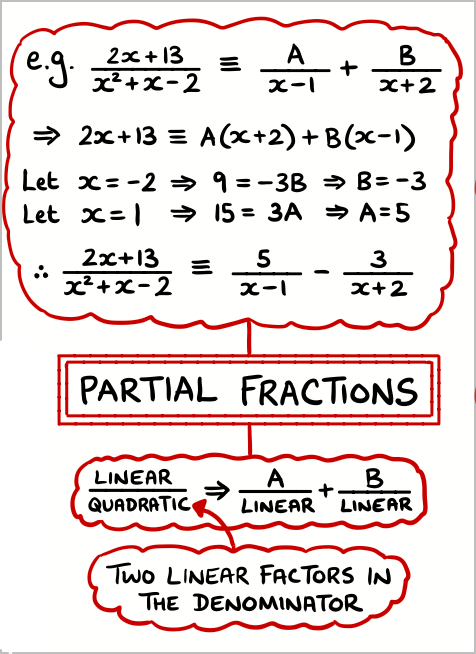
📌 Applications in Science and IB Math
- Calculus Integration: Essential for integrating rational functions, fundamental theorem applications
- Differential Equations: Solution techniques, Laplace transforms, system analysis
- Engineering: Circuit analysis, signal processing, control systems design
- Physics: Resonance phenomena, wave analysis, quantum mechanics applications
- Economics: Cost analysis, optimization problems, marginal analysis
- Computer Science: Algorithm analysis, numerical methods, computational mathematics
- Statistics: Probability generating functions, moment calculations, distribution analysis
- Pure Mathematics: Complex analysis, algebraic number theory, abstract algebra
Excellent IA Topics:
• Historical development of partial fraction techniques and mathematical contributions
• Engineering applications: RC circuits and impedance analysis using partial fractions
• Economics modeling: cost functions and marginal analysis with rational expressions
• Population dynamics: differential equation solutions via partial fraction methods
• Signal processing: Fourier analysis and frequency domain techniques
• Probability theory: moment generating functions and distribution decomposition
• Numerical analysis: integration algorithms and computational efficiency
• Music theory: harmonic analysis and acoustic wave decomposition
IA Structure Tips:
• Begin with historical context and motivation for the technique
• Develop theoretical foundations systematically
• Include substantial real-world applications with actual data
• Connect to other mathematical areas (calculus, differential equations)
• Explore computational aspects and algorithm efficiency
• Use technology to handle complex cases and verify results
• Discuss limitations and extensions to advanced mathematics
• Include original research or novel applications
• Address both theoretical beauty and practical utility
📌 Worked Examples (IB Style)
Q1. Express \(\frac{7x+1}{(x-1)(x+2)}\) in partial fractions.
Solution:
Step 1: Set up partial fraction form
\(\frac{7x+1}{(x-1)(x+2)} = \frac{A}{x-1} + \frac{B}{x+2}\)
Step 2: Clear denominators
\(7x+1 = A(x+2) + B(x-1)\)
Step 3: Use cover-up method
For A: substitute x = 1: \(7(1)+1 = A(1+2) \Rightarrow 8 = 3A \Rightarrow A = \frac{8}{3}\)
For B: substitute x = -2: \(7(-2)+1 = B(-2-1) \Rightarrow -13 = -3B \Rightarrow B = \frac{13}{3}\)
Step 4: Write final answer
\(\frac{7x+1}{(x-1)(x+2)} = \frac{8/3}{x-1} + \frac{13/3}{x+2} = \frac{8}{3(x-1)} + \frac{13}{3(x+2)}\)
✅ Answer: \(\frac{8}{3(x-1)} + \frac{13}{3(x+2)}\)
Q2. Decompose \(\frac{3x^2+2x+1}{(x-1)^2(x+1)}\) into partial fractions.
Solution:
Step 1: Set up with repeated factor
\(\frac{3x^2+2x+1}{(x-1)^2(x+1)} = \frac{A}{x-1} + \frac{B}{(x-1)^2} + \frac{C}{x+1}\)
Step 2: Clear denominators
\(3x^2+2x+1 = A(x-1)(x+1) + B(x+1) + C(x-1)^2\)
Step 3: Find coefficients using substitution
x = 1: \(3(1)^2+2(1)+1 = B(1+1) \Rightarrow 6 = 2B \Rightarrow B = 3\)
x = -1: \(3(-1)^2+2(-1)+1 = C(-1-1)^2 \Rightarrow 2 = 4C \Rightarrow C = \frac{1}{2}\)
Step 4: Find A by equating coefficients
Expanding: \(3x^2+2x+1 = A(x^2-1) + B(x+1) + C(x-1)^2\)
Coefficient of x²: 3 = A + C = A + \frac{1}{2} \Rightarrow A = \frac{5}{2}\)
✅ Answer: \(\frac{5/2}{x-1} + \frac{3}{(x-1)^2} + \frac{1/2}{x+1}\)
Q3. Express \(\frac{x^2+1}{x(x^2+x+1)}\) in partial fractions.
Solution:
Step 1: Check if x²+x+1 is irreducible
Discriminant: b²-4ac = 1²-4(1)(1) = -3 < 0, so irreducible
Step 2: Set up partial fractions
\(\frac{x^2+1}{x(x^2+x+1)} = \frac{A}{x} + \frac{Bx+C}{x^2+x+1}\)
Step 3: Clear denominators
\(x^2+1 = A(x^2+x+1) + (Bx+C)x\)
\(x^2+1 = Ax^2+Ax+A + Bx^2+Cx\)
Step 4: Equate coefficients
x²: 1 = A + B
x¹: 0 = A + C
x⁰: 1 = A
Step 5: Solve system
From x⁰: A = 1
From x¹: C = -A = -1
From x²: B = 1 – A = 0
✅ Answer: \(\frac{1}{x} + \frac{-1}{x^2+x+1}\)
Q4. Find the partial fraction decomposition of \(\frac{x^3+2x}{x^2-4}\).
Solution:
Step 1: Check if proper fraction
Degree of numerator (3) > degree of denominator (2), so improper
Step 2: Perform polynomial long division
\(\frac{x^3+2x}{x^2-4} = x + \frac{4x+2x}{x^2-4} = x + \frac{6x}{x^2-4}\)
Step 3: Factor denominator and decompose remainder
\(x^2-4 = (x-2)(x+2)\)
\(\frac{6x}{(x-2)(x+2)} = \frac{A}{x-2} + \frac{B}{x+2}\)
Step 4: Find coefficients
\(6x = A(x+2) + B(x-2)\)
x = 2: 12 = 4A ⇒ A = 3
x = -2: -12 = -4B ⇒ B = 3
✅ Answer: \(x + \frac{3}{x-2} + \frac{3}{x+2}\)
Q5. Decompose \(\frac{2x^3-x^2+x-1}{(x^2+1)^2}\) into partial fractions.
Solution:
Step 1: Identify repeated quadratic factor
Since x²+1 is irreducible and repeated, we need:
Step 2: Set up partial fraction form
\(\frac{2x^3-x^2+x-1}{(x^2+1)^2} = \frac{Ax+B}{x^2+1} + \frac{Cx+D}{(x^2+1)^2}\)
Step 3: Clear denominators
\(2x^3-x^2+x-1 = (Ax+B)(x^2+1) + (Cx+D)\)
Step 4: Expand and equate coefficients
\(2x^3-x^2+x-1 = Ax^3+Ax+Bx^2+B+Cx+D\)
x³: 2 = A ⇒ A = 2
x²: -1 = B ⇒ B = -1
x¹: 1 = A + C = 2 + C ⇒ C = -1
x⁰: -1 = B + D = -1 + D ⇒ D = 0
✅ Answer: \(\frac{2x-1}{x^2+1} + \frac{-x}{(x^2+1)^2}\)
Key strategies for success:
• Check degree first – divide if improper
• Factor completely before setting up
• Use cover-up method for simple linear factors
• Set up systematic equations for complex cases
• Always verify by combining back to original
• Show all algebraic steps clearly
📌 Multiple Choice Questions (with Detailed Solutions)
Q1. The partial fraction decomposition of \(\frac{5x-3}{(x-1)(x-2)}\) is:
A) \(\frac{2}{x-1} + \frac{3}{x-2}\) B) \(\frac{-2}{x-1} + \frac{7}{x-2}\) C) \(\frac{3}{x-1} + \frac{2}{x-2}\) D) \(\frac{7}{x-1} + \frac{-2}{x-2}\)
📖 Show Answer
Solution:
Set up: \(\frac{5x-3}{(x-1)(x-2)} = \frac{A}{x-1} + \frac{B}{x-2}\)
Clear denominators: \(5x-3 = A(x-2) + B(x-1)\)
x = 1: 5(1)-3 = A(1-2) → 2 = -A → A = -2
x = 2: 5(2)-3 = B(2-1) → 7 = B
✅ Answer: B) \(\frac{-2}{x-1} + \frac{7}{x-2}\)
Q2. What is the correct setup for \(\frac{x^2+1}{(x-1)^2(x+1)}\)?
A) \(\frac{A}{(x-1)^2} + \frac{B}{x+1}\) B) \(\frac{A}{x-1} + \frac{B}{(x-1)^2} + \frac{C}{x+1}\) C) \(\frac{Ax+B}{(x-1)^2} + \frac{C}{x+1}\) D) \(\frac{A}{x-1} + \frac{Bx+C}{x+1}\)
📖 Show Answer
Solution:
For repeated linear factor (x-1)², we need both \(\frac{A}{x-1}\) and \(\frac{B}{(x-1)^2}\)
For simple linear factor (x+1), we need \(\frac{C}{x+1}\)
Complete setup: \(\frac{A}{x-1} + \frac{B}{(x-1)^2} + \frac{C}{x+1}\)
✅ Answer: B) \(\frac{A}{x-1} + \frac{B}{(x-1)^2} + \frac{C}{x+1}\)
📌 Short Answer Questions (with Detailed Solutions)
Q1. Express \(\frac{4x+1}{x^2-1}\) as the sum of partial fractions.
📖 Show Answer
Complete solution:
Step 1: Factor denominator: \(x^2-1 = (x-1)(x+1)\)
Step 2: Set up: \(\frac{4x+1}{(x-1)(x+1)} = \frac{A}{x-1} + \frac{B}{x+1}\)
Step 3: Clear denominators: \(4x+1 = A(x+1) + B(x-1)\)
Step 4: Find coefficients:
x = 1: 4(1)+1 = A(2) → A = 5/2
x = -1: 4(-1)+1 = B(-2) → B = 3/2
✅ Answer: \(\frac{5/2}{x-1} + \frac{3/2}{x+1}\)
Q2. Find the partial fraction decomposition of \(\frac{x}{(x-2)^2}\).
📖 Show Answer
Complete solution:
Step 1: Setup for repeated factor: \(\frac{x}{(x-2)^2} = \frac{A}{x-2} + \frac{B}{(x-2)^2}\)
Step 2: Clear denominators: \(x = A(x-2) + B\)
Step 3: Find B using substitution: x = 2 → 2 = B
Step 4: Find A by equating coefficients of x: 1 = A
✅ Answer: \(\frac{1}{x-2} + \frac{2}{(x-2)^2}\)
📌 Extended Response Questions (with Full Solutions)
Q1. Consider the rational function \(f(x) = \frac{x^3+x^2+2x+2}{x^2(x+1)^2}\).
(a) Show that this is a proper rational function. [1 mark]
(b) Express f(x) in partial fractions. [6 marks]
(c) Verify your answer by combining the partial fractions. [3 marks]
📖 Show Answer
Complete solution:
(a) Proper rational function check:
Degree of numerator: 3
Degree of denominator: 2+2 = 4
Since 3 < 4, this is a proper rational function.
(b) Partial fraction decomposition:
Setup: \(\frac{x^3+x^2+2x+2}{x^2(x+1)^2} = \frac{A}{x} + \frac{B}{x^2} + \frac{C}{x+1} + \frac{D}{(x+1)^2}\)
Clear denominators: \(x^3+x^2+2x+2 = Ax(x+1)^2 + B(x+1)^2 + Cx^2(x+1) + Dx^2\)
Find coefficients by substitution:
x = 0: 2 = B(1) → B = 2
x = -1: (-1)³+(-1)²+2(-1)+2 = D(1) → D = 0
Expand and equate coefficients:
Coefficient of x³: 1 = A + C
Coefficient of x²: 1 = 2A + B + C = 2A + 2 + C
From these: A = 1, C = 0
(c) Verification:
\(\frac{1}{x} + \frac{2}{x^2} = \frac{x+2}{x^2} \times \frac{(x+1)^2}{(x+1)^2} = \frac{(x+2)(x+1)^2}{x^2(x+1)^2}\)
Expanding numerator: \((x+2)(x²+2x+1) = x³+2x²+x+2x²+4x+2 = x³+x²+2x+2\) ✓
✅ Final Answers:
(a) Proper (degree 3 < 4)
(b) \(\frac{1}{x} + \frac{2}{x^2}\)
(c) Verified by expansion