| Content | Guidance, clarification and syllabus links |
|---|---|
|
Expansion of \((a+b)^n\) where n is a positive integer.
Binomial coefficients. \(\binom{n}{r} = {}^nC_r = \frac{n!}{r!(n-r)!}\) The general term. |
Link to 1.1 Operations with numbers.
Pascal’s triangle and its properties. Use of technology to calculate binomial coefficients. Link to AHL 1.10 for more advanced counting principles. Applications in probability and statistics. The general term is \(T_{r+1} = \binom{n}{r} a^{n-r} b^r\). |
📌 Introduction
The binomial theorem is one of the most elegant and powerful results in algebra, providing a systematic way to expand expressions of the form (a + b)ⁿ where n is a positive integer. Named after the Latin word “binomium” meaning “two terms,” this theorem transforms what would be tedious multiplication into a precise formula involving binomial coefficients. The theorem’s applications extend far beyond simple algebraic manipulation, forming the foundation for probability theory, combinatorics, and advanced mathematical analysis.
The beauty of the binomial theorem lies in its connection to Pascal’s triangle, where each row provides the coefficients for the expansion. This visual representation reveals deep patterns and relationships that have fascinated mathematicians for centuries. From calculating compound interest to determining probabilities in genetics, the binomial theorem provides both computational tools and theoretical insights that bridge pure mathematics with real-world applications across science, economics, and technology.
📌 Definition Table
| Term | Definition |
|---|---|
| Binomial Expression |
An algebraic expression with exactly two terms Example: (a + b), (x – 2), (3m + 5n) |
| Binomial Theorem |
\((a+b)^n = \sum_{r=0}^{n} \binom{n}{r} a^{n-r} b^r\) Systematic method to expand binomial expressions raised to positive integer powers |
| Binomial Coefficient |
\(\binom{n}{r} = {}^nC_r = \frac{n!}{r!(n-r)!}\) The coefficient of the (r+1)th term in the expansion of (a+b)ⁿ |
| Factorial |
\(n! = n \times (n-1) \times (n-2) \times \cdots \times 2 \times 1\) By convention: 0! = 1 |
| General Term |
\(T_{r+1} = \binom{n}{r} a^{n-r} b^r\) The (r+1)th term in the expansion of (a+b)ⁿ |
| Pascal’s Triangle |
A triangular array where each number is the sum of the two above it Each row n gives the binomial coefficients for (a+b)ⁿ |
| Combinatorial Notation |
\(\binom{n}{r}\) read as “n choose r” Represents the number of ways to choose r objects from n objects |
| Symmetric Property |
\(\binom{n}{r} = \binom{n}{n-r}\) Binomial coefficients are symmetric about the middle |
📌 Properties & Key Formulas
- Binomial Theorem: \((a+b)^n = \sum_{r=0}^{n} \binom{n}{r} a^{n-r} b^r\)
- General Term: \(T_{r+1} = \binom{n}{r} a^{n-r} b^r\) (the (r+1)th term)
- Binomial Coefficient: \(\binom{n}{r} = \frac{n!}{r!(n-r)!}\)
- Symmetry: \(\binom{n}{r} = \binom{n}{n-r}\)
- Pascal’s Identity: \(\binom{n}{r} + \binom{n}{r+1} = \binom{n+1}{r+1}\)
- Sum Property: \(\sum_{r=0}^{n} \binom{n}{r} = 2^n\)
- Alternating Sum: \(\sum_{r=0}^{n} (-1)^r \binom{n}{r} = 0\) for n > 0
- Middle Term(s): For even n: middle term is \(T_{\frac{n}{2}+1}\); for odd n: two middle terms
Pascal’s Triangle (First 6 Rows):
Row 1: 1 1
Row 2: 1 2 1
Row 3: 1 3 3 1
Row 4: 1 4 6 4 1
Row 5: 1 5 10 10 5 1
Common Binomial Expansions:
- \((a+b)^2 = a^2 + 2ab + b^2\)
- \((a+b)^3 = a^3 + 3a^2b + 3ab^2 + b^3\)
- \((a+b)^4 = a^4 + 4a^3b + 6a^2b^2 + 4ab^3 + b^4\)
- \((a-b)^2 = a^2 – 2ab + b^2\)
- \((a-b)^3 = a^3 – 3a^2b + 3ab^2 – b^3\)
- \((1+x)^n = \sum_{r=0}^{n} \binom{n}{r} x^r\)
Always check: Does your expansion have the correct number of terms? For (a+b)ⁿ, there should be exactly n+1 terms.
📌 Common Mistakes & How to Avoid Them
Wrong: Finding the 4th term using \(T_4 = \binom{n}{4} a^{n-4} b^4\)
Right: The 4th term is \(T_4 = T_{3+1} = \binom{n}{3} a^{n-3} b^3\)
How to avoid: Remember: the (r+1)th term is \(T_{r+1}\), so the 4th term uses r = 3.
Wrong: \((x-2y)^3 = x^3 + 3x^2(-2y) + 3x(-2y)^2 + (-2y)^3\) calculated incorrectly
Right: \((x-2y)^3 = x^3 – 6x^2y + 12xy^2 – 8y^3\)
How to avoid: Substitute b = -2y and carefully evaluate each \((-2y)^r\) term.
Wrong: \(\binom{8}{3} = \frac{8!}{3! \times 5!} = \frac{8 \times 7 \times 6}{3 \times 2 \times 1} = 48\)
Right: \(\binom{8}{3} = \frac{8 \times 7 \times 6}{3 \times 2 \times 1} = \frac{336}{6} = 56\)
How to avoid: Double-check factorial calculations and use calculator when allowed.
Wrong: For \((2x+3)^5\), writing the general term as \(\binom{5}{r} (2x)^{5-r} 3^r\)
Right: General term is \(\binom{5}{r} (2x)^{5-r} 3^r = \binom{5}{r} 2^{5-r} 3^r x^{5-r}\)
How to avoid: Always expand numerical coefficients like \((2x)^{5-r} = 2^{5-r}x^{5-r}\).
Wrong: For \((a+b)^6\), claiming the middle term is the 3rd term
Right: For \((a+b)^6\) (7 terms total), the middle term is the 4th term: \(T_4 = \binom{6}{3} a^3 b^3\)
How to avoid: Count carefully: for n even, there’s one middle term; for n odd, two middle terms.
📌 Calculator Skills: Casio CG-50 & TI-84
Calculating Binomial Coefficients:
1. Use [OPTN] → [PROB] → [nCr] function
2. Input: 8 [nCr] 3 gives \(\binom{8}{3} = 56\)
3. For larger values: [MENU] → “Statistics” → “Distribution” → “Binomial”
Factorial Calculations:
1. Input number, then [OPTN] → [PROB] → [x!]
2. Example: 5[x!] gives 120
3. For verification: 8[x!] ÷ (3[x!] × 5[x!]) should equal \(\binom{8}{3}\)
Polynomial Expansion:
1. Use [MENU] → “Algebra” → “Polynomial Tools”
2. Enter expression like (x+2)^4
3. Select “Expand” to get full expansion
Finding Specific Terms:
1. Store values: a, b, n, r in variables
2. Calculate: [nCr](n,r) × a^(n-r) × b^r
3. Substitute numerical values to get final answer
Binomial Coefficients:
1. [MATH] → [PRB] → [3:nCr]
2. Input: 8 [nCr] 3 [ENTER] gives 56
3. Alternative: [MATH] → [PRB] → [2:nPr] then divide by r!
Factorial Function:
1. [MATH] → [PRB] → [4:!]
2. Example: 5[!] [ENTER] gives 120
3. Useful for manual binomial coefficient calculation
Expansion Verification:
1. [Y=] → Enter (x+2)^4 as Y1
2. [Y=] → Enter expanded form as Y2
3. [GRAPH] → Both should be identical
Polynomial Tools:
1. Use [APPS] → [PolySmlt2] for polynomial operations
2. Can handle symbolic expansions
3. Useful for verifying manual calculations
Pattern Recognition:
• Generate Pascal’s triangle rows using combinations
• Verify symmetry: \(\binom{n}{r} = \binom{n}{n-r}\)
• Check sum property: sum of row n should equal 2ⁿ
Error Prevention:
• Always verify binomial coefficients with factorial formula
• Use parentheses carefully in complex expressions
• Double-check sign patterns in alternating expansions
Problem-solving shortcuts:
• Store common values (n, a, b) in calculator memory
• Use ANS function to build calculations step by step
• Create simple programs for repetitive calculations
📌 Mind Map
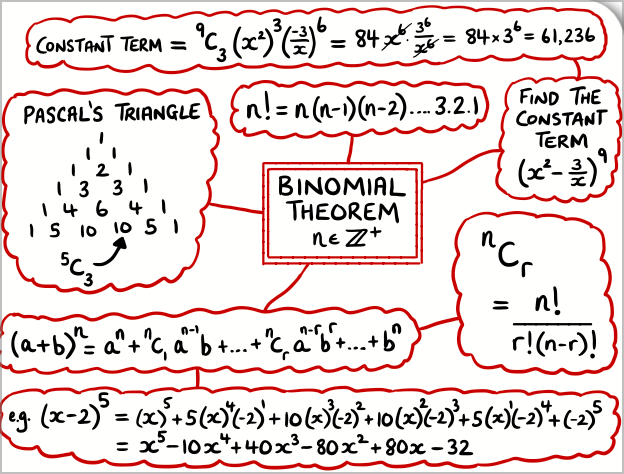
📌 Applications in Science and IB Math
- Probability Theory: Binomial distribution, coin flips, quality control sampling
- Physics: Quantum mechanics probability amplitudes, statistical mechanics
- Engineering: Signal processing, error correction codes, network reliability
- Biology: Genetics inheritance patterns, population dynamics, evolutionary models
- Economics: Portfolio theory, risk assessment, market modeling
- Computer Science: Algorithm analysis, complexity theory, cryptography
- Chemistry: Molecular orbital theory, reaction pathway analysis
- Pure Mathematics: Combinatorics, number theory, algebraic topology
Excellent IA Topics:
• Pascal’s triangle patterns and their mathematical significance
• Binomial distribution applications in quality control or medical testing
• Mathematical analysis of genetic inheritance using binomial probabilities
• Financial modeling: portfolio risk using binomial trees
• Sports analytics: predicting outcomes using binomial models
• Computer algorithms: error detection and correction using binomial coefficients
• Historical mathematics: development of binomial theorem across cultures
• Approximation techniques: using binomial theorem for near-integer powers
IA Structure Tips:
• Start with concrete examples before introducing general formulas
• Use technology to verify patterns and generate large-scale data
• Include historical context and multiple mathematical perspectives
• Connect theoretical results to practical applications
• Explore extensions like multinomial theorem or negative exponents
• Use statistical analysis to validate probabilistic applications
• Create visual representations of Pascal’s triangle patterns
• Discuss limitations and assumptions in real-world modeling
📌 Worked Examples (IB Style)
Q1. Expand \((x + 2)^4\) using the binomial theorem.
Solution:
Step 1: Apply the binomial theorem
\((x + 2)^4 = \sum_{r=0}^{4} \binom{4}{r} x^{4-r} 2^r\)
Step 2: Calculate each term
\(r = 0\): \(\binom{4}{0} x^4 2^0 = 1 \cdot x^4 \cdot 1 = x^4\)
\(r = 1\): \(\binom{4}{1} x^3 2^1 = 4 \cdot x^3 \cdot 2 = 8x^3\)
\(r = 2\): \(\binom{4}{2} x^2 2^2 = 6 \cdot x^2 \cdot 4 = 24x^2\)
\(r = 3\): \(\binom{4}{3} x^1 2^3 = 4 \cdot x \cdot 8 = 32x\)
\(r = 4\): \(\binom{4}{4} x^0 2^4 = 1 \cdot 1 \cdot 16 = 16\)
Step 3: Combine all terms
\((x + 2)^4 = x^4 + 8x^3 + 24x^2 + 32x + 16\)
✅ Final answer: \(x^4 + 8x^3 + 24x^2 + 32x + 16\)
Q2. Find the coefficient of \(x^5\) in the expansion of \((2x – 3)^8\).
Solution:
Step 1: Identify the general term
\((2x – 3)^8 = \sum_{r=0}^{8} \binom{8}{r} (2x)^{8-r} (-3)^r\)
General term: \(T_{r+1} = \binom{8}{r} (2x)^{8-r} (-3)^r\)
Step 2: Simplify the general term
\(T_{r+1} = \binom{8}{r} 2^{8-r} x^{8-r} (-3)^r = \binom{8}{r} 2^{8-r} (-3)^r x^{8-r}\)
Step 3: Find r for the \(x^5\) term
For the coefficient of \(x^5\), we need \(8 – r = 5\)
Therefore: \(r = 3\)
Step 4: Calculate the coefficient
Coefficient = \(\binom{8}{3} 2^{8-3} (-3)^3 = \binom{8}{3} 2^5 (-3)^3\)
\(= 56 \times 32 \times (-27) = 56 \times (-864) = -48384\)
✅ Coefficient of \(x^5\) is -48,384
Q3. Find the middle term in the expansion of \((a – 2b)^6\).
Solution:
Step 1: Determine the middle term
For \((a – 2b)^6\), there are \(6 + 1 = 7\) terms.
Since n = 6 is even, there is one middle term: the 4th term.
Step 2: Find the 4th term using \(T_{r+1}\)
The 4th term corresponds to \(r = 3\)
\(T_4 = T_{3+1} = \binom{6}{3} a^{6-3} (-2b)^3\)
Step 3: Calculate the term
\(T_4 = \binom{6}{3} a^3 (-2b)^3 = 20 \times a^3 \times (-8b^3) = -160a^3b^3\)
✅ Middle term: \(-160a^3b^3\)
Q4. Use the binomial theorem to find \((1.02)^5\) correct to 4 decimal places.
Solution:
Step 1: Express in binomial form
\((1.02)^5 = (1 + 0.02)^5\)
Here, \(a = 1\) and \(b = 0.02\)
Step 2: Apply binomial theorem
\((1 + 0.02)^5 = \sum_{r=0}^{5} \binom{5}{r} 1^{5-r} (0.02)^r\)
Step 3: Calculate each term
\(r = 0\): \(\binom{5}{0} (0.02)^0 = 1 \times 1 = 1\)
\(r = 1\): \(\binom{5}{1} (0.02)^1 = 5 \times 0.02 = 0.1\)
\(r = 2\): \(\binom{5}{2} (0.02)^2 = 10 \times 0.0004 = 0.004\)
\(r = 3\): \(\binom{5}{3} (0.02)^3 = 10 \times 0.000008 = 0.00008\)
\(r = 4\): \(\binom{5}{4} (0.02)^4 = 5 \times 0.00000016 = 0.0000008\)
\(r = 5\): \(\binom{5}{5} (0.02)^5 = 1 \times 0.0000000032 = 0.0000000032\)
Step 4: Sum the terms
\((1.02)^5 = 1 + 0.1 + 0.004 + 0.00008 + 0.0000008 + 0.0000000032\)
\(= 1.1040808032 ≈ 1.1041\)
✅ \((1.02)^5 ≈ 1.1041\) (to 4 decimal places)
Q5. In the expansion of \((x^2 + \frac{1}{x})^9\), find the term independent of x.
Solution:
Step 1: Write the general term
\((x^2 + \frac{1}{x})^9 = \sum_{r=0}^{9} \binom{9}{r} (x^2)^{9-r} \left(\frac{1}{x}\right)^r\)
General term: \(T_{r+1} = \binom{9}{r} (x^2)^{9-r} x^{-r}\)
Step 2: Simplify the general term
\(T_{r+1} = \binom{9}{r} x^{2(9-r)} x^{-r} = \binom{9}{r} x^{18-2r-r} = \binom{9}{r} x^{18-3r}\)
Step 3: Find r for term independent of x
For the term to be independent of x, the power of x must be zero:
\(18 – 3r = 0\)
\(3r = 18\)
\(r = 6\)
Step 4: Calculate the term
\(T_7 = T_{6+1} = \binom{9}{6} x^{18-18} = \binom{9}{6} x^0 = \binom{9}{6} = \frac{9!}{6!3!} = \frac{9 \times 8 \times 7}{3 \times 2 \times 1} = 84\)
✅ Term independent of x: 84
Key problem-solving steps:
• Identify a and b in the binomial expression
• Use the general term formula \(T_{r+1} = \binom{n}{r} a^{n-r} b^r\)
• Set up equations to find the correct value of r
• Calculate binomial coefficients carefully
• Verify your final answer makes sense
• Use calculator to check arithmetic when allowed
📌 Multiple Choice Questions (with Detailed Solutions)
Q1. What is the coefficient of \(x^3\) in the expansion of \((2x + 1)^5\)?
A) 10 B) 40 C) 80 D) 160
📖 Show Answer
Step-by-step solution:
General term: \(T_{r+1} = \binom{5}{r} (2x)^{5-r} 1^r\)
Simplify: \(T_{r+1} = \binom{5}{r} 2^{5-r} x^{5-r}\)
For \(x^3\): \(5-r = 3\), so \(r = 2\)
Coefficient = \(\binom{5}{2} 2^{5-2} = 10 \times 2^3 = 10 \times 8 = 80\)
✅ Answer: C) 80
Q2. What is \(\binom{7}{3}\)?
A) 21 B) 35 C) 42 D) 210
📖 Show Answer
Solution:
\(\binom{7}{3} = \frac{7!}{3!(7-3)!} = \frac{7!}{3! \times 4!}\)
\(= \frac{7 \times 6 \times 5 \times 4!}{3! \times 4!} = \frac{7 \times 6 \times 5}{3!} = \frac{210}{6} = 35\)
✅ Answer: B) 35
Q3. How many terms are there in the expansion of \((a + b)^{10}\)?
A) 10 B) 11 C) 20 D) 21
📖 Show Answer
Solution:
In the binomial expansion of \((a + b)^n\), there are \(n + 1\) terms.
This is because r ranges from 0 to n inclusive.
For \((a + b)^{10}\), there are \(10 + 1 = 11\) terms.
✅ Answer: B) 11
📌 Short Answer Questions (with Detailed Solutions)
Q1. Expand \((x – 2)^3\) using the binomial theorem.
📖 Show Answer
Complete solution:
Using \((a + b)^n = \sum_{r=0}^{n} \binom{n}{r} a^{n-r} b^r\)
Here, \(a = x\), \(b = -2\), \(n = 3\)
\((x – 2)^3 = \sum_{r=0}^{3} \binom{3}{r} x^{3-r} (-2)^r\)
\(= \binom{3}{0} x^3 (-2)^0 + \binom{3}{1} x^2 (-2)^1 + \binom{3}{2} x^1 (-2)^2 + \binom{3}{3} x^0 (-2)^3\)
\(= 1 \cdot x^3 \cdot 1 + 3 \cdot x^2 \cdot (-2) + 3 \cdot x \cdot 4 + 1 \cdot 1 \cdot (-8)\)
\(= x^3 – 6x^2 + 12x – 8\)
✅ Answer: \(x^3 – 6x^2 + 12x – 8\)
Q2. Find the 6th term in the expansion of \((2a + 3b)^8\).
📖 Show Answer
Complete solution:
The 6th term corresponds to \(r = 5\) (since \(T_{r+1}\) gives the (r+1)th term)
Using general term: \(T_{r+1} = \binom{n}{r} a^{n-r} b^r\)
\(T_6 = T_{5+1} = \binom{8}{5} (2a)^{8-5} (3b)^5\)
\(= \binom{8}{5} (2a)^3 (3b)^5\)
\(= 56 \times 8a^3 \times 243b^5\)
\(= 56 \times 8 \times 243 \times a^3b^5 = 108864a^3b^5\)
✅ Answer: \(108864a^3b^5\)
📌 Extended Response Questions (with Full Solutions)
Q1. Consider the expansion of \((1 + x)^{12}\).
(a) Find the coefficient of \(x^4\). [2 marks]
(b) Find the coefficient of \(x^8\). [2 marks]
(c) Comment on the relationship between these coefficients. [2 marks]
(d) Use this expansion to find an approximation for \(1.01^{12}\). [4 marks]
📖 Show Answer
Complete solution:
(a) Coefficient of \(x^4\):
Using general term: \(T_{r+1} = \binom{12}{r} 1^{12-r} x^r = \binom{12}{r} x^r\)
For \(x^4\): r = 4
Coefficient = \(\binom{12}{4} = \frac{12!}{4!8!} = \frac{12 \times 11 \times 10 \times 9}{4 \times 3 \times 2 \times 1} = 495\)
(b) Coefficient of \(x^8\):
For \(x^8\): r = 8
Coefficient = \(\binom{12}{8} = \frac{12!}{8!4!} = \binom{12}{4} = 495\)
(c) Relationship:
The coefficients are equal: \(\binom{12}{4} = \binom{12}{8} = 495\)
This demonstrates the symmetry property: \(\binom{n}{r} = \binom{n}{n-r}\)
(d) Approximation for \(1.01^{12}\):
\(1.01^{12} = (1 + 0.01)^{12}\)
Using first few terms of the expansion:
\((1 + x)^{12} = 1 + 12x + 66x^2 + 220x^3 + 495x^4 + \cdots\)
Substituting x = 0.01:
\(≈ 1 + 12(0.01) + 66(0.01)^2 + 220(0.01)^3 + 495(0.01)^4\)
\(= 1 + 0.12 + 0.0066 + 0.00022 + 0.000495\)
\(≈ 1.1268\)
✅ Final Answers:
(a) 495
(b) 495
(c) Equal due to symmetry property
(d) \(1.01^{12} ≈ 1.1268\)