| Content | Guidance, clarification and syllabus links |
|---|---|
|
Sum of infinite convergent geometric series.
Tests for convergence. Applications including compound interest and annuities. |
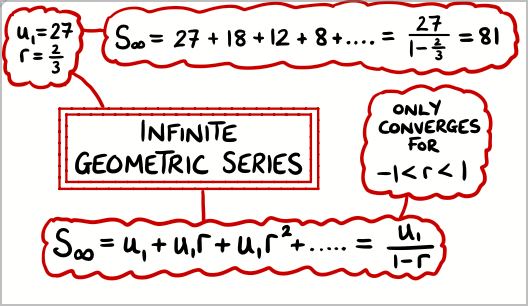
\(S_\infty = \frac{a}{1-r}\) where \(|r| < 1\).
Link to 1.3 Geometric sequences and series. Applications could include the bouncing ball, recurring decimals, fractals, Achilles and the tortoise paradox. Students should understand when a geometric series converges and when it diverges. Link to limits and series in AHL topic 5. |
📌 Introduction
Infinite geometric series represent one of the most beautiful and counterintuitive concepts in mathematics. While it seems impossible to add infinitely many numbers and get a finite result, infinite convergent geometric series demonstrate that this is not only possible but occurs in countless real-world phenomena. From the bouncing ball that never quite stops to the recurring decimal 0.333… = 1/3, these series help us understand how infinite processes can have finite outcomes.
Building on our knowledge of finite geometric series from SL 1.3, we now explore what happens when we extend the series to infinity. The key insight is that convergence depends entirely on the common ratio r: when |r| < 1, the terms become smaller and smaller, allowing the infinite sum to approach a finite limit. This concept has profound applications in physics, finance, computer science, and pure mathematics, forming a bridge between discrete mathematics and calculus.
📌 Definition Table
| Term | Definition |
|---|---|
| Infinite Geometric Series |
A series of the form \(a + ar + ar^2 + ar^3 + \cdots = \sum_{n=0}^{\infty} ar^n\) Where a is the first term and r is the common ratio |
| Convergence |
An infinite series converges if the sum approaches a finite limit For geometric series: converges when \(|r| < 1\) |
| Divergence |
An infinite series diverges if the sum does not approach a finite limit For geometric series: diverges when \(|r| \geq 1\) |
| Sum to Infinity |
\(S_\infty = \frac{a}{1-r}\) where \(|r| < 1\) The finite limit of an infinite convergent geometric series |
| Partial Sum |
\(S_n = \frac{a(1-r^n)}{1-r}\) for \(r \neq 1\) Sum of the first n terms of the series |
| Limit |
\(\lim_{n \to \infty} S_n = S_\infty\) when the series converges The value that the partial sums approach as n increases |
| Recurring Decimal |
A decimal with repeating digits that can be expressed as an infinite geometric series Example: 0.333… = 3/10 + 3/100 + 3/1000 + … |
| Geometric Progression |
Alternative name for geometric sequence Each term is obtained by multiplying the previous term by r |
📌 Properties & Key Formulas
- Convergence Test: \(\sum_{n=0}^{\infty} ar^n\) converges if and only if \(|r| < 1\)
- Sum Formula: \(S_\infty = \frac{a}{1-r}\) when \(|r| < 1\)
- Divergence Cases: If \(|r| \geq 1\), the series diverges to infinity
- Relationship to Finite Sums: \(\lim_{n \to \infty} S_n = \lim_{n \to \infty} \frac{a(1-r^n)}{1-r} = \frac{a}{1-r}\)
- First Term Property: If series starts with \(ar\), then \(S_\infty = \frac{ar}{1-r}\)
- Scaling Property: \(k \cdot S_\infty = k \cdot \frac{a}{1-r}\) for constant k
- Subtraction Property: \(S_\infty – S_n = \frac{ar^{n+1}}{1-r}\) (remaining terms)
Common Convergent Series Examples:
-
For a geometric series with first term \(a\) and common ratio \(r\) such that \(|r| < 1\):
\[ S = a + ar + ar^2 + ar^3 + \cdots = \frac{a}{1 – r} \] - **Convergence Condition:** The series converges only when \(|r| < 1\).
Remember: The sum formula only applies to convergent series. For divergent series, the sum is undefined or infinite.
📌 Common Mistakes & How to Avoid Them
Wrong: For \(2 + 4 + 8 + 16 + \cdots\), using \(S_\infty = \frac{2}{1-2} = -2\)
Right: Since \(|r| = 2 > 1\), the series diverges. No finite sum exists.
How to avoid: Always check the convergence condition \(|r| < 1\) first.
Wrong: For \(3 + 6 + 12 + 24 + \cdots\), using \(a = 3\) when \(r = 2\)
Right: This series diverges since \(|r| = 2 > 1\)
How to avoid: Identify the correct first term and common ratio before applying any formula.
Wrong: \(0.454545… = \frac{45}{100} + \frac{45}{10000} + \cdots\) with \(r = \frac{1}{100}\)
Right: \(0.454545… = \frac{45}{100} + \frac{45}{10000} + \cdots\) with \(r = \frac{1}{100}\) ✓
How to avoid: Carefully identify the repeating pattern and corresponding geometric series.
Wrong: For \(1 – \frac{1}{2} + \frac{1}{4} – \frac{1}{8} + \cdots\), using \(r = \frac{1}{2}\)
Right: The common ratio is \(r = -\frac{1}{2}\), so \(S_\infty = \frac{1}{1-(-\frac{1}{2})} = \frac{2}{3}\)
How to avoid: Pay careful attention to alternating signs – they indicate a negative common ratio.
Wrong: Using \(S_n = \frac{a(1-r^n)}{1-r}\) for infinite series
Right: For infinite convergent series, use \(S_\infty = \frac{a}{1-r}\) where \(|r| < 1\)
How to avoid: Remember that infinite series require taking the limit as n → ∞.
📌 Calculator Skills: Casio CG-50 & TI-84
Testing Convergence:
1. Calculate several partial sums to observe the pattern
2. Use TABLE function to generate terms: Y1 = A*R^X
3. Use SEQ function: seq(2*(0.5)^X, X, 0, 20) for first 21 terms
4. Use SUM function to add partial sums
Recurring Decimals:
1. Enter the decimal: 0.333333333…
2. Use [OPTN] → [NUM] → [►Frac] to convert to fraction
3. Verify: 1÷3 = 0.333…
Graphical Verification:
1. Graph Y1 = sum of first X terms
2. Use [TRACE] to see how sum approaches limit
3. Graph Y2 = theoretical sum for comparison
Series Computation:
1. Use [MENU] → “Sequence” for generating terms
2. Store partial sums: SUM(SEQ(…))
3. Compare with formula: A/(1-R)
Sequence and Series Operations:
1. [2nd] [STAT] → “OPS” → [5:seq(] for sequences
2. seq(2*.5^X, X, 0, 20) generates terms
3. [2nd] [STAT] → “MATH” → [5:sum(] to add them
4. sum(seq(2*.5^X, X, 0, N)) for partial sums
Fraction Conversion:
1. Enter decimal: 0.181818…
2. [MATH] → [1:►Frac] converts to fraction
3. Check: 2/11 = 0.181818…
Graphical Analysis:
1. [Y=] → Y1 = sum(seq(…, X, 0, X))
2. Use [WINDOW] to set appropriate range
3. [TRACE] to see convergence behavior
Programming for Series:
1. [PRGM] → [NEW] to create program
2. Use loops to compute partial sums
3. Display convergence to theoretical value
Convergence testing:
• Compute S₁₀, S₂₀, S₅₀ to see if approaching limit
• Compare with theoretical S∞ = a/(1-r)
• Check that |r| < 1 for convergence
Error analysis:
• Calculate |S_n – S_∞| for different n values
• Observe exponential decrease in error
• Use this for approximation accuracy
Real-world modeling:
• Store parameters in variables
• Use series for compound interest problems
• Model bouncing ball heights
📌 Mind Map
📌 Applications in Science and IB Math
- Physics: Damped oscillations, radioactive decay series, light intensity through filters
- Economics: Perpetual annuities, economic multiplier effects, present value calculations
- Computer Science: Algorithm analysis, data compression, fractals and computer graphics
- Engineering: Signal processing, control systems, electrical circuits with capacitors
- Biology: Population dynamics, pharmacokinetics, ecosystem energy transfer
- Number Theory: Recurring decimals, p-adic numbers, continued fractions
- Probability: Geometric distribution, infinite sample spaces, Markov chains
- Pure Mathematics: Real analysis, topology, function series, Fourier analysis
Excellent IA Topics:
• Mathematical analysis of the bouncing ball problem with air resistance
• Fractal geometry and self-similarity using infinite geometric series
• Economic modeling: perpetual annuities and their real-world applications
• Zeno’s paradoxes: mathematical resolution using infinite series
• Recurring decimals: establishing the connection between fractions and infinite series
• Koch snowflake: perimeter and area calculations using infinite series
• Musical mathematics: harmonic series and frequency relationships
• Population genetics: allele frequency changes over infinite generations
IA Structure Tips:
• Start with concrete examples before moving to abstract theory
• Use calculator/computer verification of theoretical results
• Include historical context (Zeno, Achilles and the tortoise)
• Connect to real-world phenomena and practical applications
• Explore the philosophical implications of infinite processes
• Compare different types of series (geometric vs arithmetic)
• Use graphical representations to illustrate convergence
• Discuss the mathematical rigor behind infinite limits
📌 Worked Examples (IB Style)
Q1. Find the sum to infinity of the series: \(\frac{1}{3} + \frac{1}{9} + \frac{1}{27} + \frac{1}{81} + \cdots\)
Solution:
Step 1: Identify the first term and common ratio
First term: \(a = \frac{1}{3}\)
To find r: \(r = \frac{\text{second term}}{\text{first term}} = \frac{1/9}{1/3} = \frac{1}{9} \times \frac{3}{1} = \frac{1}{3}\)
Step 2: Check for convergence
\(|r| = \left|\frac{1}{3}\right| = \frac{1}{3} < 1\)
Since |r| < 1, the series converges.
Step 3: Apply the sum formula
\(S_\infty = \frac{a}{1-r} = \frac{1/3}{1-1/3} = \frac{1/3}{2/3} = \frac{1}{3} \times \frac{3}{2} = \frac{1}{2}\)
✅ Sum to infinity = \(\frac{1}{2}\)
Q2. Express the recurring decimal \(0.272727…\) as a fraction.
Solution:
Step 1: Express as an infinite geometric series
\(0.272727… = 0.27 + 0.0027 + 0.000027 + \cdots\)
\(= \frac{27}{100} + \frac{27}{10000} + \frac{27}{1000000} + \cdots\)
Step 2: Identify first term and common ratio
First term: \(a = \frac{27}{100}\)
Common ratio: \(r = \frac{27/10000}{27/100} = \frac{27}{10000} \times \frac{100}{27} = \frac{1}{100}\)
Step 3: Check convergence and find sum
\(|r| = \frac{1}{100} < 1\), so the series converges.
\(S_\infty = \frac{27/100}{1-1/100} = \frac{27/100}{99/100} = \frac{27}{100} \times \frac{100}{99} = \frac{27}{99} = \frac{3}{11}\)
✅ \(0.272727… = \frac{3}{11}\)
Q3. A ball is dropped from a height of 10m. After each bounce, it reaches 60% of its previous height. Find the total distance traveled by the ball.
Solution:
Step 1: Analyze the motion
• Initial drop: 10m downward
• First bounce: 6m up, then 6m down
• Second bounce: 3.6m up, then 3.6m down
• Third bounce: 2.16m up, then 2.16m down
• And so on…
Step 2: Set up the series
Total distance = Initial drop + Sum of all up distances + Sum of all down distances
Total distance = 10 + (6 + 3.6 + 2.16 + …) + (6 + 3.6 + 2.16 + …)
Total distance = 10 + 2(6 + 3.6 + 2.16 + …)
Step 3: Find the sum of bounce heights
For the series 6 + 3.6 + 2.16 + …
First term: a = 6, Common ratio: r = 0.6
Since |r| = 0.6 < 1, the series converges.
Sum = \(\frac{6}{1-0.6} = \frac{6}{0.4} = 15\)
Step 4: Calculate total distance
Total distance = 10 + 2(15) = 10 + 30 = 40m
✅ Total distance = 40m
Q4. Find the sum to infinity of: \(8 – 4 + 2 – 1 + \frac{1}{2} – \frac{1}{4} + \cdots\)
Solution:
Step 1: Identify the pattern
This is an alternating geometric series.
First term: \(a = 8\)
To find r: \(r = \frac{-4}{8} = -\frac{1}{2}\)
Step 2: Verify the pattern
Check: \(8 \times (-\frac{1}{2}) = -4\) ✓
Check: \(-4 \times (-\frac{1}{2}) = 2\) ✓
Check: \(2 \times (-\frac{1}{2}) = -1\) ✓
Step 3: Check convergence
\(|r| = \left|-\frac{1}{2}\right| = \frac{1}{2} < 1\)
The series converges.
Step 4: Apply sum formula
\(S_\infty = \frac{a}{1-r} = \frac{8}{1-(-\frac{1}{2})} = \frac{8}{1+\frac{1}{2}} = \frac{8}{\frac{3}{2}} = 8 \times \frac{2}{3} = \frac{16}{3}\)
✅ Sum to infinity = \(\frac{16}{3}\)
Q5. A perpetual annuity pays $1000 at the end of each year. If the interest rate is 5% per year, find the present value.
Solution:
Step 1: Set up present value calculation
Present value of payments:
• Year 1: \(\frac{1000}{1.05}\)
• Year 2: \(\frac{1000}{(1.05)^2}\)
• Year 3: \(\frac{1000}{(1.05)^3}\)
• And so on…
Step 2: Express as geometric series
PV = \(\frac{1000}{1.05} + \frac{1000}{(1.05)^2} + \frac{1000}{(1.05)^3} + \cdots\)
PV = \(1000\left(\frac{1}{1.05} + \frac{1}{(1.05)^2} + \frac{1}{(1.05)^3} + \cdots\right)\)
Step 3: Identify series parameters
First term: \(a = \frac{1}{1.05}\)
Common ratio: \(r = \frac{1}{1.05} = \frac{1}{1.05} \approx 0.952\)
Since |r| < 1, the series converges.
Step 4: Calculate present value
Sum of series = \(\frac{1/1.05}{1-1/1.05} = \frac{1/1.05}{(1.05-1)/1.05} = \frac{1/1.05}{0.05/1.05} = \frac{1}{0.05} = 20\)
Therefore: PV = \(1000 \times 20 = \$20,000\)
✅ Present value = $20,000
Key problem-solving steps:
• Identify the first term and common ratio
• Check convergence condition |r| < 1
• Apply sum formula only if convergent
• For divergent series, state that no finite sum exists
• For word problems, set up the series carefully
• Verify your answer makes sense in context
📌 Multiple Choice Questions (with Detailed Solutions)
Q1. What is the sum to infinity of \(\frac{3}{4} + \frac{3}{16} + \frac{3}{64} + \cdots\)?
A) \(\frac{3}{4}\) B) 1 C) \(\frac{4}{3}\) D) The series diverges
📖 Show Answer
Step-by-step solution:
First term: \(a = \frac{3}{4}\)
Common ratio: \(r = \frac{3/16}{3/4} = \frac{3}{16} \times \frac{4}{3} = \frac{1}{4}\)
Since \(|r| = \frac{1}{4} < 1\), the series converges.
\(S_\infty = \frac{a}{1-r} = \frac{3/4}{1-1/4} = \frac{3/4}{3/4} = 1\)
✅ Answer: B) 1
Q2. For which values of x does the series \(x + x^2 + x^3 + x^4 + \cdots\) converge?
A) \(x > 1\) B) \(|x| < 1\) C) \(x < 1\) D) All real x
📖 Show Answer
Solution:
This is a geometric series with first term \(a = x\) and common ratio \(r = x\).
For convergence, we need \(|r| < 1\), which means \(|x| < 1\).
When \(|x| < 1\), the sum is \(\frac{x}{1-x}\).
✅ Answer: B) \(|x| < 1\)
Q3. What fraction is equivalent to the recurring decimal \(0.636363…\)?
A) \(\frac{63}{100}\) B) \(\frac{7}{11}\) C) \(\frac{63}{99}\) D) \(\frac{21}{33}\)
📖 Show Answer
Solution:
\(0.636363… = \frac{63}{100} + \frac{63}{10000} + \frac{63}{1000000} + \cdots\)
First term: \(a = \frac{63}{100}\), Common ratio: \(r = \frac{1}{100}\)
Sum: \(S_\infty = \frac{63/100}{1-1/100} = \frac{63/100}{99/100} = \frac{63}{99} = \frac{7}{11}\)
✅ Answer: B) \(\frac{7}{11}\)
📌 Short Answer Questions (with Detailed Solutions)
Q1. Does the series \(5 + 10 + 20 + 40 + \cdots\) converge or diverge? Justify your answer.
📖 Show Answer
Complete solution:
Step 1: Identify the series type and parameters
This is a geometric series with first term \(a = 5\)
Common ratio: \(r = \frac{10}{5} = 2\)
Step 2: Apply convergence test
For convergence, we need \(|r| < 1\)
Here, \(|r| = |2| = 2 > 1\)
Conclusion: The series diverges because \(|r| \geq 1\)
✅ The series diverges (no finite sum exists)
Q2. Find the sum to infinity of \(\frac{2}{3} + \frac{2}{9} + \frac{2}{27} + \frac{2}{81} + \cdots\)
📖 Show Answer
Complete solution:
Step 1: Identify first term and common ratio
First term: \(a = \frac{2}{3}\)
Common ratio: \(r = \frac{2/9}{2/3} = \frac{2}{9} \times \frac{3}{2} = \frac{1}{3}\)
Step 2: Check convergence
\(|r| = \left|\frac{1}{3}\right| = \frac{1}{3} < 1\), so the series converges
Step 3: Apply sum formula
\(S_\infty = \frac{a}{1-r} = \frac{2/3}{1-1/3} = \frac{2/3}{2/3} = 1\)
✅ Sum to infinity = 1
📌 Extended Response Questions (with Full Solutions)
Q1. A savings scheme works as follows: $100 is invested at the start, then $90 at the end of the first year, $81 at the end of the second year, and so on, with each payment being 90% of the previous year’s payment.
(a) Show that this forms a geometric series. [2 marks]
(b) If this continues indefinitely, find the total amount invested. [3 marks]
(c) If the investment earns 6% annual interest, find the present value of all future payments. [4 marks]
📖 Show Answer
Complete solution:
(a) Showing geometric series:
Payment sequence: $100, $90, $81, $72.90, …
Ratio between consecutive terms:
\(\frac{90}{100} = 0.9\), \(\frac{81}{90} = 0.9\), \(\frac{72.90}{81} = 0.9\)
Since the ratio is constant (0.9), this forms a geometric series.
(b) Total amount invested:
Series: 100 + 90 + 81 + 72.90 + …
First term: a = 100, Common ratio: r = 0.9
Since |r| = 0.9 < 1, the series converges.
Total amount = \(\frac{100}{1-0.9} = \frac{100}{0.1} = \$1000\)
(c) Present value at 6% interest:
Present values of payments:
• Initial: $100 (already at present value)
• Year 1: \(\frac{90}{1.06}\)
• Year 2: \(\frac{81}{(1.06)^2}\)
• Year 3: \(\frac{72.90}{(1.06)^3}\)
The future payments form a geometric series:
\(\frac{90}{1.06} + \frac{81}{(1.06)^2} + \frac{72.90}{(1.06)^3} + \cdots\)
First term: \(a = \frac{90}{1.06} = 84.906\)
Common ratio: \(r = \frac{0.9}{1.06} = 0.8491\)
Sum of future payments: \(\frac{84.906}{1-0.8491} = \frac{84.906}{0.1509} = 562.40\)
Total present value = 100 + 562.40 = $662.40
✅ Final Answers:
(a) Geometric series with r = 0.9
(b) Total invested = $1000
(c) Present value = $662.40