| Content | Guidance, clarification and syllabus links |
|---|---|
|
Simple deductive proof, including:
• proof by contradiction • algebraic proof • proof of the irrationality of numbers such as \(\sqrt{2}\) • geometric proof |
Students should understand the nature of proof and be able to construct simple proofs.
The difference between a proof and verification by examples should be understood. Use of technology to verify results is encouraged, but this does not constitute proof. Simple counterexamples to show that a statement is false. Link to proof by induction in AHL topic 1. |
📌 Introduction
Mathematical proof is the cornerstone of mathematical reasoning, providing absolute certainty that mathematical statements are true. Unlike verification through examples or calculator computations, proof establishes truth through logical reasoning that covers all possible cases. Simple deductive proof forms the foundation of mathematical thinking and provides students with essential skills for rigorous mathematical argument.
The ability to construct and understand mathematical proofs develops critical thinking skills that extend beyond mathematics. Students learn to distinguish between evidence (which suggests truth) and proof (which establishes truth), understand the logical structure of arguments, and appreciate the beauty and certainty that mathematical proof provides. This topic introduces fundamental proof techniques that students will encounter throughout their mathematical studies.
📌 Definition Table
| Term | Definition |
|---|---|
| Proof |
A logical argument that establishes the truth of a mathematical statement with complete certainty Must cover all possible cases, not just specific examples |
| Deductive Proof |
A proof that proceeds from general principles (axioms, definitions, previously proven theorems) to specific conclusions Uses logical reasoning to establish truth |
| Proof by Contradiction |
Assume the opposite of what you want to prove, then show this leads to a logical contradiction Also called reductio ad absurdum (“reduction to absurdity”) |
| Direct Proof |
A straightforward logical argument that proceeds directly from assumptions to conclusion Often uses algebraic manipulation or logical steps |
| Counterexample |
A single example that shows a statement is false One counterexample is sufficient to disprove a universal statement |
| Rational Number |
A number that can be expressed as \(\frac{p}{q}\) where p and q are integers and \(q \neq 0\) Examples: \(\frac{1}{2}\), \(-3\), \(0.25\) |
| Irrational Number |
A real number that cannot be expressed as \(\frac{p}{q}\) where p and q are integers Examples: \(\sqrt{2}\), \(\pi\), \(e\) |
| Theorem |
A mathematical statement that has been proven to be true Can be used as a foundation for proving other statements |
| Assumption/Hypothesis |
A statement that is taken to be true for the purpose of the proof Starting point from which conclusions are drawn |
📌 Properties & Key Concepts
- Structure of Proof: Assumptions → Logical Steps → Conclusion
- Proof vs Verification: Proof covers all cases; examples only verify specific instances
- Contradiction Method: Assume negation → Derive contradiction → Original statement is true
- Algebraic Proof: Use algebraic manipulation and known properties to establish relationships
- Geometric Proof: Use geometric properties, theorems, and logical reasoning
- Universal vs Existential: “All” statements need general proof; “Some” statements need one example
- Disproof by Counterexample: One example that violates the statement disproves it
Common Proof Structures:
- Direct Proof: To prove P implies Q, assume P and show Q follows
- Proof by Contradiction: To prove P, assume not P and derive a contradiction
- Proof by Cases: Consider all possible cases and prove the statement in each case
- Existence Proof: To prove something exists, construct an example
- Uniqueness Proof: Show existence, then show any two solutions must be equal
Remember: A proof must be convincing to someone who is skeptical. Every step must be logically justified, and all cases must be covered.
📌 Common Mistakes & How to Avoid Them
Wrong: “Since 2² + 3² = 13 is odd, the sum of squares of consecutive integers is always odd”
Right: Use algebraic proof: If n and n+1 are consecutive integers, then n² + (n+1)² = 2n² + 2n + 1, which is always odd
How to avoid: Examples suggest patterns but don’t prove them. Use general algebraic expressions.
Wrong: “To prove √2 is irrational, assume √2 is irrational…”
Right: “To prove √2 is irrational, assume √2 is rational and derive a contradiction”
How to avoid: In proof by contradiction, assume the negation of what you want to prove.
Wrong: Proving a statement only for positive integers when it should hold for all integers
Right: Consider all relevant cases: positive, negative, and zero
How to avoid: Identify all possible cases before beginning the proof.
Wrong: Jumping between unrelated statements without clear connections
Right: Each statement should follow logically from previous statements
How to avoid: Use connecting words: “therefore,” “since,” “because,” “it follows that.”
Wrong: Deriving the original statement as the “contradiction”
Right: Derive a logical impossibility (like 0 = 1 or p is both odd and even)
How to avoid: The contradiction should be a statement that is obviously false or violates basic logic.
📌 Calculator Skills: Verification vs Proof
Calculator can help verify results:
1. Test conjectures with multiple examples
2. Check arithmetic in your proofs
3. Explore patterns that might suggest proof strategies
4. Verify final answers
What calculators CANNOT do:
• Prove general statements
• Cover infinite cases
• Provide logical justification
• Replace mathematical reasoning
Using Casio CG-50 for exploration:
1. Use TABLE function to test patterns
2. Graph functions to visualize relationships
3. Use STAT functions to analyze data patterns
4. Verify specific calculations within your proof
Useful functions for proof preparation:
1. Use [2nd] [TABLE] to generate sequences
2. Graph functions to see behavior
3. Use [MATH] menu for number theory functions
4. Store formulas and test multiple values
Example: Testing irrationality of √2
1. Calculate √2 to many decimal places
2. Try to find rational approximations
3. Observe that no simple fraction equals √2 exactly
4. This suggests √2 might be irrational (but doesn’t prove it!)
Remember: Technology suggests; mathematics proves!
📌 Mind Map
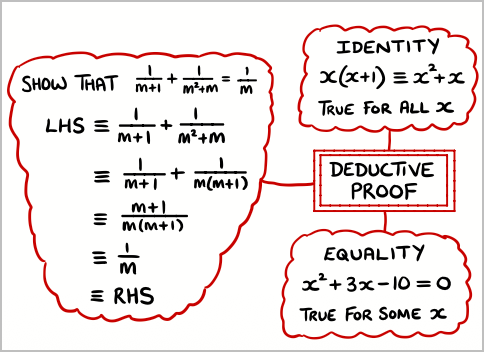
📌 Applications in Science and IB Math
- Pure Mathematics: Foundation for all advanced mathematical theorems and concepts
- Computer Science: Algorithm correctness, program verification, logical reasoning in programming
- Physics: Deriving physical laws from fundamental principles, theoretical physics proofs
- Logic & Philosophy: Formal logical systems, philosophical arguments, critical thinking
- Engineering: Proving safety and reliability of systems, mathematical modeling validation
- Cryptography: Proving security of encryption methods, mathematical foundations of cybersecurity
- Economics: Proving optimality of economic models, game theory proofs
- Statistics: Proving properties of statistical tests, establishing confidence intervals
Suitable IA Topics:
• Explore different proofs of the irrationality of √2, √3, etc.
• Investigate the proof of the infinitude of prime numbers
• Examine geometric proofs vs algebraic proofs of the same result
• Study proof by contradiction vs direct proof methods
• Explore historical development of proof techniques
• Investigate counterintuitive mathematical results and their proofs
• Compare proof methods across different areas of mathematics
IA Structure Tips:
• Present multiple proof methods for the same result
• Discuss the historical context and development of proof techniques
• Analyze the logical structure of different types of proofs
• Include your own attempts at constructing proofs
• Reflect on the role of proof in mathematical certainty
• Connect proof methods to broader mathematical thinking
📌 Worked Examples (IB Style)
Q1. Prove that the sum of two even integers is always even.
Solution (Direct Proof):
Step 1: State what we want to prove
We want to prove: If a and b are even integers, then a + b is even.
Step 2: Use the definition of even numbers
Since a is even, we can write a = 2k for some integer k
Since b is even, we can write b = 2m for some integer m
Step 3: Add the two even numbers
a + b = 2k + 2m = 2(k + m)
Step 4: Conclude
Since k + m is an integer, 2(k + m) is even by definition.
Therefore, a + b is even.
✅ The sum of two even integers is always even. ∎
Q2. Prove that √2 is irrational.
Solution (Proof by Contradiction):
Step 1: Assume the opposite
Assume √2 is rational. Then √2 = p/q where p, q are integers with no common factors and q ≠ 0.
Step 2: Square both sides
2 = p²/q², so 2q² = p²
Step 3: Analyze what this means
Since 2q² = p², we know p² is even, which means p is even.
So p = 2r for some integer r.
Step 4: Substitute back
2q² = (2r)² = 4r², so q² = 2r²
This means q² is even, so q is even.
Step 5: Find the contradiction
Both p and q are even, so they have a common factor of 2.
This contradicts our assumption that p and q have no common factors.
Step 6: Conclude
Our assumption must be false. Therefore, √2 is irrational.
✅ √2 is irrational. ∎
Q3. Prove that in any triangle, the sum of any two sides is greater than the third side.
Solution (Geometric Proof):
Step 1: Set up the triangle
Let triangle ABC have sides of length a, b, and c opposite to vertices A, B, and C respectively.
Step 2: Consider the path from A to C
The direct path from A to C has length b.
The indirect path from A to B to C has length a + c.
Step 3: Apply the geometric principle
The shortest distance between two points is a straight line.
Therefore, the direct path is shorter than any indirect path: b < a + c
Step 4: Apply to all combinations
Similarly: a < b + c and c < a + b
Step 5: Conclude
In any triangle, the sum of any two sides is greater than the third side.
This is known as the Triangle Inequality.
✅ Triangle Inequality proven. ∎
Q4. Disprove: “All prime numbers are odd.”
Solution (Counterexample):
Step 1: Understand what we need to disprove
The statement claims that every prime number is odd.
To disprove this, we need just one even prime number.
Step 2: Find a counterexample
Consider the number 2.
Step 3: Verify it’s prime
2 has exactly two positive divisors: 1 and 2.
Therefore, 2 is prime by definition.
Step 4: Verify it’s even
2 = 2 × 1, so 2 is divisible by 2.
Therefore, 2 is even by definition.
Step 5: Conclude
Since 2 is both prime and even, the statement “All prime numbers are odd” is false.
❌ Statement disproven by counterexample: 2 is prime and even. ∎
Q5. Prove that the square of an odd integer is odd.
Solution (Algebraic Proof):
Step 1: Express an odd integer generally
Let n be an odd integer. Then n = 2k + 1 for some integer k.
Step 2: Square the odd integer
n² = (2k + 1)²
Step 3: Expand using algebra
n² = (2k)² + 2(2k)(1) + 1² = 4k² + 4k + 1
Step 4: Factor to show it’s odd
n² = 4k² + 4k + 1 = 4k(k + 1) + 1 = 2[2k(k + 1)] + 1
Step 5: Conclude
Since 2k(k + 1) is an integer, n² has the form 2m + 1 where m = 2k(k + 1).
Therefore, n² is odd by definition.
✅ The square of an odd integer is always odd. ∎
Key proof-writing tips:
• State assumptions clearly at the beginning
• Use precise mathematical language
• Justify each logical step
• Consider all necessary cases
• Write for a skeptical audience
• End with a definitive conclusion
📌 Multiple Choice Questions (with Detailed Solutions)
Q1. Which of the following is a counterexample to the statement “All even numbers greater than 2 are composite”?
A) 4 B) 6 C) 8 D) None of these
📖 Show Answer
Step-by-step solution:
Check each option:
A) 4 = 2 × 2, so 4 is composite (has factors other than 1 and itself)
B) 6 = 2 × 3, so 6 is composite
C) 8 = 2 × 4, so 8 is composite
All even numbers greater than 2 are indeed composite (they’re all divisible by 2).
✅ Answer: D) None of these (the statement is actually true)
Q2. In a proof by contradiction, what do we assume at the beginning?
A) The statement we want to prove
B) The negation of what we want to prove
C) A related but different statement
D) Nothing; we start from first principles
📖 Show Answer
Solution:
In proof by contradiction, we assume the opposite (negation) of what we want to prove.
Then we show this assumption leads to a logical contradiction.
Since the assumption leads to impossibility, the original statement must be true.
✅ Answer: B) The negation of what we want to prove
Q3. What is the difference between a mathematical proof and verification by examples?
A) There is no difference
B) Proof covers all cases; examples only show specific instances
C) Examples are more reliable than proofs
D) Proofs are just many examples put together
📖 Show Answer
Solution:
A proof establishes truth for ALL possible cases using logical reasoning.
Examples only verify the statement for specific instances.
No matter how many examples you test, you cannot prove a general statement without covering all cases.
✅ Answer: B) Proof covers all cases; examples only show specific instances
📌 Short Answer Questions (with Detailed Solutions)
Q1. Prove that the product of two consecutive integers is always even.
📖 Show Answer
Complete solution:
Proof: Let n be any integer. Then n and n+1 are consecutive integers.
Case 1: If n is even, then n = 2k for some integer k.
Product = n(n+1) = 2k(n+1) = 2[k(n+1)], which is even.
Case 2: If n is odd, then n+1 is even, so n+1 = 2m for some integer m.
Product = n(n+1) = n(2m) = 2[nm], which is even.
In both cases, the product is even. ∎
✅ The product of consecutive integers is always even.
Q2. Find a counterexample to disprove: “If n² is even, then n is even.”
📖 Show Answer
Complete solution:
Wait – let me reconsider this statement. Let’s test some values:
If n = 1 (odd): n² = 1 (odd)
If n = 2 (even): n² = 4 (even)
If n = 3 (odd): n² = 9 (odd)
If n = 4 (even): n² = 16 (even)
Actually, this statement appears to be TRUE! We cannot find a counterexample because:
If n is odd, then n² is odd (never even).
So whenever n² is even, n must indeed be even.
❌ No counterexample exists – the statement is actually true!