| Content | Guidance, clarification and syllabus links |
|---|---|
|
Laws of exponents with integer exponents. Introduction to logarithms with base 10 and base e. Numerical evaluation of logarithms using technology. Relationship between logarithms and exponents. Laws of logarithms. Change of base. |
The definition of a logarithm is not expected to be proved or derived by students. Students are expected to be able to determine exact values of logarithms such as \(\log_2 8\) and \(\log_{10} 0.001\). Use of technology to evaluate logarithms. Solving exponential equations using logarithms. Solving logarithmic equations. Link to exponential and logarithmic functions in topic 2. |
📌 Introduction
The laws of exponents provide the foundation for working with powers and form the basis for understanding exponential functions. These rules allow us to simplify complex expressions involving powers and solve equations where variables appear as exponents. The concept of logarithms emerges as the inverse operation of exponentiation, enabling us to “undo” exponential operations.
Understanding exponents and logarithms is crucial for modeling real-world phenomena such as population growth, radioactive decay, sound intensity (decibels), earthquake magnitude (Richter scale), and pH in chemistry. These mathematical tools bridge algebra and advanced topics like calculus, providing essential techniques for solving exponential and logarithmic equations that appear throughout mathematics and science.
📌 Definition Table
| Term | Definition |
|---|---|
| Exponent (Power) |
In \(a^n\), the exponent \(n\) indicates how many times the base \(a\) is multiplied by itself Example: \(2^5 = 2 \times 2 \times 2 \times 2 \times 2 = 32\) |
| Base |
In \(a^n\), the base \(a\) is the number being raised to the power Must be positive for real-valued logarithms |
| Logarithm |
\(\log_a x = y\) means \(a^y = x\) The logarithm is the exponent to which the base must be raised to get the argument |
| Common Logarithm |
\(\log x\) means \(\log_{10} x\) (base 10) Used in scientific applications like pH and Richter scale |
| Natural Logarithm |
\(\ln x\) means \(\log_e x\) where \(e ≈ 2.718\) Used in calculus and natural growth/decay models |
| Argument |
In \(\log_a x\), the argument is \(x\) Must be positive for real-valued logarithms |
| Zero Exponent |
\(a^0 = 1\) for any \(a ≠ 0\) Example: \(5^0 = 1\), \((-3)^0 = 1\) |
| Negative Exponent |
\(a^{-n} = \frac{1}{a^n}\) Example: \(2^{-3} = \frac{1}{2^3} = \frac{1}{8}\) |
📌 Properties & Key Formulas
- Product Law: \(a^m \times a^n = a^{m+n}\)
- Quotient Law: \(\frac{a^m}{a^n} = a^{m-n}\) where \(a ≠ 0\)
- Power Law: \((a^m)^n = a^{mn}\)
- Product to Power: \((ab)^n = a^n b^n\)
- Quotient to Power: \(\left(\frac{a}{b}\right)^n = \frac{a^n}{b^n}\) where \(b ≠ 0\)
- Log Definition: \(\log_a x = y \iff a^y = x\) where \(a > 0, a ≠ 1, x > 0\)
- Log Product Law: \(\log_a(xy) = \log_a x + \log_a y\)
- Log Quotient Law: \(\log_a\left(\frac{x}{y}\right) = \log_a x – \log_a y\)
- Log Power Law: \(\log_a(x^n) = n \log_a x\)
- Change of Base: \(\log_a x = \frac{\log_c x}{\log_c a} = \frac{\log x}{\log a} = \frac{\ln x}{\ln a}\)
Important Special Cases:
- \(\log_a 1 = 0\) (since \(a^0 = 1\))
- \(\log_a a = 1\) (since \(a^1 = a\))
- \(a^{\log_a x} = x\) (inverse relationship)
- \(\log_a(a^x) = x\) (inverse relationship)
- \(\log 10^x = x\) and \(10^{\log x} = x\)
- \(\ln e^x = x\) and \(e^{\ln x} = x\)
Remember: The domain of \(\log_a x\) is \(x > 0\). Also, \(\log x\) means \(\log_{10} x\) and \(\ln x\) means \(\log_e x\).
📌 Common Mistakes & How to Avoid Them
Wrong: \(a^m + a^n = a^{m+n}\)
Right: \(a^m \times a^n = a^{m+n}\) (multiplication, not addition)
How to avoid: Remember that exponent laws apply to multiplication and division, not addition and subtraction.
Wrong: If \(\log_a x = y\), then \(x^y = a\)
Right: If \(\log_a x = y\), then \(a^y = x\)
How to avoid: Remember: “base to the power equals argument” – the base gets raised to the power.
Wrong: \(\log(x + y) = \log x + \log y\)
Right: \(\log(xy) = \log x + \log y\) (product, not sum)
How to avoid: Log laws only work for multiplication, division, and powers – not addition or subtraction.
Wrong: Solving \(\log(x – 2) = 1\) and getting \(x = 12\) without checking
Right: Check that \(x – 2 > 0\), so \(x > 2\). Since 12 > 2, the solution is valid
How to avoid: Always verify that arguments of logarithms are positive.
Wrong: Using \(\log\) and \(\ln\) interchangeably
Right: \(\log x = \log_{10} x\) and \(\ln x = \log_e x\) are different functions
How to avoid: Always specify the base or use the correct notation. When in doubt, write the base explicitly.
📌 Calculator Skills: Casio CG-50 & TI-84
Exponents:
1. Use [^] key for exponents: 2^5 gives 32
2. For negative exponents: 2^(-3) using parentheses
3. Scientific notation: 1.5 × 10^6 enter as 1.5E6
Logarithms:
1. [LOG] key for base-10 logarithms: log(100) = 2
2. [LN] key for natural logarithms: ln(e) = 1
3. For other bases, use change of base: log₂(8) = ln(8)/ln(2)
Solving equations:
1. Press [MENU] → “Equation/Func” → “Solve”
2. Enter equation like: 2^X=32
3. Press [SOLVE] and specify range for X
Verification:
• Use [ANS] key to check solutions
• Store values in variables: 5→A, then use A in calculations
Exponents:
1. Use [^] or [**] for exponents
2. [2nd] [^] for square root, or use fractional exponents
3. Store large numbers: 2.5E8 for 2.5 × 10⁸
Logarithms:
1. [LOG] for base-10: LOG(1000) = 3
2. [LN] for natural log: LN(e²) = 2
3. Change of base: LOG(8)/LOG(2) for log₂(8)
Equation solver:
1. Press [MATH] → [0:Solver]
2. Enter 0 = 2^X – 32
3. Press [ENTER], then [ALPHA] [SOLVE]
Graphing method:
1. Graph Y₁ = 2^X and Y₂ = 32
2. Use [2nd] [CALC] → [5:intersect] to find solution
3. This visual method helps verify algebraic solutions
Checking your work:
• Substitute solutions back into original equations
• Use different approaches (algebraic vs graphical) for verification
• Round appropriately for context (exact vs decimal)
Common calculator errors:
• Forgetting parentheses in complex expressions
• Using LOG when you mean LN (or vice versa)
• Not clearing previous calculations
Efficiency tips:
• Learn to use memory functions (STO→ and RCL)
• Use parentheses liberally to avoid order of operations errors
• Check your calculator is in the correct angle mode if using trig
📌 Mind Map
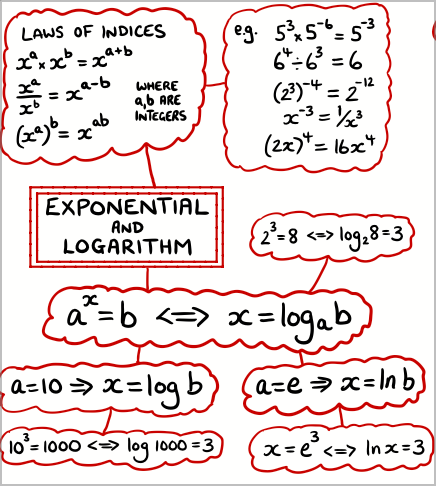
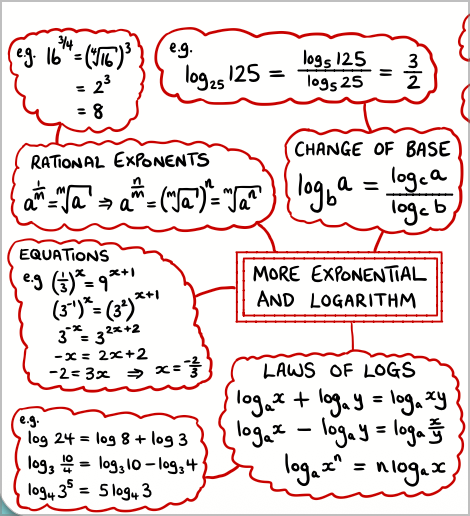
📌 Applications in Science and IB Math
- Chemistry: pH scale (\(pH = -\log[H^+]\)), acid-base equilibrium, reaction kinetics
- Physics: Radioactive decay (\(N = N_0 e^{-\lambda t}\)), sound intensity (decibels), light absorption
- Earth Sciences: Richter scale for earthquakes (\(M = \log\frac{I}{I_0}\)), carbon dating
- Biology: Population growth models, bacterial cultures, enzyme kinetics, allometric scaling
- Economics: Continuous compounding, inflation models, economic growth rates
- Computer Science: Algorithm complexity (\(O(\log n)\)), information theory, data compression
- Engineering: Signal processing, control systems, electrical circuits with capacitors
- Psychology: Weber-Fechner law (perception intensity), learning curves, memory decay
Excellent IA Topics:
• pH analysis of household substances using logarithmic scale
• Earthquake magnitude comparison using Richter scale mathematics
• Population growth modeling with exponential and logistic functions
• Sound intensity and decibel scale investigation
• Radioactive decay simulation and half-life calculations
• Bacterial growth experiments with exponential modeling
• Investment growth: comparing exponential models
IA Structure Tips:
• Collect real data and fit exponential/logarithmic models
• Use technology for regression analysis and curve fitting
• Compare theoretical predictions with experimental results
• Discuss limitations and assumptions of exponential models
• Include error analysis and goodness of fit measures
• Connect mathematical concepts to real-world implications
📌 Worked Examples (IB Style)
Q1. Simplify: \(\frac{2^5 \times 2^3}{2^4}\)
Solution:
Step 1: Apply the product law in the numerator
\(2^5 \times 2^3 = 2^{5+3} = 2^8\)
Step 2: Apply the quotient law
\(\frac{2^8}{2^4} = 2^{8-4} = 2^4\)
Step 3: Evaluate
\(2^4 = 16\)
✅ Final answer: 16
Q2. Solve for x: \(3^{x+1} = 27\)
Solution:
Step 1: Express 27 as a power of 3
\(27 = 3^3\)
Step 2: Rewrite the equation
\(3^{x+1} = 3^3\)
Step 3: Since the bases are equal, the exponents are equal
\(x + 1 = 3\)
Step 4: Solve for x
\(x = 3 – 1 = 2\)
✅ Final answer: x = 2
Q3. Find the exact value of \(\log_4 64\)
Solution:
Step 1: Use the definition of logarithm
\(\log_4 64 = y\) means \(4^y = 64\)
Step 2: Express both numbers as powers of 2
\(4 = 2^2\) and \(64 = 2^6\)
Step 3: Substitute into the equation
\((2^2)^y = 2^6\)
\(2^{2y} = 2^6\)
Step 4: Equate exponents
\(2y = 6\)
\(y = 3\)
✅ Final answer: \(\log_4 64 = 3\)
Q4. Solve for x: \(\log_2(x + 3) = 4\)
Solution:
Step 1: Convert to exponential form
\(\log_2(x + 3) = 4\) means \(2^4 = x + 3\)
Step 2: Evaluate \(2^4\)
\(2^4 = 16\)
Step 3: Solve for x
\(16 = x + 3\)
\(x = 16 – 3 = 13\)
Step 4: Check domain restriction
For \(\log_2(x + 3)\) to be defined, we need \(x + 3 > 0\)
Since \(13 + 3 = 16 > 0\), our solution is valid
✅ Final answer: x = 13
Q5. Express \(\log_3 20\) in terms of common logarithms
Solution:
Step 1: Apply the change of base formula
\(\log_a x = \frac{\log x}{\log a}\) where \(\log\) means \(\log_{10}\)
Step 2: Substitute values
\(\log_3 20 = \frac{\log 20}{\log 3}\)
Step 3: This can be evaluated using a calculator
\(\log_3 20 = \frac{\log 20}{\log 3} ≈ \frac{1.301}{0.477} ≈ 2.727\)
✅ Final answer: \(\log_3 20 = \frac{\log 20}{\log 3}\)
\(\log_3 20 = \frac{\ln 20}{\ln 3}\) (same result, different base)
Key verification steps:
• Check that all arguments of logarithms are positive
• Substitute solutions back into the original equation
• Use exact values when possible, approximations when required
• Show clear steps when converting between exponential and logarithmic forms
• State any restrictions on variables clearly
📌 Multiple Choice Questions (with Detailed Solutions)
Q1. What is the value of \(2^{-3} + 2^0\)?
A) \(\frac{7}{8}\) B) \(\frac{9}{8}\) C) \(\frac{1}{7}\) D) \(\frac{1}{9}\)
📖 Show Answer
Step-by-step solution:
1. Evaluate \(2^{-3}\): \(2^{-3} = \frac{1}{2^3} = \frac{1}{8}\)
2. Evaluate \(2^0\): \(2^0 = 1\)
3. Add: \(\frac{1}{8} + 1 = \frac{1}{8} + \frac{8}{8} = \frac{9}{8}\)
✅ Answer: B) \(\frac{9}{8}\)
Q2. If \(\log_2 x = 5\), what is the value of x?
A) 10 B) 25 C) 32 D) 64
📖 Show Answer
Step-by-step solution:
1. Use the definition of logarithm: \(\log_2 x = 5\) means \(2^5 = x\)
2. Calculate: \(2^5 = 2 \times 2 \times 2 \times 2 \times 2 = 32\)
✅ Answer: C) 32
Q3. Simplify: \(\log_5(25 \times 5^3)\)
A) 3 B) 4 C) 5 D) 6
📖 Show Answer
Step-by-step solution:
1. Simplify inside the log: \(25 \times 5^3 = 5^2 \times 5^3 = 5^{2+3} = 5^5\)
2. Apply the power law: \(\log_5(5^5) = 5 \log_5(5) = 5 \times 1 = 5\)
✅ Answer: C) 5
📌 Short Answer Questions (with Detailed Solutions)
Q1. Solve the equation \(4^x = 2^{x+3}\)
📖 Show Answer
Complete solution:
Step 1: Express both sides with the same base
Since \(4 = 2^2\), we have: \((2^2)^x = 2^{x+3}\)
Step 2: Apply the power law
\(2^{2x} = 2^{x+3}\)
Step 3: Equate the exponents
\(2x = x + 3\)
Step 4: Solve for x
\(2x – x = 3\), so \(x = 3\)
✅ Answer: x = 3
Q2. Given that \(\log_a 5 = p\) and \(\log_a 3 = q\), express \(\log_a 45\) in terms of p and q.
📖 Show Answer
Complete solution:
Step 1: Factor 45
\(45 = 9 \times 5 = 3^2 \times 5\)
Step 2: Apply logarithm laws
\(\log_a 45 = \log_a(3^2 \times 5) = \log_a(3^2) + \log_a 5\)
Step 3: Apply the power law
\(\log_a(3^2) = 2\log_a 3 = 2q\)
Step 4: Combine
\(\log_a 45 = 2q + p\)
✅ Answer: \(\log_a 45 = 2q + p\)
📌 Extended Response Questions (with Full Solutions)
Q1. The Richter scale measures earthquake magnitude using the formula \(M = \log\left(\frac{I}{I_0}\right)\), where I is the intensity of the earthquake and \(I_0\) is the intensity of a reference earthquake.
(a) An earthquake has magnitude 6.2. Express its intensity in terms of \(I_0\). [3 marks]
(b) How many times more intense is an earthquake of magnitude 8 compared to one of magnitude 5? [4 marks]
(c) Two earthquakes have intensities \(I_1\) and \(I_2\). If \(I_2 = 50 I_1\), find the difference in their magnitudes. [4 marks]
📖 Show Answer
Complete solution:
(a) Earthquake with magnitude 6.2:
Given: \(M = 6.2\)
Using \(M = \log\left(\frac{I}{I_0}\right)\):
\(6.2 = \log\left(\frac{I}{I_0}\right)\)
Converting to exponential form:
\(\frac{I}{I_0} = 10^{6.2}\)
Therefore: \(I = 10^{6.2} I_0\)
(b) Comparing magnitude 8 and magnitude 5:
For magnitude 8: \(8 = \log\left(\frac{I_8}{I_0}\right)\), so \(I_8 = 10^8 I_0\)
For magnitude 5: \(5 = \log\left(\frac{I_5}{I_0}\right)\), so \(I_5 = 10^5 I_0\)
Ratio: \(\frac{I_8}{I_5} = \frac{10^8 I_0}{10^5 I_0} = \frac{10^8}{10^5} = 10^{8-5} = 10^3 = 1000\)
The magnitude 8 earthquake is 1000 times more intense
(c) Two earthquakes with \(I_2 = 50 I_1\):
Let \(M_1\) and \(M_2\) be their magnitudes.
\(M_1 = \log\left(\frac{I_1}{I_0}\right)\) and \(M_2 = \log\left(\frac{I_2}{I_0}\right)\)
Since \(I_2 = 50 I_1\):
\(M_2 = \log\left(\frac{50 I_1}{I_0}\right) = \log\left(50 \cdot \frac{I_1}{I_0}\right)\)
Using the product law:
\(M_2 = \log 50 + \log\left(\frac{I_1}{I_0}\right) = \log 50 + M_1\)
Therefore: \(M_2 – M_1 = \log 50 ≈ 1.70\)
✅ Final Answers:
(a) \(I = 10^{6.2} I_0\)
(b) 1000 times more intense
(c) Magnitude difference = \(\log 50 ≈ 1.70\)