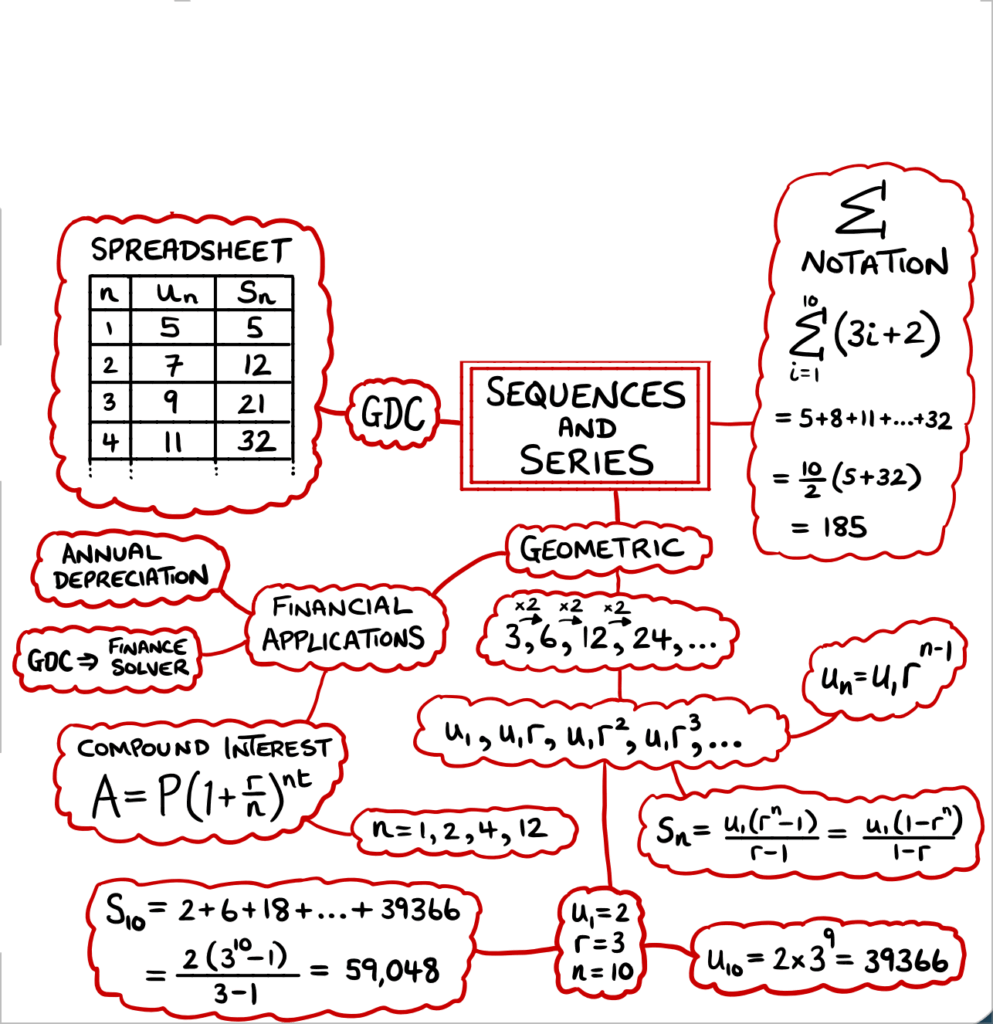
Use of the formulae for the nth term and the sum of the first n terms of the sequence.
Use of sigma notation for sums of geometric sequences.
Spreadsheets, GDCs and graphing software may be used to generate and display sequences in several ways.
If technology is used in examinations, students will be expected to identify the first term and the common ratio.
Link to models/functions in topic 2 and regression in topic 4.
Applications. Examples include the spread of disease, salary increase and decrease, and population growth.
📌 Introduction
Geometric sequences and series represent patterns where consecutive terms are related by multiplication by a constant factor called the common ratio. Unlike arithmetic sequences that grow by constant addition, geometric sequences exhibit exponential growth or decay patterns that model many real-world phenomena including population dynamics, radioactive decay, compound interest, and viral spread.
The power of geometric sequences lies in their multiplicative nature – once you know the first term and common ratio, you can determine any term in the sequence or calculate the sum of any number of terms. This exponential behavior makes geometric sequences essential for modeling situations with constant percentage growth or decay over equal time intervals.
📌 Definition Table
Term
Definition
Geometric Sequence
A sequence where the ratio between consecutive terms is constant.
Example: 2, 6, 18, 54, 162, … (common ratio = 3)
Common Ratio (r)
The constant value by which each term is multiplied to get the next term: \(r = \frac{u_{n+1}}{u_n}\)
Can be positive, negative, fractional, or greater than 1
First Term (a or \(u_1\))
The initial term of the sequence, often denoted as \(u_1\) or \(a\)
nth Term (\(u_n\))
General term of the sequence: \(u_n = ar^{n-1}\)
Also written as: \(u_n = u_1 \times r^{n-1}\)
Geometric Series
The sum of terms in a geometric sequence
Example: 2 + 6 + 18 + 54 + 162 = 242
Sum of n terms (\(S_n\))
\(S_n = \frac{a(r^n – 1)}{r – 1}\) when \(r \neq 1\)
\(S_n = na\) when \(r = 1\)
Sigma Notation (\(\sum\))
Compact notation for expressing the sum of a series
\(\sum_{k=1}^{n} ar^{k-1} = a + ar + ar^2 + … + ar^{n-1}\)
📌 Properties & Key Formulas
General Form: \(u_1, u_1r, u_1r^2, u_1r^3, u_1r^4, \ldots\)
nth Term Formula: \(u_n = ar^{n-1}\) where \(a\) is first term, \(r\) is common ratio
Sum Formula (r ≠ 1): \(S_n = \frac{a(r^n – 1)}{r – 1}\) or \(S_n = \frac{a(1 – r^n)}{1 – r}\)
Sum Formula (r = 1): \(S_n = na\) (constant sequence)
How to avoid: Carefully calculate \(r = \frac{u_{n+1}}{u_n}\) including signs.
⚠️ Common Mistake #5: Mixing up sum formula versions
Wrong: Randomly choosing between \(\frac{a(r^n – 1)}{r – 1}\) and \(\frac{a(1 – r^n)}{1 – r}\) Right: Both are equivalent! Choose the one that’s easier for your calculation
How to avoid: Note that \(\frac{a(r^n – 1)}{r – 1} = \frac{a(1 – r^n)}{1 – r}\) (multiply top and bottom by -1).
📌 Calculator Skills: Casio CG-50 & TI-84
📱 Using Casio CG-50 for Geometric Sequences
Method 1: Using TABLE function
1. Press [MENU] → Select “Graph”
2. Enter your sequence formula as Y1 = 3*(2^(X-1)) (for \(u_n = 3 \times 2^{n-1}\))
3. Press [F6] (TABLE) to generate terms
4. Use [SET] to adjust starting value and step size
Method 2: Using List function
1. Press [MENU] → Select “Run-Matrix”
2. Press [OPTN] → [LIST] → [SEQ]
3. Enter: seq(3*(2^(X-1)), X, 1, 8, 1) for first 8 terms
4. Press [EXE] to calculate
Calculating sums:
1. Create list of terms using seq() function
2. Press [OPTN] → [LIST] → [SUM]
3. Apply to your list: sum(Ans)
Finding ratios:
• Create two lists: terms and their consecutive terms
• Use division to verify constant ratio
📱 Using TI-84 for Geometric Sequences
Setting up sequence mode:
1. Press [MODE], scroll to “SEQ” and press [ENTER]
2. Press [Y=] to access sequence editor
Entering sequences:
1. In Y= menu, enter: u(n) = 3*(2^(n-1))
2. Set nMin = 1 (starting value)
3. Press [2nd] → [WINDOW] to set sequence parameters
Generating terms from home screen:
1. Press [2nd] → [STAT] → [OPS] → [5:seq(]
2. Enter: seq(3*(2^(X-1)), X, 1, 8, 1)
3. Press [ENTER] for first 8 terms
Verification method:
• Always check first few terms manually to verify your formula is correct
• Use calculator to find pattern, then verify with hand calculations
Working with fractional ratios:
• Use parentheses: (1/2)^(n-1) not 1/2^n-1
• Store fractions as decimals when necessary: 0.5^(n-1)
Large terms:
• For exponential growth, terms can become very large quickly
• Use scientific notation when appropriate
• Be aware of calculator limitations for very large numbers
Social Sciences: Social media spread, rumor propagation, market penetration models
Mathematics: Fractal geometry, infinite series, probability distributions, chaos theory
➗ IA Tips & Guidance:Use geometric sequences to model exponential growth and decay phenomena in your IA.
Excellent IA Topics:
• Compound interest vs simple interest analysis over long periods
• Population growth models using geometric sequences
• Radioactive decay and half-life calculations
• Viral spread modeling (especially relevant post-pandemic)
• Depreciation of assets using geometric decay
• Bacterial growth in laboratory conditions
IA Structure Tips:
• Collect real data and fit geometric models
• Compare theoretical predictions with actual data
• Discuss limitations of exponential models
• Use technology to generate and analyze large datasets
• Consider factors that might cause deviations from pure geometric growth
📌 Worked Examples (IB Style)
Q1. Find the 8th term of the geometric sequence: 5, 15, 45, 135, …
Solution:
Step 1: Identify the first term and common ratio
First term: \(a = u_1 = 5\)
Common ratio: \(r = \frac{15}{5} = 3\)
Step 2: Apply the nth term formula
\(u_n = ar^{n-1}\)
Step 2: Find value after 10 years
\(u_{11} = 1000 \times (1.05)^{10} = 1000 \times 1.629 = $1629\) (approximately)
Step 3: Find total growth
Total growth = Final value – Initial value
Total growth = $1629 – $1000 = $629
✅ Final answer: Value after 10 years = $1629, Total growth = $629
Real-world interpretation:
The investment grows exponentially, not linearly. Each year’s growth is 5% of the previous year’s total, creating compound growth.
Q5. Find the value of x if the terms 2x, 6x, and 18x form a geometric sequence.
Solution:
Step 1: Use the property of geometric sequences
For three consecutive terms in geometric sequence: \(\frac{u_2}{u_1} = \frac{u_3}{u_2}\)
Or equivalently: \(u_2^2 = u_1 \times u_3\)
Step 2: Set up the equation
Using the ratio property:
\(\frac{6x}{2x} = \frac{18x}{6x}\)
Step 3: Solve for x
\(\frac{6x}{2x} = 3\) and \(\frac{18x}{6x} = 3\)
Both ratios equal 3, confirming this is geometric for any \(x \neq 0\)
Step 4: Verify the answer
The sequence 2x, 6x, 18x has common ratio 3 for any non-zero value of x
For example, when x = 1: sequence is 2, 6, 18 with ratio 3 ✓
✅ Final answer: Any value of x where \(x \neq 0\)
📝 Paper Tip:Always verify your answers by checking if the calculated terms actually form a geometric sequence with constant ratio.
Key verification steps:
• Check that consecutive ratios are equal
• Substitute back into original conditions
• Show clear working for finding first term and common ratio
• Use calculator to verify large calculations
• Consider special cases like r = 1 or negative ratios
Q2. A geometric sequence has \(u_2 = 12\) and \(u_5 = 96\). Find the first term and common ratio.
📖 Show Answer
Complete solution:
Step 1: Set up equations
\(u_2 = ar = 12\) … (1)
\(u_5 = ar^4 = 96\) … (2)
Step 2: Find common ratio
Divide (2) by (1): \(\frac{ar^4}{ar} = \frac{96}{12}\)
\(r^3 = 8\), so \(r = 2\)
Step 3: Find first term
Substitute into (1): \(a \times 2 = 12\), so \(a = 6\)
✅ Answer: \(a = 6\), \(r = 2\)
📌 Extended Response Questions (with Full Solutions)
Q1. A viral video is shared according to a geometric pattern. On day 1, the video has 100 views. Each day, the number of new views is 2.5 times the number of new views from the previous day.
(a) Show that the number of new views on day \(n\) is given by \(u_n = 100 \times (2.5)^{n-1}\). [2 marks]
(b) Find the total number of views after 7 days. [4 marks]
(c) After how many complete days will the video first exceed 50,000 views in a single day? [3 marks]
📖 Show Answer
Complete solution:
(a) Showing the formula
Day 1: 100 new views
Day 2: \(100 \times 2.5 = 250\) new views
Day 3: \(250 \times 2.5 = 100 \times (2.5)^2 = 625\) new views
This forms a geometric sequence with \(a = 100\), \(r = 2.5\)
General term: \(u_n = ar^{n-1} = 100 \times (2.5)^{n-1}\) ✓
(b) Total views after 7 days
Using sum formula: \(S_n = \frac{a(r^n – 1)}{r – 1}\)