D4.2.1 GENETIC DRIFT AND GENE FLOW
📌Definition Table
| Term | Definition |
|---|---|
| Genetic drift | Random change in allele frequencies in a population due to chance events, especially in small populations. |
| Bottleneck effect | Genetic drift caused by a drastic reduction in population size, leading to reduced genetic diversity. |
| Founder effect | Genetic drift occurring when a small group of individuals colonises a new habitat, carrying only part of the original genetic variation. |
| Gene flow | Movement of alleles between populations through migration of individuals or gametes. |
| Allele frequency | Proportion of a specific allele within a population’s gene pool. |
| Genetic diversity | Variety of alleles and genotypes within a population. |
📌Introduction
Population genetics studies how allele frequencies change over time, shaping evolution. Two important mechanisms beyond natural selection are genetic drift and gene flow. Genetic drift is driven by random chance, often reducing genetic variation in small populations. Gene flow, in contrast, introduces new alleles into a population, often increasing diversity and counteracting drift. Together, they influence whether populations diverge or remain genetically connected, making them central to understanding evolutionary dynamics.
📌 Genetic Drift: Random Changes in Small Populations
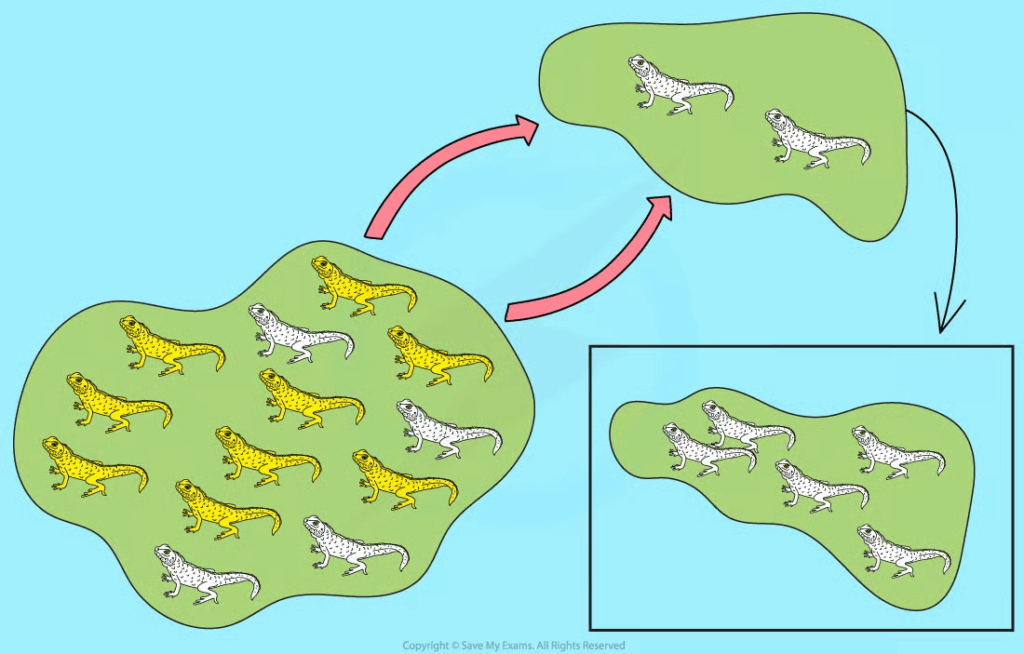
- Drift has a stronger effect in small populations, where chance events alter allele frequencies significantly.
- The bottleneck effect reduces genetic diversity after catastrophic events like disease, natural disasters, or overhunting.
- The founder effect occurs when a few individuals establish a new population, often carrying unrepresentative alleles.
- Drift can lead to fixation (allele frequency reaches 100%) or loss of alleles.
- Unlike natural selection, drift does not favour advantageous traits — changes are random.
🧠 Examiner Tip: Don’t confuse genetic drift with natural selection. Drift is random, while selection is non-random and driven by fitness advantages.
📌 Gene Flow: Movement of Alleles Between Populations
- Occurs when individuals migrate between populations and interbreed.
- Maintains genetic connectivity between populations.
- Can increase genetic diversity by introducing new alleles.
- May counteract effects of drift by reintroducing lost alleles.
- Too much gene flow can reduce local adaptation, while limited flow promotes divergence.
🧬 IA Tips & Guidance: A class experiment could simulate genetic drift using coloured beads to represent alleles in small vs large populations, or gene flow using exchange between groups.
📌 Interaction Between Drift and Flow
- Drift reduces diversity; gene flow replenishes it.
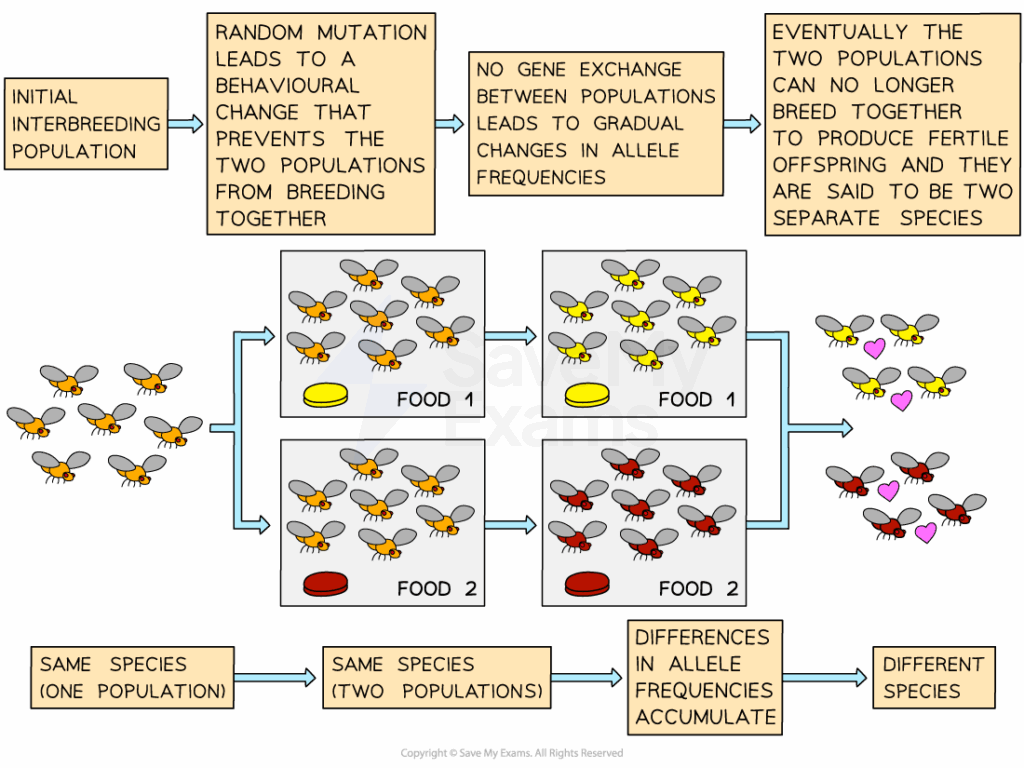
- Isolated populations with little flow diverge genetically, sometimes leading to speciation.
- Conservation biology emphasises gene flow corridors to maintain diversity in endangered species.
- Balance between drift and flow shapes population stability and adaptation.
- Human migration patterns provide strong real-world examples of gene flow.
🌐 EE Focus: An EE could explore whether gene flow prevents or promotes speciation in fragmented habitats, combining molecular data with ecological theory.
📌 Case Studies
- Cheetah bottleneck: extremely low diversity due to past population collapse.
- Island colonisation: founder effects in island bird populations.
- Human gene flow: interbreeding between modern humans and Neanderthals.
- Conservation corridors: tiger reserves connected by wildlife corridors reduce drift effects.
- Drift explains some allele frequency patterns where selection pressure is absent.
❤️ CAS Link: Students could simulate genetic drift with classroom role-play or model migration with exchange games, then present results to peers to show random vs directed processes.
🌍 Real-World Connection: Understanding drift and flow is crucial for conservation genetics, disease resistance, agriculture (crop gene banks), and tracking human evolutionary history.
📌 Population Genetics Framework
- Hardy-Weinberg principle provides a baseline of no drift, no flow, no selection.
- Deviations indicate evolutionary processes.
- Drift and flow must be considered alongside mutation and selection.
- Genetic data allows tracking of these processes in real time.
- These mechanisms are essential for predicting population responses to change.
🔍 TOK Perspective: Genetic drift challenges the notion that evolution is always adaptive. TOK issue: To what extent do random processes undermine deterministic explanations in science?