D3.1.1 ASEXUAL AND SEXUAL REPRODUCTION
📌Definition Table
| Term | Definition |
|---|---|
| Asexual reproduction | Production of offspring from a single parent without gametes, producing clones. |
| Sexual reproduction | Production of offspring by fusion of male and female gametes, leading to genetic variation. |
| Gamete | Haploid reproductive cell (sperm or egg) involved in sexual reproduction. |
| Fertilisation | Fusion of male and female gametes to form a diploid zygote. |
| Genetic variation | Differences in DNA sequences among individuals, arising from meiosis, recombination, and fertilisation. |
📌Introduction
Reproduction is a fundamental process ensuring continuity of life. Organisms reproduce either asexually, producing genetically identical offspring, or sexually, producing genetically varied offspring. Both strategies have evolutionary advantages: asexual reproduction ensures rapid population increase in stable environments, while sexual reproduction enhances genetic diversity, promoting adaptation
📌 Comparison of Asexual and Sexual Reproduction
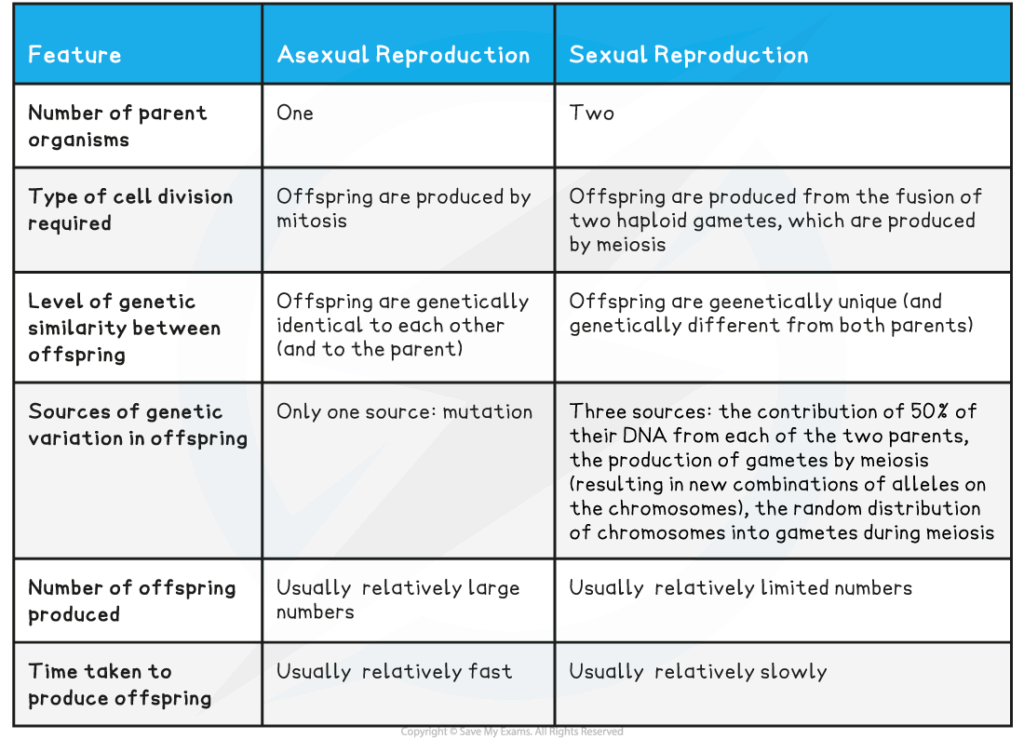
- Asexual reproduction is rapid, requires no mate, and maintains successful genotypes.
- Methods include binary fission (bacteria), budding (yeast, hydra), and vegetative propagation (plants).
- Sexual reproduction requires specialized gametes and fertilisation but generates variation.
- Meiosis introduces genetic diversity through crossing over and independent assortment.
- Sexual reproduction increases resilience to environmental change and disease.
🧠 Examiner Tip: Always contrast the advantages and disadvantages of both reproductive strategies, especially in terms of speed vs variation.
📌 Examples in Nature
- Bacteria reproduce asexually via binary fission.
- Fungi and algae can switch between asexual and sexual modes depending on conditions.
- Plants reproduce asexually via runners, bulbs, or tubers, and sexually via flowers and seeds.
- Many animals, such as starfish, can regenerate lost parts (asexual) but also reproduce sexually.
- Alternation between asexual and sexual phases increases survival chances.
🧬 IA Tips & Guidance: An IA could involve investigating propagation in plants (cuttings vs seeds), linking experimental design to differences in reproduction modes.
📌 Significance of Sexual Reproduction
- Generates diversity for natural selection to act upon.
- Provides adaptability against environmental stress, parasites, or pathogens.
- Costs include energy investment in finding mates and slower population growth.
- Asexual reproduction dominates in stable environments, while sexual reproduction prevails in changing ones.
- Evolutionary theory (Red Queen hypothesis) highlights the advantage of sexual variation in resisting parasites.
🌐 EE Focus: An EE could explore alternation of generations in plants or the evolutionary significance of sexual vs asexual reproduction in specific species.
📌 Role of Reproduction in Evolutionary Adaptation
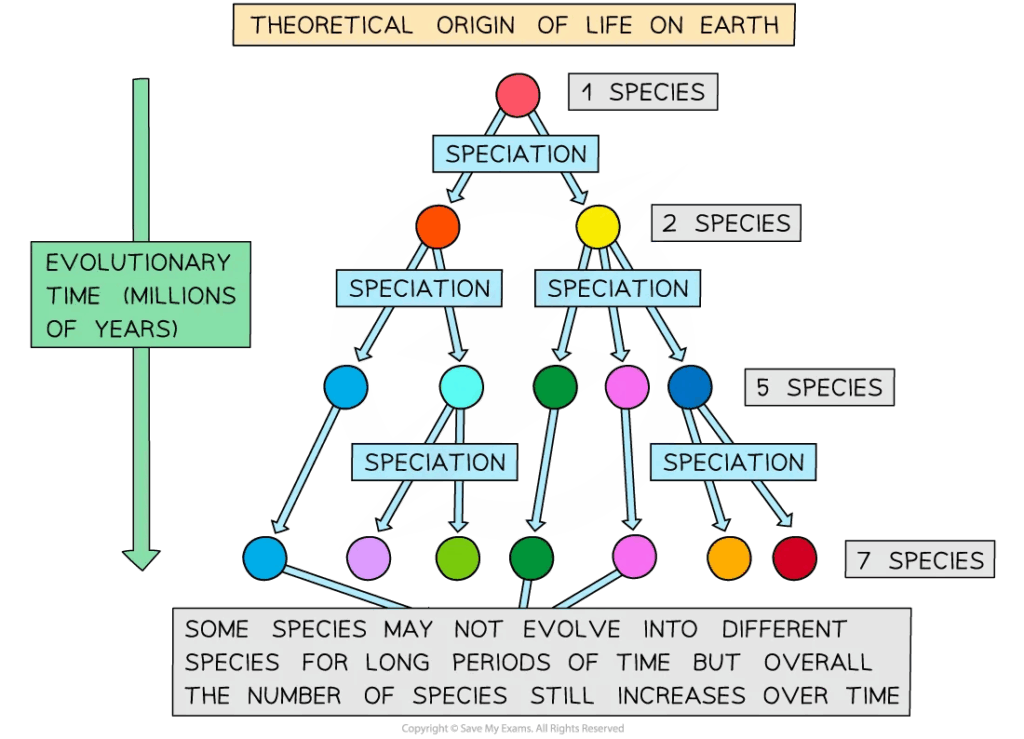
- Mutations plus recombination generate new allele combinations.
- Asexual species rely mainly on mutation for change.
- Sexual reproduction accelerates evolutionary responses.
- Hybridisation between species contributes to biodiversity.
- Genetic variation underpins speciation and adaptation.
❤️ CAS Link: Students could create awareness campaigns on cloning in plants or artificial reproductive technologies, linking classroom concepts to food security and ethics.
🌍 Real-World Connection: Reproductive strategies are central to agriculture, conservation, and medicine. Asexual propagation enables cloning of desirable crops, while sexual reproduction underpins selective breeding. In medicine, assisted reproductive technologies like IVF mimic sexual reproduction, offering solutions for infertility.
📌 Reproductive Strategies in Humans and Other Species
- Humans rely exclusively on sexual reproduction through gamete fusion.
- Some organisms use parthenogenesis (development from unfertilised eggs).
- Many species can switch modes depending on environmental stress.
- Comparison reveals how reproduction adapts to survival needs.
- Human use of reproductive technology reflects natural principles.
🔍 TOK Perspective: Our categorisation of reproduction as “asexual” or “sexual” simplifies complex realities. TOK reflection: To what extent do human classifications of natural processes shape what we consider knowledge in biology?