D2.1.2 MITOSIS AND MEIOSIS
📌Definition Table
| Term | Definition |
|---|---|
| Mitosis | Nuclear division producing two genetically identical daughter cells. |
| Meiosis | Nuclear division producing four genetically diverse haploid cells. |
| Chromatid | One half of a duplicated chromosome. |
| Homologous chromosomes | Chromosome pairs (one maternal, one paternal) with same loci. |
| Crossing over | Exchange of genetic material between homologous chromosomes during prophase I of meiosis. |
| Independent assortment | Random distribution of homologous chromosomes to gametes. |
📌Introduction
Mitosis and meiosis are distinct processes of nuclear division with vital roles in growth, repair, and reproduction. Mitosis ensures identical daughter cells for somatic functions, while meiosis produces genetic variation in gametes for sexual reproduction. Both follow structured stages but differ fundamentally in outcomes and evolutionary importance.
📌 Mitosis Stages
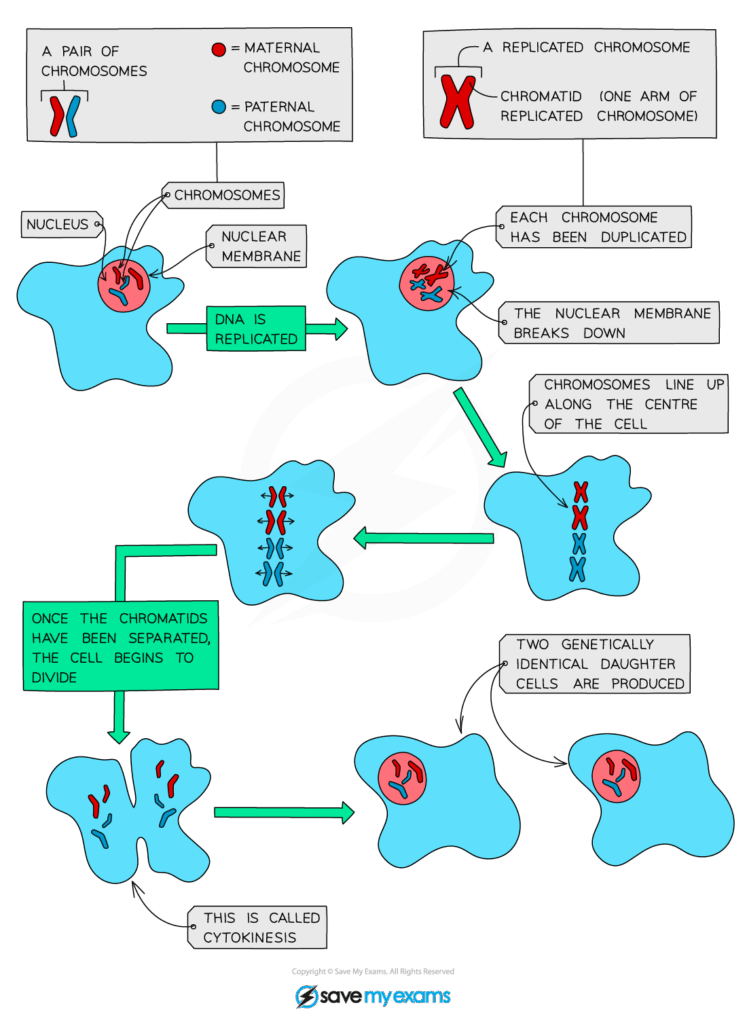
- Prophase: chromosomes condense, spindle forms, nuclear envelope breaks down.
- Metaphase: chromosomes align at equator.
- Anaphase: sister chromatids separate, pulled to poles.
- Telophase: nuclear membranes reform, chromosomes decondense.
- Cytokinesis divides cytoplasm → two identical cells.
🧠 Examiner Tip: Label diagrams carefully; metaphase and anaphase are frequently confused.
📌 Meiosis I
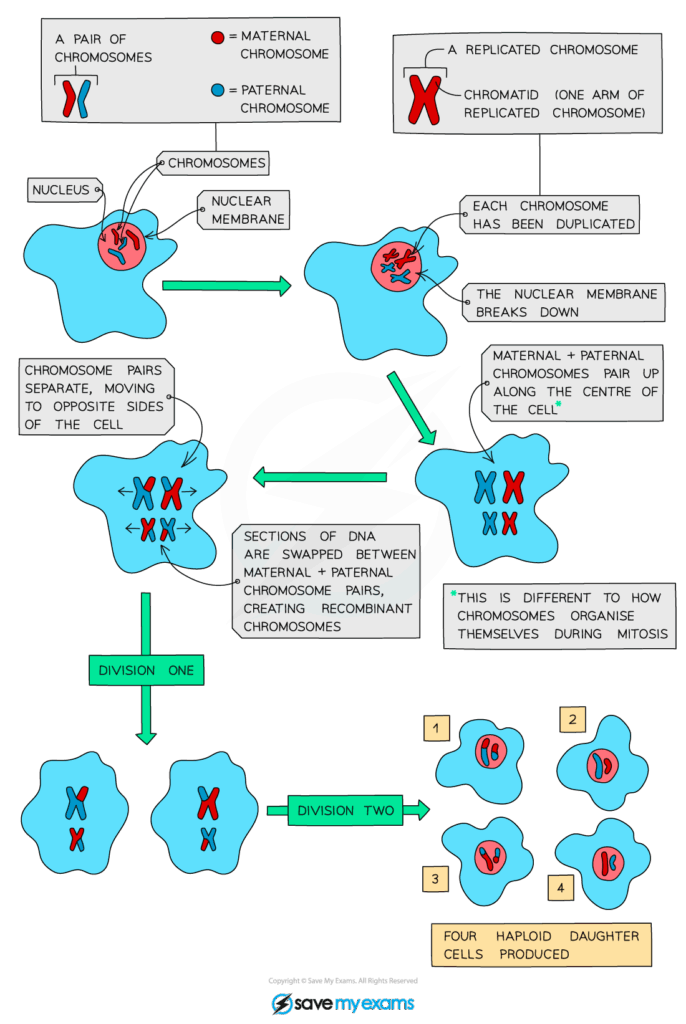
- Prophase I: homologous chromosomes pair (synapsis); crossing over occurs.
- Metaphase I: homologous pairs align randomly (independent assortment).
- Anaphase I: homologues separate, but sister chromatids remain together.
- Telophase I: cells divide into haploid nuclei.
- Results in genetic diversity through recombination and assortment.
🧬 IA Tips & Guidance: Microscopic examination of meiosis in plant anthers (e.g., lily) can illustrate crossing over.
📌 Meiosis II
- Resembles mitosis but starts with haploid cells.
- Prophase II: spindles form again.
- Metaphase II: chromosomes align singly.
- Anaphase II: sister chromatids finally separate.
- Telophase II: results in four haploid daughter cells.
- Provides further diversification of gametes.
🌐 EE Focus: An EE could investigate how meiosis underpins Mendelian genetics, testing segregation and assortment principles.
📌 Comparison of Mitosis and Meiosis
- Mitosis: 1 division → 2 diploid identical cells.
- Meiosis: 2 divisions → 4 haploid genetically varied cells.
- Mitosis: growth and repair; meiosis: reproduction.
- Crossing over and independent assortment unique to meiosis.
- Errors in meiosis → chromosomal disorders (e.g., Down syndrome).
❤️ CAS Link: Students could design peer teaching sessions using role-play to act out mitosis vs meiosis stages.
🌍 Real-World Connection: Fertility treatments and genetic counselling rely on understanding meiosis. Cancer research depends on mitotic control.
📌 Errors and Their Consequences
- Non-disjunction: failure of chromosomes to separate → aneuploidy.
- Can cause conditions such as trisomy 21 (Down syndrome).
- Mitotic errors can cause tumour growth.
- Checkpoint failures during meiosis lead to infertility.
- Genetic diversity depends on accurate meiotic processes.
🔍 TOK Perspective: Mitosis and meiosis are taught as distinct “sets of stages.” TOK issue: Do these rigid models oversimplify what is, in reality, a fluid continuum of molecular events?