D1.3.1 TYPES AND CAUSES OF MUTATIONS
📌Definition Table
| Term | Definition |
|---|---|
| Mutation | A permanent change in the nucleotide sequence of DNA. |
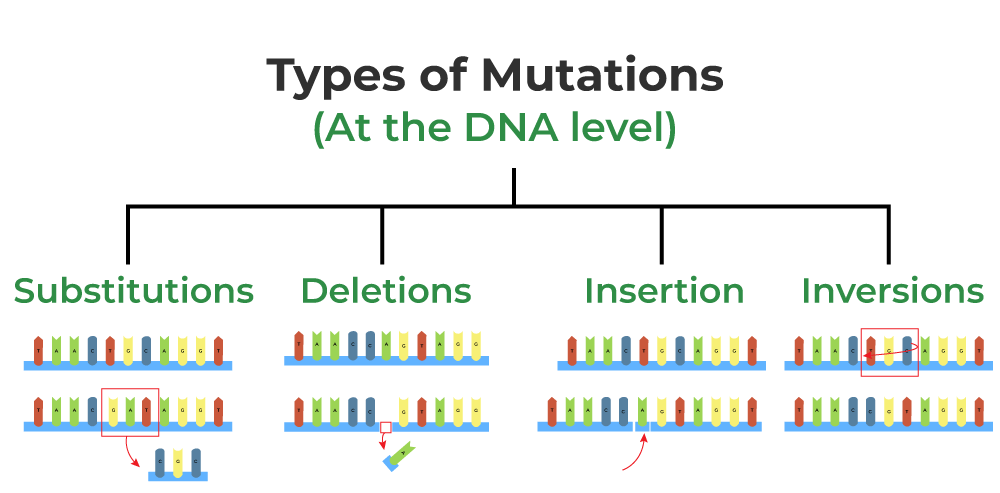
| Point Mutation | Change affecting a single base (substitution, insertion, or deletion). |
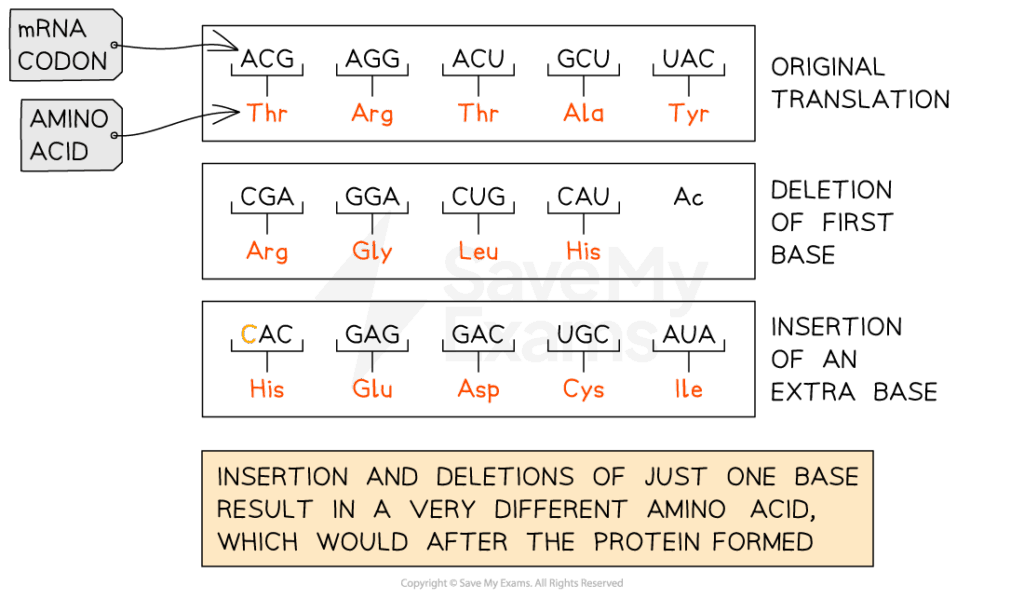
| Frameshift Mutation | Caused by insertion/deletion of bases that shift the reading frame. |
| Mutagen | An external factor (e.g., radiation, chemicals) that increases mutation rate. |
| Silent Mutation | A base change that does not alter the amino acid sequence due to degeneracy of the genetic code. |
📌Introduction
Mutations are the ultimate source of genetic variation and can occur spontaneously or be induced by mutagens. They affect protein synthesis by altering the genetic code, potentially changing amino acid sequences and impacting protein structure and function. While many mutations are harmful or neutral, a minority may be beneficial, driving evolutionary processes.
📌 Types of Mutations
- Substitution mutations may be silent, missense, or nonsense, with varying impacts on the resulting protein.
- Insertions and deletions can cause frameshift mutations, altering the reading frame of mRNA and drastically changing the polypeptide.
- Large-scale mutations include duplications, inversions, and translocations, which affect chromosomal structure.
- Germline mutations are heritable, affecting gametes and passed to offspring, while somatic mutations are confined to body cells.
- Spontaneous mutations arise during DNA replication errors, whereas induced mutations result from exposure to mutagens like UV light, X-rays, or chemicals in tobacco smoke.
🧠 Examiner Tip: Always distinguish between point mutations and chromosomal mutations, and specify whether a mutation leads to a silent, missense, or nonsense outcome.
📌 Causes of Mutations
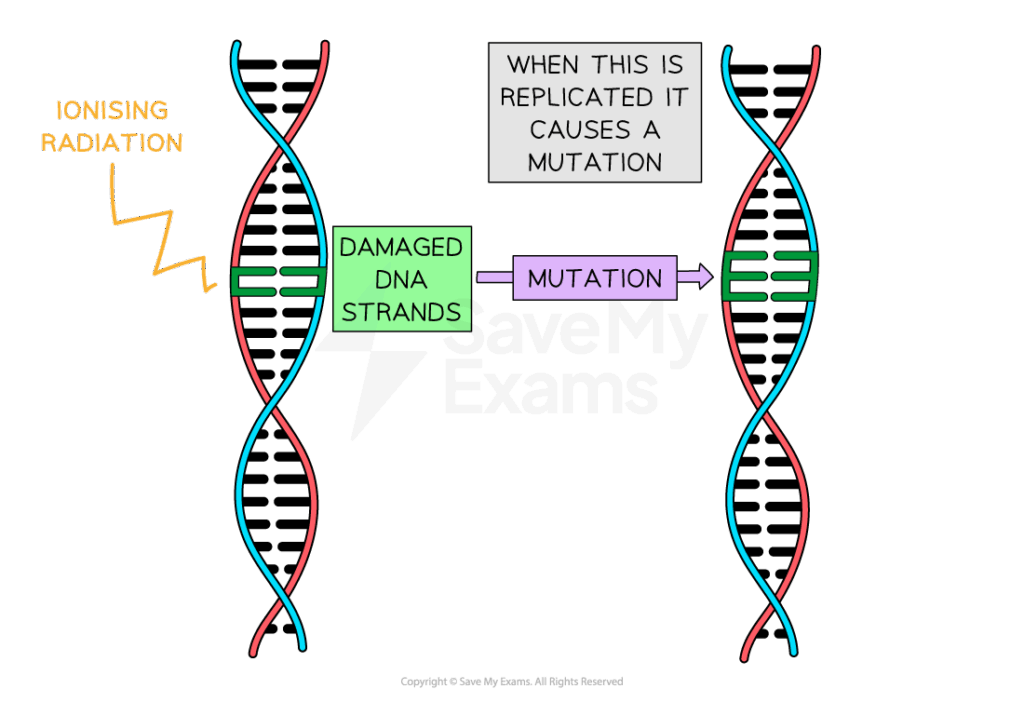
- Spontaneous errors in DNA replication when proofreading fails.
- Physical mutagens like UV radiation causing thymine dimers, or X-rays inducing double-strand breaks.
- Chemical mutagens such as nitrosamines, benzopyrene (tobacco smoke), or mustard gas.
- Biological mutagens including viral insertions (retroviruses).
- Mutation hotspots (e.g., CpG islands) are regions of higher mutation frequency.
🧬 IA Tips & Guidance: Mutation frequency can be investigated with bacterial cultures exposed to UV light or mutagenic chemicals, linking lab work to DNA repair and variation.
📌 Mutations and Genetic Variation
- Mutations introduce new alleles into populations, fueling natural selection.
- Some are neutral, others deleterious, and a few advantageous (e.g., sickle-cell allele conferring malaria resistance).
- In sexually reproducing organisms, mutations combine with meiosis and fertilisation to enhance genetic diversity.
- In asexual organisms, mutation is the primary driver of variation and evolution.
🌐 EE Focus: An EE could investigate mutation rates in different organisms or the effect of environmental mutagens (e.g., UV intensity) on DNA damage.
📌 Consequences of Mutations
- Silent mutations do not alter amino acid sequence due to redundancy of the code.
- Missense mutations change one amino acid, potentially altering protein function (e.g., sickle-cell anemia).
- Nonsense mutations introduce a premature stop codon, truncating proteins (e.g., cystic fibrosis).
- Frameshift mutations often render proteins non-functional due to widespread sequence disruption.
- Mutations in oncogenes or tumour suppressor genes can initiate cancer.
❤️ CAS Link: Students could run a community awareness campaign about mutagens in daily life (UV exposure, smoking) and their link to cancer, connecting classroom learning to public health.
🌍 Real-World Connection: Mutations underlie many medical conditions, from cancer to genetic disorders like cystic fibrosis and Huntington’s disease. In agriculture, induced mutations create crop varieties with desirable traits, while in virology, mutations explain viral evolution and vaccine updates (e.g., influenza).
📌 Mutations in Medicine and Evolution
- Cancer progression often involves multiple accumulated mutations.
- Viral pandemics (e.g., COVID-19 variants) demonstrate real-time mutation effects.
- Mutations provide raw material for adaptive evolution across species.
- Biotechnology uses controlled mutations for protein engineering.
🔍 TOK Perspective: Mutations are random yet interpreted as meaningful in evolution and medicine. This raises epistemological questions: how can chance processes generate order? And to what extent does our classification of mutations (silent, harmful, beneficial) depend on human value judgments?