D1.2.2 TRANSLATION AND ROLE OF RIBOSOMES
📌Definition Table
| Term | Definition |
|---|---|
| Translation | Process of synthesizing a polypeptide chain from mRNA using ribosomes. |
| Codon | Sequence of three nucleotides in mRNA that codes for a specific amino acid. |
| Anticodon | Complementary triplet sequence on tRNA that pairs with an mRNA codon. |
| tRNA (transfer RNA) | Molecule that carries specific amino acids to ribosomes during translation. |
| Ribosome | Cellular structure (made of rRNA and proteins) that catalyzes peptide bond formation. |
| Polysome | Cluster of multiple ribosomes translating a single mRNA simultaneously. |
📌Introduction
Translation is the second step of protein synthesis, where ribosomes decode the mRNA sequence into a polypeptide chain. This process occurs in the cytoplasm in both prokaryotes and eukaryotes, with ribosomes acting as molecular machines that align tRNAs with codons and catalyze peptide bond formation.
📌 Mechanism of Translation
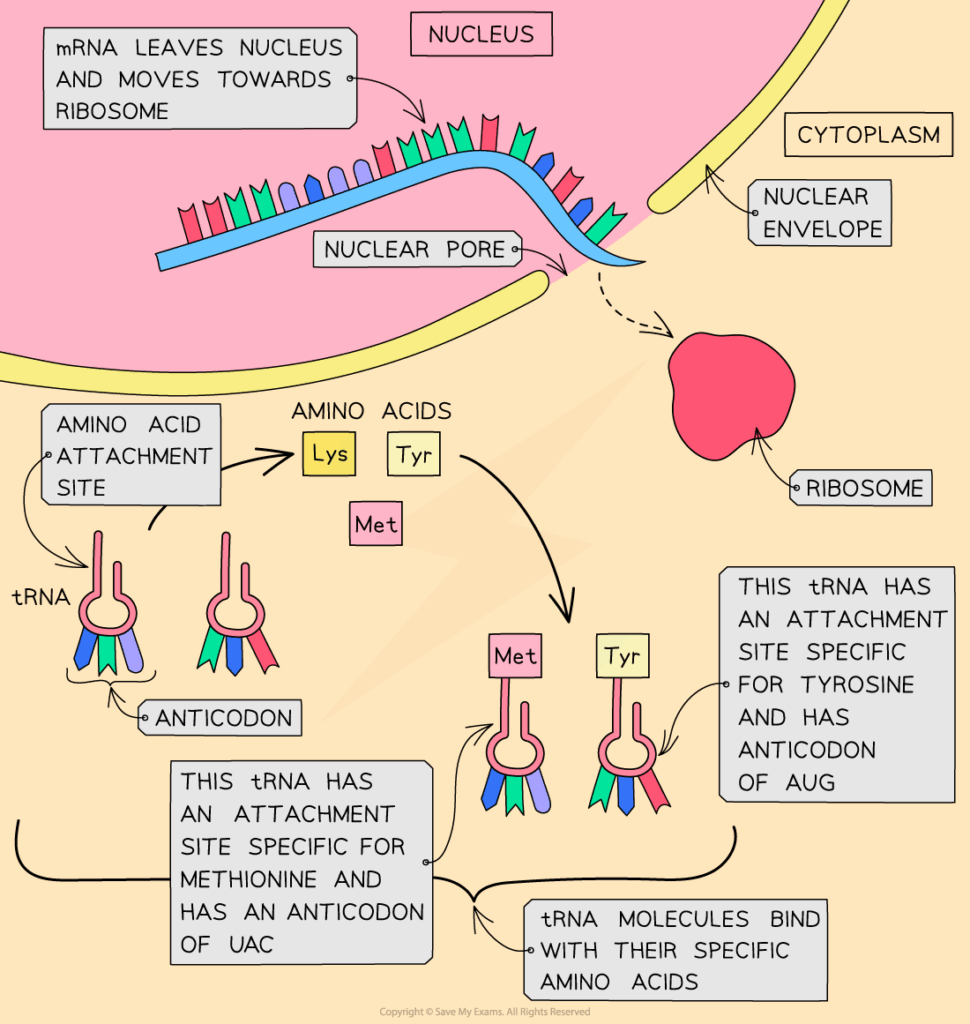
- Initiation
- Small ribosomal subunit binds to mRNA near the start codon (AUG).
- Initiator tRNA carrying methionine binds to AUG codon.
- Large ribosomal subunit attaches, forming the complete ribosome.
- Elongation
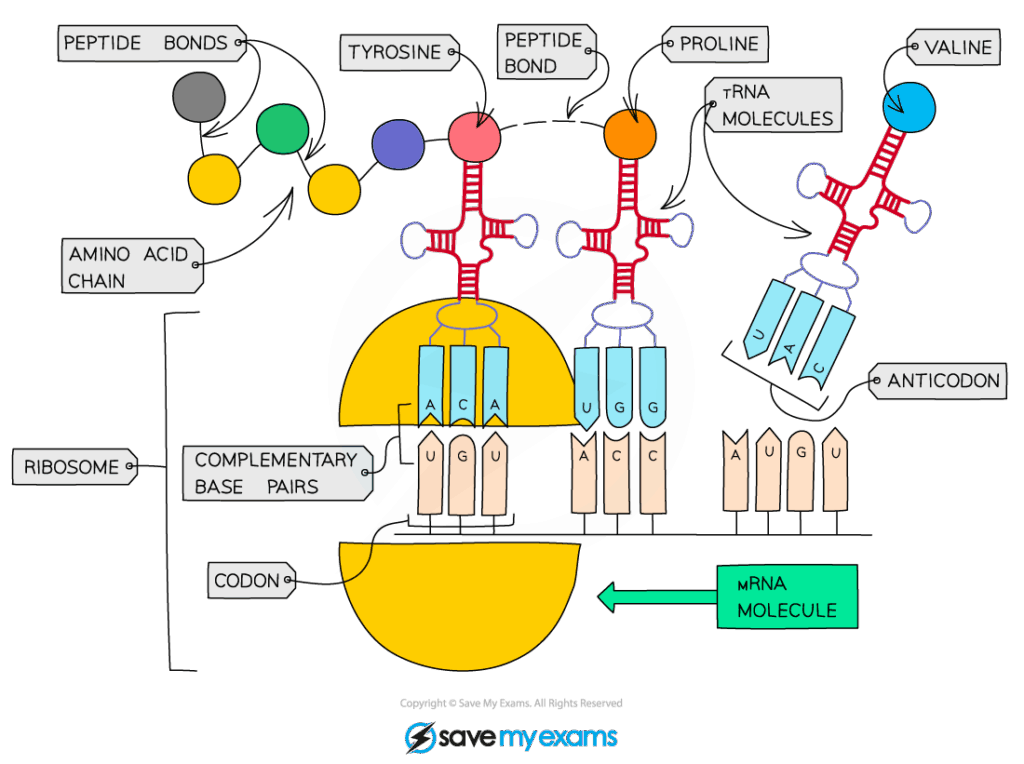
- Incoming tRNAs bind to the A site with anticodon–codon pairing.
- Peptide bond forms between amino acids in P and A sites.
- Ribosome shifts (translocation), moving tRNA to the P site, freeing the A site.
- Termination
- Stop codon (UAA, UAG, UGA) is reached.
- Release factors bind, causing the ribosome to disassemble and release the polypeptide.
- Polypeptide undergoes folding or further modification.
🧠 Examiner Tip: Always identify the ribosomal sites (A, P, and E) when describing translation. This is a common exam requirement.
📌 Role of Ribosomes
- Ribosomes are made of rRNA and proteins, with large and small subunits.
- They catalyze peptide bond formation via peptidyl transferase activity (rRNA acting as a ribozyme).
- In prokaryotes, ribosomes are 70S; in eukaryotes, 80S.
- Ribosomes can be free (producing cytoplasmic proteins) or bound to ER (producing secretory or membrane proteins).
- Polysomes increase efficiency by producing multiple polypeptides from one mRNA simultaneously.
🧬 IA Tips & Guidance: An IA could involve modeling codon–anticodon matching using color-coded cards or beads to simulate translation, or analyzing how inhibitors like antibiotics affect bacterial protein synthesis.
📌 Genetic Code and Fidelity
- The genetic code is universal, degenerate, and non-overlapping.
- Degeneracy means multiple codons code for the same amino acid, reducing mutation impact.
- Specificity comes from anticodon–codon pairing and aminoacyl-tRNA synthetase enzymes charging tRNAs with correct amino acids.
- Stop codons ensure proper termination, preventing faulty proteins.
- Errors in translation can result in misfolded proteins and disease.
🌐 EE Focus: An EE could investigate ribosome structure differences between prokaryotes and eukaryotes, analyzing how antibiotics selectively target bacterial translation.
📌 Efficiency and Regulation of Translation
- Initiation is the main regulatory step of translation.
- Polysomes enable rapid protein production in response to demand.
- Translation can be upregulated under growth signals (e.g., insulin) or suppressed during stress.
- Ribosome pausing helps coordinate protein folding.
- mRNA stability directly affects protein output.
❤️ CAS Link: Students could create classroom workshops demonstrating translation with role-play (students acting as mRNA, tRNA, and ribosome components), linking active learning with complex processes.
🌍 Real-World Connection: Antibiotics such as tetracycline and chloramphenicol work by inhibiting bacterial ribosomes, while sparing eukaryotic ribosomes. Translation defects are linked to genetic diseases like cystic fibrosis and Duchenne muscular dystrophy, where faulty proteins arise. mRNA vaccines also depend on efficient ribosomal translation to produce antigens inside host cells, showing how translation knowledge drives biotechnology and medicine.
📌 Integration with Protein Synthesis
- Translation links genetic information to functional proteins.
- Errors in translation compromise cell function and health.
- Ribosome structure and function are highly conserved across species, highlighting evolutionary importance.
- Regulation of translation ensures proteins are made only when needed.
- Combined with transcription, translation determines the proteome of a cell.
🔍 TOK Perspective: Ribosomes were discovered through electron microscopy and biochemical studies, revealing molecular machines at a scale invisible to the naked eye. TOK reflection: How does reliance on technology to “see the unseen” affect the certainty of scientific claims?