C4.2.1 ENERGY FLOW IN ECOSYSTEMS TROPHIC LEVELS, PRODUCTIVITY
📌Definition Table
| Term | Definition |
|---|---|
| Trophic level | The feeding position of an organism in a food chain (e.g., producer, primary consumer). |
| Productivity | The rate at which energy is accumulated in biomass by organisms. |
| Gross primary productivity (GPP) | Total energy captured by producers via photosynthesis. |
| Net primary productivity (NPP) | Energy available to consumers after producers’ respiration (NPP = GPP – respiration). |
| Energy transfer efficiency | The percentage of energy transferred from one trophic level to the next (usually ~10%). |
| Biomass | The total dry mass of living material in an ecosystem. |
📌Introduction
Energy enters ecosystems through photosynthesis and flows through food chains as organisms consume one another. At each trophic level, energy is lost as heat, waste, or used for metabolic processes, limiting the length of food chains and shaping ecosystem structure. Productivity measures how efficiently energy is converted into biomass and varies with environmental conditions. Understanding energy flow is fundamental to ecology and human management of ecosystems.
📌 Trophic Levels and Energy Flow
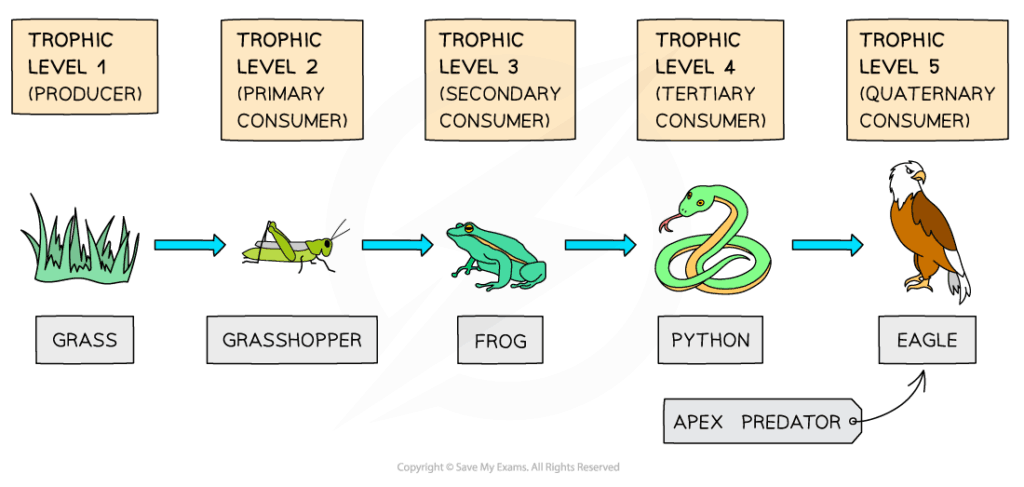
- Producers (plants, algae, cyanobacteria) capture solar energy and form the base of food webs.
- Consumers occupy higher trophic levels: primary consumers (herbivores), secondary consumers (carnivores), tertiary predators.
- Decomposers recycle nutrients and release energy stored in dead matter.
- Energy decreases at each level due to metabolic losses, limiting food chains to 4–5 levels.
- Energy pyramids represent decreasing energy and biomass with increasing trophic level.
🧠 Examiner Tip: Always distinguish between energy flow (one way) and nutrient cycling (recycling). Many students confuse the two.
📌 Primary Productivity
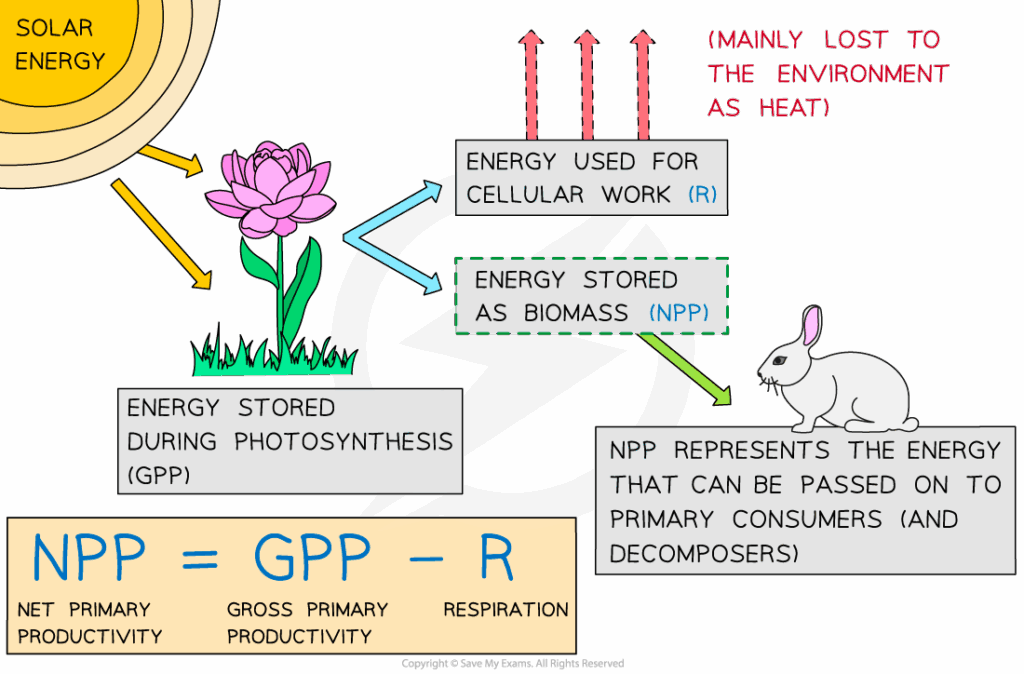
- Gross primary productivity (GPP): total energy fixed by photosynthesis.
- Net primary productivity (NPP): GPP – respiration; energy available to consumers.
- NPP varies by ecosystem: highest in tropical rainforests, lowest in deserts and open oceans.
- Climate (light, temperature, water, nutrients) strongly influences productivity.
- Productivity sets the energy budget for entire ecosystems.
🧬 IA Tips & Guidance: Students can measure NPP using light/dark bottle experiments with aquatic plants to quantify oxygen production as a proxy for photosynthesis.
📌 Energy Transfer Efficiency
- Only ~10% of energy is transferred to the next trophic level.
- Losses occur due to respiration, excretion, undigested food, and heat.
- Transfer efficiency varies: herbivores may be more efficient than carnivores; ectotherms waste less energy than endotherms.
- Efficiency influences population sizes at different trophic levels.
- Humans exploit efficiency by eating lower on food chains (plants vs meat).
🌐 EE Focus: An EE could compare energy transfer efficiency in different ecosystems (aquatic vs terrestrial) and its implications for food security.
📌 Energy Pyramids and Food Webs
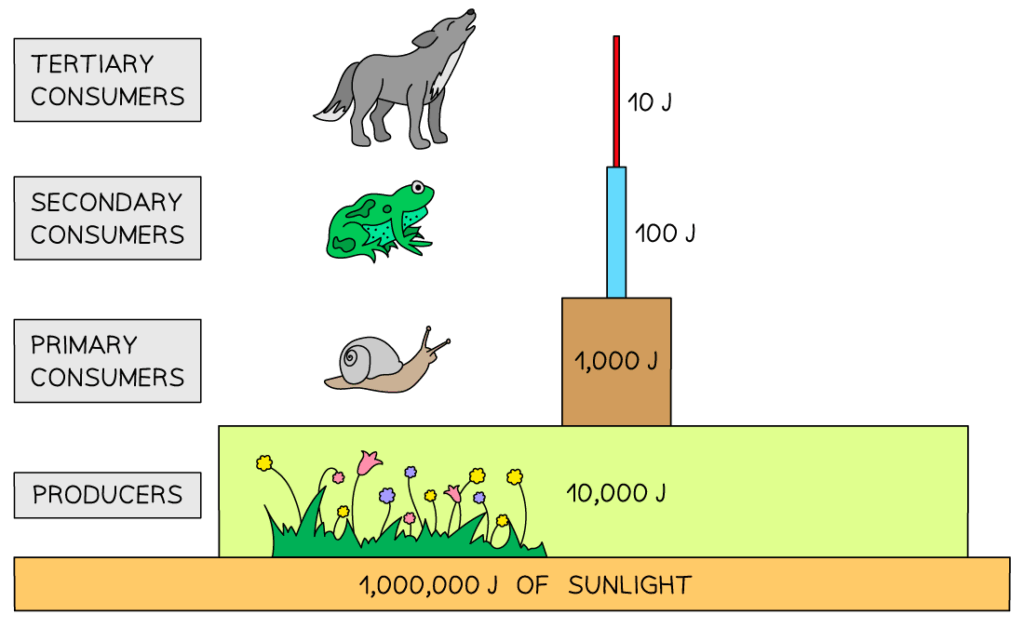
- Energy pyramids always upright, reflecting loss at each level.
- Biomass pyramids may be inverted in aquatic ecosystems due to rapid turnover of phytoplankton.
- Food webs show interconnections among species, not just linear chains.
- Keystone species play critical roles in maintaining energy pathways.
- Disturbances (removal of predators, climate change) disrupt flows.
❤️ CAS Link: Students could create educational posters or food web models to teach younger students about energy transfer in ecosystems.
🌍 Real-World Connection: Energy efficiency principles are applied in sustainable agriculture and aquaculture, promoting diets with lower ecological footprints.
📌 Human Influence on Energy Flow
- Humans shorten food chains by directly consuming producers (crops) and primary consumers (fish, livestock).
- Overfishing and deforestation disrupt natural energy pathways.
- Agriculture maximises NPP by fertilisers, irrigation, and genetic modification.
- Intensive farming increases yields but reduces ecosystem stability.
- Renewable energy use in ecosystems (e.g., solar panels in agroforestry) integrates natural flows with human needs.
🔍 TOK Perspective: Energy pyramids simplify complex ecosystems into neat models. TOK issue: Do such diagrams oversimplify by ignoring detritus-based food webs and recycling pathways?