B4.1.2 – ADAPTATIONS FOR WATER AND SALT BALANCE
📌Definition Table
| Term | Definition |
|---|---|
| Osmoregulation | The control of water and solute concentrations to maintain homeostasis. |
| Osmoconformer | An organism (mostly marine invertebrates) whose internal osmotic concentration matches the external environment. |
| Osmoregulator | An organism that actively regulates internal osmotic concentration regardless of external conditions. |
| Excretion | The removal of nitrogenous waste products that also contributes to maintaining water and salt balance. |
| Salt gland | A specialised gland (in seabirds, reptiles, marine iguanas) that actively excretes excess salts. |
| Antidiuretic hormone (ADH) | A hormone that regulates kidney reabsorption of water, influencing urine concentration. |
📌Introduction
Life depends on maintaining stable water and ion concentrations, yet organisms inhabit diverse environments ranging from freshwater rivers to hyper-saline seas and deserts. Maintaining balance is critical for enzyme activity, cell integrity, and nerve impulses. Strategies vary: osmoconformers tolerate external fluctuations, while osmoregulators expend energy to stabilise internal conditions. Adaptations include specialised excretory systems, salt glands, and behavioural responses to minimise water loss or salt gain.
📌 Marine and Freshwater Organisms
- Marine invertebrates (e.g., jellyfish, sea anemones) are osmoconformers; their body fluids approximate seawater composition, reducing energy expenditure.
- Marine fish face constant osmotic water loss to seawater; adaptations include:
- Drinking seawater and actively excreting excess salts via gills.
- Producing small volumes of concentrated urine.
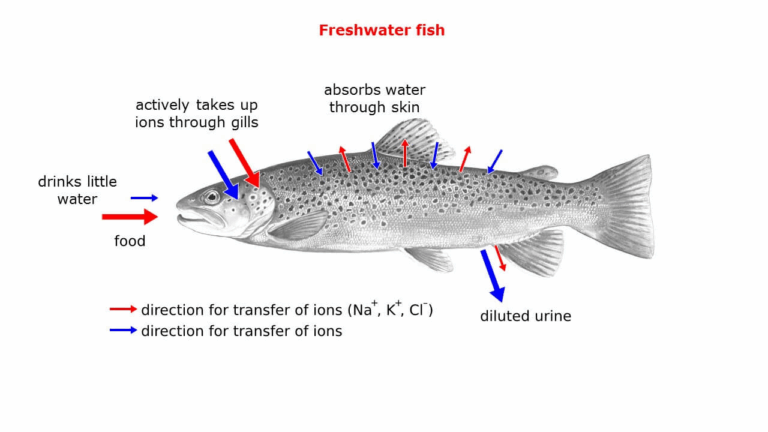
- Freshwater fish face osmotic water gain; adaptations include:
- Excreting large volumes of dilute urine.
- Actively absorbing salts through gills to compensate for loss.
- Amphibians rely on permeable skin but adopt behavioural adaptations (burrowing in mud, reducing exposure) to avoid desiccation.
🧠 Examiner Tip: Always highlight the contrast between freshwater and marine fish — this comparison is a frequent exam point.
📌 Terrestrial Adaptations for Water Conservation
- Desert animals minimise water loss by producing concentrated urine and dry faeces.
- Kangaroo rats oxidise food molecules to produce metabolic water, reducing reliance on drinking.
- Reptiles and birds excrete uric acid, conserving water compared to mammals that excrete urea.
- Nocturnal behaviour reduces exposure to daytime heat and evaporation.
- Structural features, like waxy cuticles in arthropods, reduce water loss across surfaces.
🧬 IA Tips & Guidance: Students could investigate urine concentration in mammals exposed to different fluid intakes (safe simulations), or model water loss using plant cuticles and desiccation chambers.
📌 Salt Glands and Specialised Organs
- Marine reptiles (e.g., iguanas, sea turtles) and seabirds excrete excess salts through nasal or orbital salt glands.
- These glands actively pump ions against steep gradients, conserving water by eliminating salts without large urine volumes.
- Elasmobranchs (sharks, rays) retain urea in tissues to equalise osmotic pressure with seawater, reducing water loss.
- Crocodiles and amphibians have specialised integumentary features that reduce evaporative water loss.
🌐 EE Focus: An EE could explore salt gland efficiency in seabirds, or compare nitrogenous waste excretion (urea, uric acid, ammonia) across species and link this to evolutionary adaptations to habitat.
📌 Hormonal Regulation in Mammals

- Kidneys maintain water and salt balance by selectively reabsorbing or excreting solutes.
- ADH increases water reabsorption in collecting ducts, producing concentrated urine during dehydration.
- Aldosterone promotes sodium reabsorption, influencing osmotic gradients.
- Long loops of Henle in desert mammals concentrate urine more efficiently than in temperate species.
- Hormonal responses allow rapid adjustment to fluctuating water availability.
❤️ CAS Link: Students could lead workshops on hydration and salt balance in humans (e.g., during sports), linking physiology to lifestyle.
🌍 Real-World Connection: Understanding osmoregulation informs medicine (treatment of dehydration, kidney disease), agriculture (breeding drought-tolerant livestock), and conservation (managing animals in zoos or aquaculture).
📌 Extreme Environmental Strategies
- Estuarine organisms (e.g., crabs, mussels) tolerate fluctuating salinity through flexible osmoregulation.
- Migratory fish like salmon remodel kidney and gill function when moving between freshwater and seawater.
- Desert amphibians enter aestivation, encasing themselves in mucous cocoons to conserve moisture.
- Tardigrades survive complete desiccation by entering a cryptobiotic state.
- Camels tolerate large fluctuations in body temperature and water content, reducing water needs.
🔍 TOK Perspective: Osmoregulation highlights the use of models (osmotic gradients, kidney diagrams) in teaching. TOK issue: do simplified models accurately represent the dynamic interplay of environment, hormones, and behaviour, or do they risk oversimplification?