B3.3.3 – LOCOMOTION AND JOINT MOVEMENT
📌Definition Table
| Term | Definition |
|---|---|
| Locomotion | The ability of an organism to move from one location to another using coordinated skeletal and muscular systems. |
| Synovial joint | A freely movable joint with cartilage, synovial fluid, ligaments, and a capsule, allowing a wide range of motion. |
| Flexion | Decreasing the angle between two bones at a joint. |
| Extension | Increasing the angle between two bones at a joint. |
| Abduction | Movement away from the midline of the body. |
| Adduction | Movement toward the midline of the body. |
📌Introduction
Locomotion is a fundamental feature of motile animals, enabling them to forage, escape predators, migrate, and reproduce. Movement requires the integration of skeletal structure, joints, and antagonistic muscle pairs, coordinated by the nervous system. Joints provide flexibility, while muscles generate force, and bones act as levers. Together, they allow efficient movement patterns adapted to different environments, whether walking on land, swimming in water, or flying through air.
📌 Synovial Joints and Movement Types
- Synovial joints allow free movement due to their structure:
- Cartilage → cushions bone ends and reduces wear.
- Synovial fluid → lubricates and reduces friction.
- Capsule and ligaments → stabilize joint while permitting flexibility.
- Types of synovial joints:
- Hinge joints (elbow, knee) → flexion and extension only.
- Ball-and-socket joints (shoulder, hip) → wide range of movements (flexion, extension, rotation, abduction, adduction, circumduction).
- Pivot joints (atlas-axis vertebrae) → rotation.
- Movement efficiency depends on joint design and associated muscle arrangement.
🧠 Examiner Tip: Always link joint type to range of movement (e.g., hinge = one plane; ball-and-socket = multiple planes). Just naming the joint is not enough.
📌 Antagonistic Muscle Pairs at Joints
- Muscles can only contract, not push, so they work in antagonistic pairs.
- Example: Elbow joint
- Biceps contract → flexion (forearm moves up).
- Triceps contract → extension (forearm moves down).
- Example: Knee joint
- Quadriceps contract → extension.
- Hamstrings contract → flexion.
- This arrangement allows precise control, smooth coordination, and reversal of movement.
🧬 IA Tips & Guidance: Students can investigate reaction time and muscle response using grip strength or reflex arc experiments. Alternatively, biomechanics software can analyze joint angles and forces during exercise.
📌 Locomotion Adaptations in Animals
- Terrestrial locomotion: limbs act as levers; spines and muscles adapted for running (cheetah) or jumping (kangaroo).
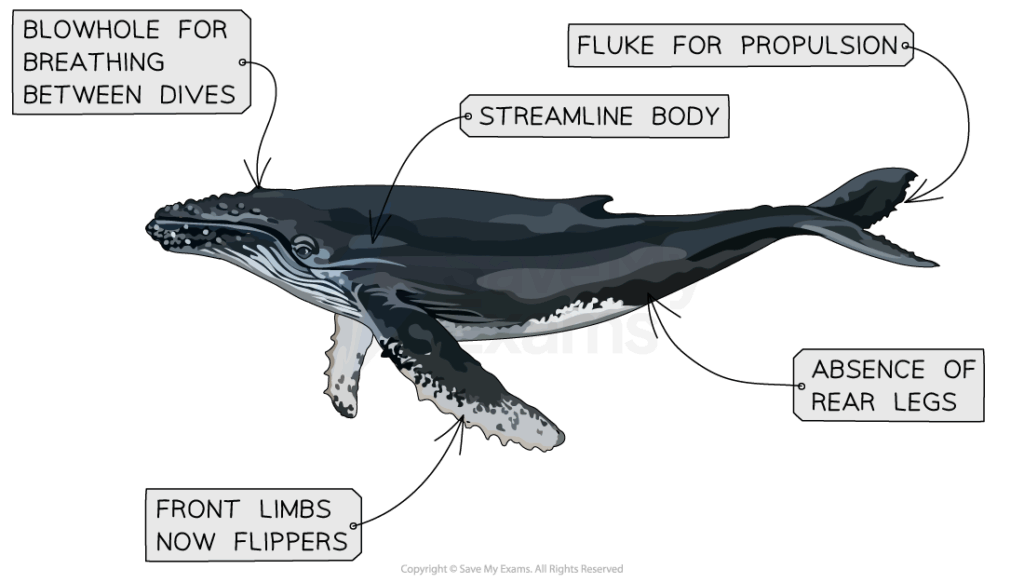
- Aquatic locomotion: streamlined body, fins/flippers, reduced limb resistance (fish, dolphins).
- Aerial locomotion: wings as modified forelimbs, lightweight skeletons, strong flight muscles (birds, bats).
- Specialized adaptations (elastic tendons in kangaroos, pneumatic bones in birds) show how skeletal and muscular systems evolve for ecological niches.
🌐 EE Focus: An EE could investigate biomechanics of human locomotion under different conditions (running vs swimming) or compare skeletal adaptations for flight vs swimming in vertebrates.
📌 Coordination of Movement
- Nervous system activates specific motor units for graded force.
- Proprioceptors in muscles and joints provide feedback about body position.
- Muscle tone and reflex arcs ensure stability during movement.
- Locomotion efficiency requires integration of skeletal, muscular, and nervous systems.
❤️ CAS Link: Students could organize sports workshops or physiotherapy awareness sessions demonstrating how antagonistic muscles and joints work in daily movement, linking biology to health and fitness.
🌍 Real-World Connection:
Joint injuries (ACL tears, dislocations, arthritis) highlight the importance of joint integrity. Prosthetics and exoskeletons apply knowledge of joint mechanics to restore movement. Sports science optimizes training by analyzing joint stress and efficiency. Robotic designs often mimic synovial joints and antagonistic muscle systems.
📌 Comparative Biomechanics
- Efficiency of locomotion varies across species:
- Fish achieve nearly frictionless movement through water.
- Birds combine wing shape with skeletal lightness for flight efficiency.
- Humans evolved bipedal locomotion, freeing forelimbs for tool use.
- These comparisons highlight evolutionary solutions to the universal challenge of movement.
🔍 TOK Perspective: Biomechanics often simplifies living motion into mechanical models. TOK reflection: To what extent can reductionist mechanical models truly explain the complexity of coordinated biological locomotion?