B3.1.3 – VENTILATION AND GAS TRANSPORT
📌Definition Table
| Term | Definition |
|---|---|
| Ventilation | The movement of a respiratory medium (air or water) across a gas exchange surface. |
| Tidal ventilation | Inhalation and exhalation of air into lungs, as seen in mammals. |
| Haemoglobin | A protein in red blood cells that binds oxygen for transport in the blood. |
| Oxygen dissociation curve | A graph showing how haemoglobin saturation varies with partial pressure of oxygen. |
| Bohr effect | The shift of the oxygen dissociation curve in response to increased CO₂, enhancing oxygen release to tissues. |
📌Introduction
Gas exchange alone is insufficient without mechanisms to move gases into and out of respiratory surfaces (ventilation) and transport them around the body (gas transport). Animals have evolved specialised ventilatory mechanisms to maintain concentration gradients and circulatory systems to distribute oxygen efficiently. Haemoglobin and other respiratory pigments increase the blood’s oxygen-carrying capacity, while regulatory adaptations optimise delivery in different conditions.
📌 Ventilation in Mammals
- Mammals use a negative pressure system: the diaphragm contracts and flattens while intercostal muscles expand the ribcage, drawing air into the lungs.
- Exhalation is usually passive, driven by elastic recoil of lung tissue, but can be active during exercise.
- Ventilation maintains high oxygen and low carbon dioxide concentrations in alveoli, sustaining gradients for diffusion.
- Control centres in the medulla regulate breathing rate, responding to CO₂ levels in the blood.
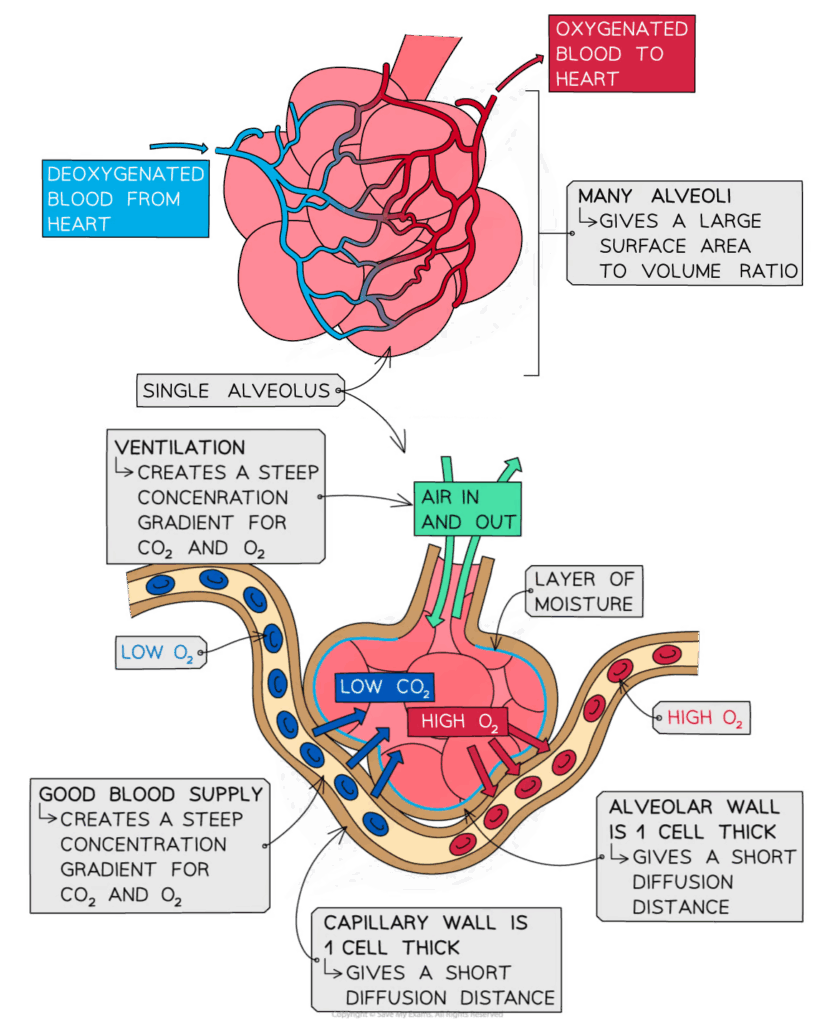
🧠 Examiner Tip: Avoid vague statements like “air goes in and out.” Always describe muscle movements, pressure changes, and resulting airflow direction.
📌 Gas Transport by Haemoglobin
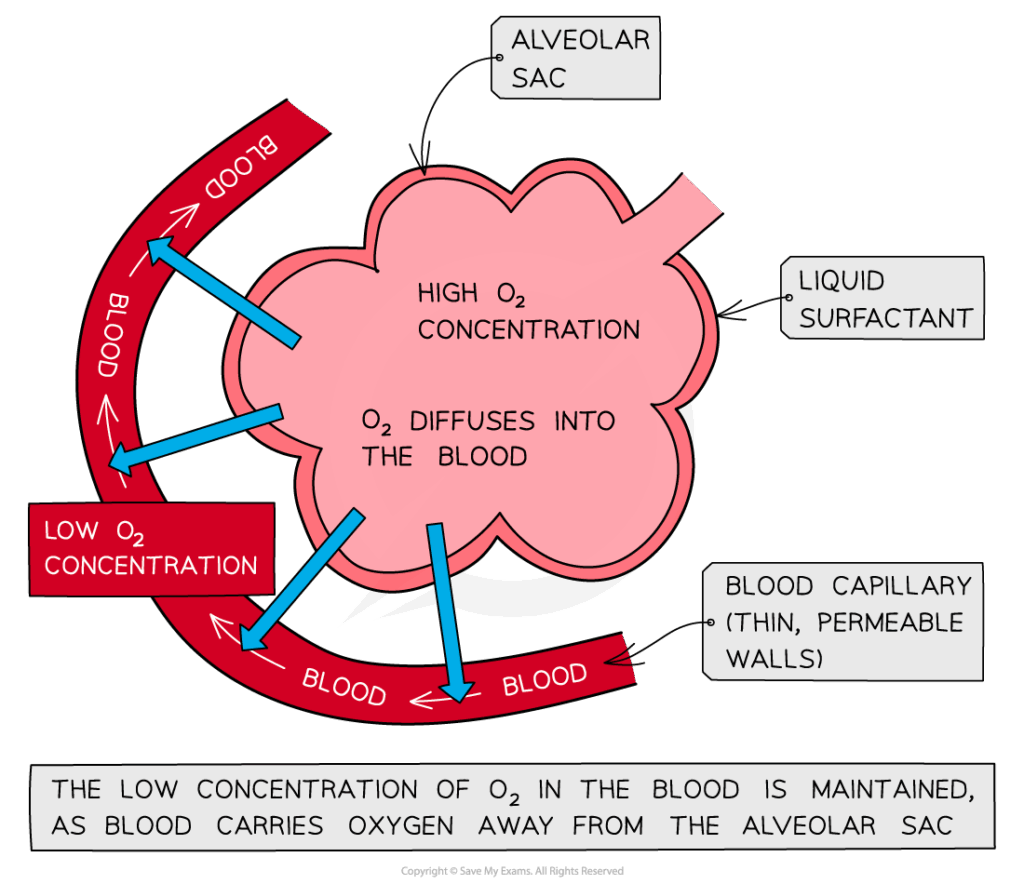
- Haemoglobin binds oxygen in the lungs (where oxygen partial pressure is high) and releases it in tissues (where oxygen partial pressure is low).
- The oxygen dissociation curve is sigmoidal (S-shaped) due to cooperative binding of oxygen to haemoglobin.
- The Bohr effect ensures more oxygen is released in actively respiring tissues where CO₂ and acidity are high.
- In some animals, haemoglobin is adapted for specific conditions (e.g., high affinity in llamas at altitude, or myoglobin in diving mammals).
🧬 IA Tips & Guidance: Students could model oxygen dissociation curves using computer simulations or data analysis tasks, comparing normal vs Bohr-shifted curves.
📌 Ventilation in Other Animals
- Fish use unidirectional ventilation by passing water over gills, maintaining a continuous concentration gradient.
- Birds have highly efficient ventilation with unidirectional airflow through parabronchi and air sacs, ensuring oxygen uptake even during exhalation.
- Insects use abdominal pumping to move air in and out of tracheae, increasing diffusion rates in active states.
🌐 EE Focus: An EE could analyse how different ventilatory mechanisms contribute to ecological success, e.g., why bird respiration allows sustained flight or why diving mammals have adapted haemoglobin/myoglobin properties.
📌 Carbon Dioxide Transport
- CO₂ is transported mainly as bicarbonate ions in plasma, catalysed by the enzyme carbonic anhydrase.
- Some CO₂ binds to haemoglobin to form carbaminohaemoglobin, while a small amount dissolves directly in plasma.
- Transport of CO₂ plays a key role in regulating blood pH.
❤️ CAS Link: Students could build interactive models showing how haemoglobin binds oxygen and how the dissociation curve shifts, presenting them in school workshops.
🌍 Real-World Connection: Disorders such as anaemia, emphysema, and high-altitude sickness all relate to gas transport or ventilation. Blood doping in sports manipulates haemoglobin concentration to increase oxygen delivery, linking biology to ethics in athletics.
📌 Integration of Ventilation and Transport
- Ventilation maintains gradients at the respiratory surface, while circulation and haemoglobin ensure delivery to tissues.
- This integrated system highlights how multiple organ systems work together for efficiency.
🔍 TOK Perspective: Hemoglobin’s oxygen dissociation curve is often presented as a simplified model, but real curves vary across species and conditions. This raises a TOK issue: to what extent do simplified models clarify biological principles versus masking complexity?