B2.3.3 -SPECIALISED CELLS AND THEIR ADAPTATIONS
📌Definition Table
| Term | Definition |
|---|---|
| Specialised cell | A cell that has developed specific structures to perform a defined role efficiently. |
| Adaptation | A structural, physiological, or biochemical feature that enables a cell to perform its function more effectively. |
| Neuron | A nerve cell specialised for transmitting electrical impulses across long distances. |
| Erythrocyte (red blood cell) | A cell specialised for oxygen transport via haemoglobin, adapted by lacking organelles. |
| Root hair cell | A plant cell specialised for absorption of water and minerals from soil. |
| Guard cell | A specialised plant cell that regulates gas exchange and water loss by controlling stomatal opening. |
📌Introduction
Specialised cells embody the principle that “form follows function.” Each has evolved structural and biochemical adaptations to optimise its role. For instance, neurons transmit impulses rapidly, while root hair cells maximise absorption. Studying specialised cells demonstrates how organisms achieve efficiency through cellular diversity.
📌 Animal Cell Adaptations
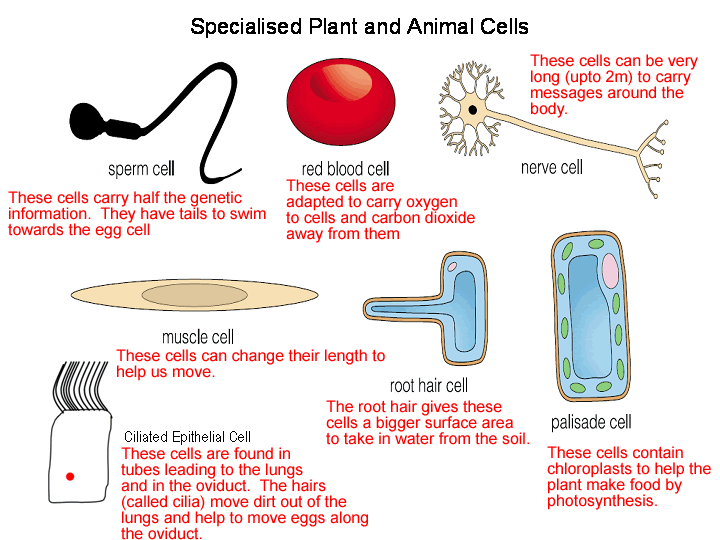
- Neurons are long and thin, often reaching over a metre in humans, which allows them to transmit impulses rapidly across long distances. Their axons are insulated by myelin sheaths that speed conduction. Synaptic terminals enable communication with multiple target cells.
- Erythrocytes (red blood cells) are biconcave discs, increasing surface area for gas exchange. They lack nuclei and most organelles, maximising haemoglobin content for oxygen transport. Their flexibility allows them to squeeze through narrow capillaries.
- Muscle cells are packed with mitochondria to provide ATP for contraction. They contain specialised contractile proteins (actin and myosin) arranged in sarcomeres.
- Sperm cells have flagella for motility, a midpiece full of mitochondria for energy, and an acrosome containing enzymes to penetrate the egg.
🧠 Examiner Tip: Always link structural features to function. For example, “red blood cells lack a nucleus” is not enough; you must add “which allows more haemoglobin to be packed inside, increasing oxygen transport.”
📌 Plant Cell Adaptations
- Root hair cells have elongated extensions that increase surface area for absorbing water and minerals. They contain many mitochondria to fuel active transport of minerals into the root.
- Guard cells have thickened inner walls and thin outer walls, enabling stomatal opening and closing. They contain chloroplasts to provide ATP for active ion pumping.
- Xylem vessels are elongated, dead cells with lignified walls that provide structural support and an efficient pathway for water transport.
- Phloem sieve tube elements lack nuclei and most organelles, allowing efficient transport of sugars, while companion cells maintain metabolic functions.
🧬 IA Tips & Guidance: Students could investigate how changing environmental conditions (e.g., light intensity) affects guard cell function, linking stomatal behaviour to cell adaptations. Microscopy studies of specialised cells in onion root tips or blood smears also make good practical extensions.
📌 Adaptations and Efficiency
- Specialised cells illustrate how efficiency results from form-function relationships: neurons optimise communication, erythrocytes optimise transport, and root hairs optimise absorption.
- This efficiency arises at the cost of flexibility; most specialised cells cannot divide and rely on stem cells for replacement.
🌐 EE Focus: An EE could compare adaptations of specialised cells across kingdoms, for instance, animal vs plant strategies for maximising surface area (neurons vs root hair cells). Another angle is investigating how structural defects in specialised cells (e.g., sickle cell anaemia in erythrocytes) lead to disease.
📌 Coordination and Dependence
- Specialised cells never function alone — tissues and organs depend on their coordination. For example, neurons, muscle cells, and epithelial cells must work together for movement.
- This interdependence highlights the cooperative nature of multicellularity.
❤️ CAS Link: Students could create microscope slide exhibitions of specialised cells, then present them to peers or younger students, linking microscopic features to everyday body and plant functions.
🌍 Real-World Connection: Many diseases result from failure of specialised cells. For instance, destruction of insulin-producing beta cells in the pancreas causes diabetes, while defective red blood cells cause anaemia. In agriculture, understanding guard cell behaviour aids in developing drought-resistant crops.
📌 Limits of Specialisation
- While specialisation allows high efficiency, it reduces regenerative capacity. For example, neurons rarely divide, making nerve damage difficult to repair.
- Evolution has balanced this limitation by retaining stem cells for tissue maintenance.
🔍 TOK Perspective: Specialised cells raise questions about reductionism versus holism. Looking at a single cell type explains its efficiency, but understanding life requires seeing how diverse cell types integrate into a functioning organism. This echoes TOK discussions of whether breaking systems into parts loses the essence of the whole.