B2.2.2 – ADAPTATIONS OF MITOCHONDRIA AND CHLOROPLASTS
📌Definition Table
| Term | Definition |
|---|---|
| Cristae | Folds of the inner mitochondrial membrane that increase surface area for electron transport and ATP synthesis. |
| Matrix | The fluid-filled compartment inside mitochondria containing enzymes, DNA, and ribosomes for respiration. |
| Thylakoids | Flattened membrane sacs in chloroplasts containing pigments and electron carriers for photosynthesis. |
| Stroma | The fluid matrix of chloroplasts containing enzymes for the Calvin cycle, DNA, and ribosomes. |
| Grana | Stacks of thylakoids that maximize light absorption for photosynthesis. |
📌Introduction
Mitochondria and chloroplasts are specialized double-membrane organelles central to energy transformations. Both show unique structural adaptations that maximize their efficiency in ATP production (mitochondria) and glucose synthesis (chloroplasts). Their compartmentalisation allows separation of biochemical pathways, ensuring rapid and controlled energy conversion.
📌 Adaptations of Mitochondria
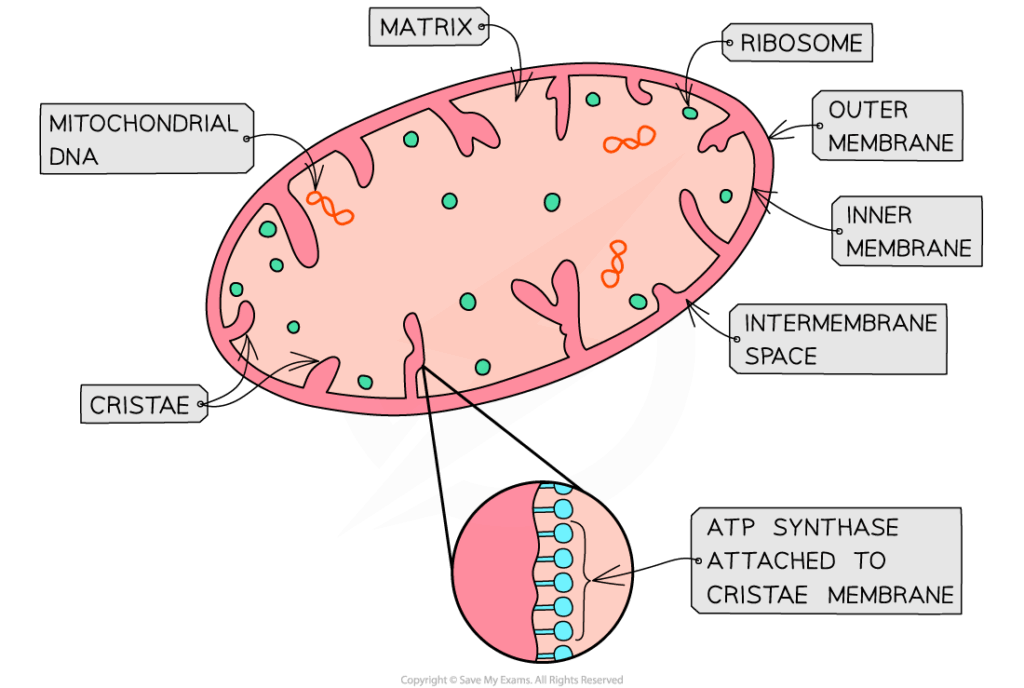
- Double membrane system: outer membrane is permeable, inner membrane folded into cristae for large surface area.
- Cristae host the electron transport chain and ATP synthase.
- Intermembrane space enables proton accumulation, maintaining a steep gradient essential for oxidative phosphorylation.
- The matrix contains ribosomes, circular DNA, and enzymes for the Krebs cycle.
- Compartmentalisation ensures efficient sequencing of respiration (glycolysis → Krebs cycle → oxidative phosphorylation).
- Active cells (e.g., muscle cells) have more mitochondria with longer, densely packed cristae for higher ATP yield.
🧠 Examiner Tip: Don’t just state “cristae increase surface area.” Always link structure to function: more surface area = more electron carriers + ATP synthase = more ATP production.
📌 Adaptations of Chloroplasts

- Double membrane envelope with transport proteins regulates molecule movement.
- Thylakoid membranes house photosystems, pigments, and electron carriers for the light-dependent stage.
- Grana stacks maximise surface area for light capture and electron flow.
- Thylakoid space has very small volume, enabling rapid proton gradient formation.
- Stroma contains Calvin cycle enzymes, ribosomes, and DNA, supporting protein synthesis for photosynthesis.
- Photosystems funnel light energy efficiently to reaction centres.
🧬 IA Tips & Guidance: A practical extension could be comparing oxygen consumption in isolated mitochondria versus starch production in isolated chloroplasts. Such experiments connect organelle structure with measurable activity.
📌 Relationship Between Structure and Function
- Mitochondria: cristae and proton gradients maximise ATP yield.
- Chloroplasts: grana and thylakoids maximise light capture and carbohydrate synthesis.
- Both are semi-autonomous, with DNA and ribosomes, supporting endosymbiotic theory.
🌐 EE Focus: An EE could investigate how chloroplast structures differ between sun and shade plants, or compare mitochondrial density in muscle versus fat tissue, linking structure to metabolic demand.
📌 Semi-Autonomy and Evolutionary Significance
- Contain circular DNA and ribosomes → can produce some proteins independently.
- Evidence for endosymbiotic origin from free-living prokaryotes.
- Enhances efficiency and adaptability of energy conversion.
❤️ CAS Link: Students could build 3D organelle models with removable sections (cristae, grana, stroma) and use them to teach younger students about energy conversion.
🌍 Real-World Connection: Mitochondrial disorders (e.g., myopathies) result from ATP production failures. In agriculture, chloroplast adaptations are engineered to improve photosynthesis and crop yield.
📌 Integration in Energy Conversion
- Mitochondria and chloroplasts are interconnected in energy flow.
- ATP from mitochondria powers biosynthesis, while sugars from chloroplasts fuel respiration.
- Demonstrates how compartmentalisation supports cooperation between organelles.
🔍 TOK Perspective: Focusing on organelles separately is reductionist, but energy efficiency emerges holistically from their integration in the cell. This raises TOK questions on reductionism vs holism in science.