B2.2.3 – PROTEIN SYNTHESIS AND VESICLE FORMATION
📌Definition Table
| Term | Definition |
|---|---|
| Ribosome | A molecular machine composed of rRNA and proteins that synthesises polypeptides by translating mRNA. |
| Rough Endoplasmic Reticulum (RER) | A network of membranes studded with ribosomes, where proteins destined for secretion or membranes are synthesised. |
| Signal sequence | A short amino acid sequence that directs ribosomes to the RER for protein targeting. |
| Golgi apparatus | An organelle of stacked cisternae that modifies, sorts, and packages proteins into vesicles. |
| Vesicle | A small membrane-bound sac that transports proteins and other molecules within or out of the cell. |
| Clathrin | A protein that coats vesicles during formation, helping them bud from membranes. |
📌Introduction
Protein synthesis and vesicle formation represent one of the most coordinated examples of organelle interaction in eukaryotic cells. Proteins are first produced by ribosomes, either free in the cytoplasm or bound to the rough endoplasmic reticulum. Those intended for secretion, lysosomes, or membranes follow a pathway involving the RER, Golgi apparatus, and vesicular transport. Vesicles act as carriers, moving proteins safely and efficiently through the cytoplasm, ensuring that they reach their correct destination. This system demonstrates compartmentalisation, precision, and regulation, all of which are vital for maintaining cell function.
📌 Ribosomes and Protein Synthesis
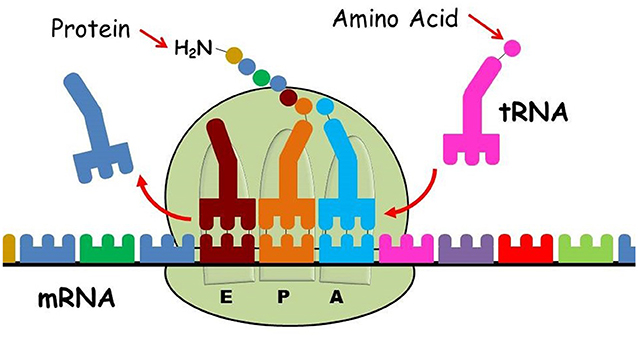
- Ribosomes consist of a large and a small subunit, composed of rRNA and protein, which together form the site of translation. They read mRNA codons and assemble amino acids into a polypeptide chain through peptide bond formation.
- Free ribosomes float in the cytoplasm and primarily synthesise proteins for use inside the cell, such as enzymes in glycolysis or proteins destined for mitochondria and chloroplasts.
- Bound ribosomes attach to the RER when the polypeptide being synthesised begins with a signal sequence. This sequence directs the ribosome to a receptor on the ER membrane.
- Once bound to the RER, the ribosome continues translation, and the growing polypeptide chain is threaded into the lumen of the ER, where it may fold and undergo initial modifications.
- This distinction between free and bound ribosomes reflects compartmentalisation of protein targeting: cytoplasmic use vs secretion or membrane insertion.
🧠 Examiner Tip: When asked about ribosomes, do not just state “they make proteins.” Specify whether they are free or bound, and always mention the fate of their proteins — cytoplasmic use or export/lysosomal pathway.
📌 Role of the Rough ER and Golgi Apparatus
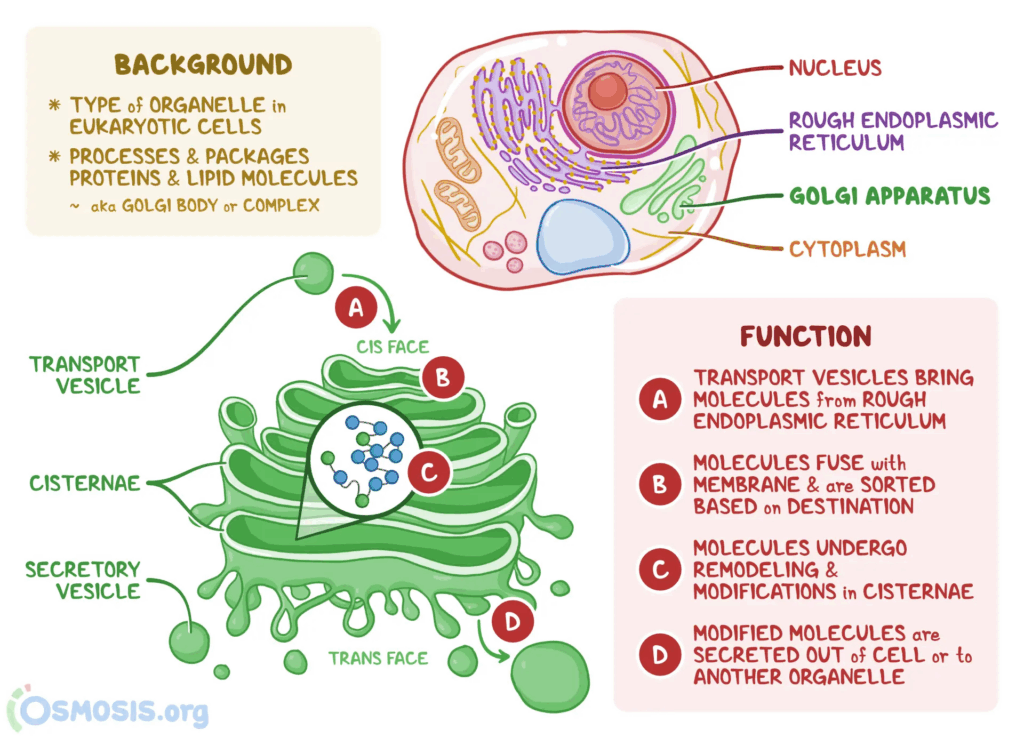
- The rough ER provides a surface for ribosome attachment and a lumen where proteins destined for export or membranes enter for folding and modification.
- Proteins in the RER often undergo glycosylation (addition of carbohydrate groups) or folding with the help of chaperone proteins.
- From the RER, proteins are packaged into transport vesicles which bud off and travel to the Golgi apparatus.
- The Golgi consists of flattened sacs called cisternae with a “cis” face (receiving side from RER) and a “trans” face (exporting side).
- As proteins move through the Golgi, they undergo further modifications such as glycosylation, sulfation, or phosphorylation. This ensures that proteins are functional and correctly tagged for their destination.
- Finally, proteins are sorted into vesicles that deliver them to the plasma membrane, lysosomes, or secretory pathways.
🧬 IA Tips & Guidance: Students could design investigations using fluorescent protein tagging to track protein movement from ER to Golgi to vesicles. Another practical link is studying enzyme secretion (e.g., amylase) and relating secretion rates to protein synthesis pathways.
📌 Vesicle Formation and Transport
- Vesicles are small, membrane-bound sacs that transport proteins and other macromolecules between organelles or out of the cell.
- Formation begins with a patch of membrane coated with clathrin proteins, which help bend the membrane into a pit.
- Receptor proteins on the membrane bind specific cargo molecules, ensuring that vesicles carry only intended contents.
- Cytoskeletal elements such as actin filaments and microtubules assist in pinching off the vesicle and guiding it to its destination.
- Vesicles then travel along cytoskeletal tracks using motor proteins like kinesin or dynein, ensuring directed movement.
- Upon reaching their target, vesicles recognise the correct membrane via “SNARE” proteins and fuse, releasing their contents.
🌐 EE Focus: An EE could explore how vesicle trafficking contributes to diseases such as Alzheimer’s (linked to protein misfolding and mis-targeting) or study how clathrin-mediated endocytosis varies under different experimental conditions. Another angle could investigate the efficiency of protein secretion in plant vs animal cells.
📌 Integration of Protein Synthesis and Vesicle Pathways
- The protein pathway demonstrates a coordinated system: DNA → mRNA → ribosome translation → ER modification → Golgi sorting → vesicular transport → final destination.
- This integration shows how organelles are not isolated but form part of a continuous assembly line, where mistakes at one step (e.g., misfolding in ER) affect the entire chain.
- Vesicles ensure that proteins remain protected within membranes and are not exposed to cytoplasmic enzymes that could degrade them.
- Together, protein synthesis and vesicle formation represent one of the clearest examples of structure and function working in harmony within a cell.
❤️ CAS Link: A CAS project could involve students making an animation or interactive “factory model” showing ribosomes as workers, ER as assembly lines, Golgi as packaging centres, and vesicles as delivery trucks. Presenting this model in a school outreach program would help simplify complex cellular processes for a wider audience.
🌍 Real-World Connection: Many diseases are linked to defects in protein synthesis or vesicle trafficking. For example, cystic fibrosis results from misfolded CFTR proteins not reaching the plasma membrane, while lysosomal storage diseases occur when vesicles fail to deliver enzymes properly. In biotechnology, harnessing vesicle pathways is essential for producing and exporting recombinant proteins like insulin.
📌 Specialisation and Regulation
- Protein synthesis and vesicle trafficking are highly regulated processes, ensuring that proteins are only made when required and are delivered precisely where needed.
- Signal sequences and molecular tags (like glycosylation patterns) act as cellular “addresses,” directing proteins to the right location.
- Vesicle formation is energy-dependent, requiring ATP and GTP hydrolysis, which ensures that transport is tightly controlled and unidirectional.
- This precise regulation highlights the efficiency and adaptability of eukaryotic cells, which can rapidly increase secretion in response to signals (e.g., hormone release).
🔍 TOK Perspective: The pathway of protein synthesis and vesicle trafficking is often taught as a linear model, but in reality, it is highly dynamic, with multiple feedback loops and redundancies. This raises a TOK question: to what extent do simplified models help learning, and when do they risk obscuring the true complexity of biological systems?