B4.2.1 – FUNDAMENTALS OF ECOLOGICAL NICHES
📌Definition Table
| Term | Definition |
|---|---|
| Ecological niche | The role and position a species has in its environment, including its use of resources, interactions, and contribution to energy flow. |
| Habitat | The physical location where an organism lives; distinct from its niche. |
| Fundamental niche | The full range of environmental conditions under which a species can survive and reproduce. |
| Realised niche | The actual niche occupied, limited by competition, predation, and other biotic factors. |
| Specialist species | Species with narrow niches, adapted to very specific environmental conditions. |
| Generalist species | Species with broad niches, capable of surviving in varied conditions and using diverse resources. |
📌Introduction
The concept of a niche is central to ecology, as it defines not only where a species lives but also how it interacts with its environment. Unlike a habitat, which is purely spatial, a niche includes feeding habits, behavioural patterns, and relationships with other organisms. Niches prevent species from directly overlapping in resource use, thereby structuring communities. Understanding niches allows ecologists to explain biodiversity, predict species distributions, and assess the impact of environmental changes.
📌 Defining Niches and Their Components
- A niche integrates abiotic factors (temperature, salinity, pH, oxygen) with biotic interactions (competition, predation, symbiosis).
- Feeding niches include diet specialisation, feeding times, and foraging methods (e.g., nocturnal vs diurnal predators).
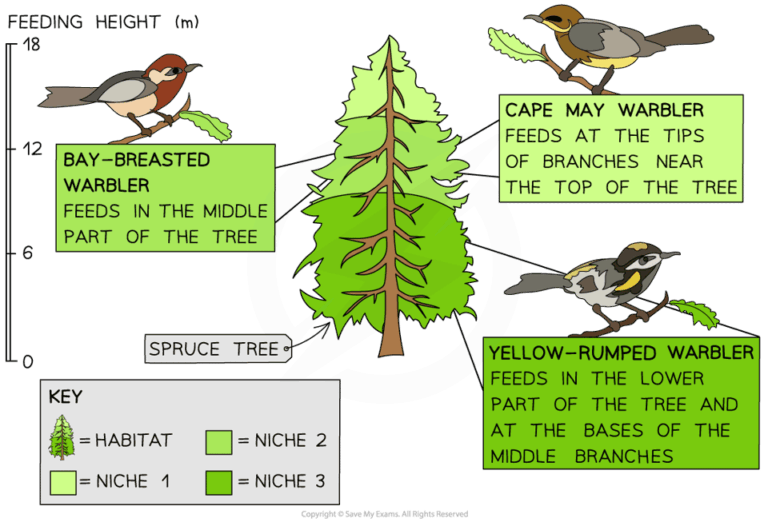
- Spatial niches describe where organisms forage or reproduce — e.g., canopy birds vs understory birds.
- Temporal niches reduce competition by shifting activity times — e.g., desert rodents active at night.
- Uniqueness of niches underlies the competitive exclusion principle: no two species can indefinitely occupy the same niche.
🧠 Examiner Tip: Avoid simply equating “niche = habitat.” Always stress role + function + interactions. Diagrams contrasting habitat vs niche are common assessment tools.
📌 Fundamental vs Realised Niches
- The fundamental niche is the theoretical range of conditions under which a species can survive.
- The realised niche is narrower, reflecting limits imposed by competition, predation, or symbiosis.
- Example: Barnacle species — Chthamalus can survive lower shore zones but is excluded by Balanus competition.
- Realised niches may expand if competitors are removed (competitive release).
- Niche compression occurs in ecosystems with high biodiversity, forcing narrower roles.
🧬 IA Tips & Guidance: Practicals can involve observing species distribution in transects (e.g., barnacles along a shore gradient) and inferring fundamental vs realised niches.
📌 Specialists vs Generalists
- Specialists (e.g., koalas, which eat only eucalyptus) are highly efficient in stable conditions but vulnerable to environmental change.
- Generalists (e.g., rats, cockroaches) survive across varied habitats due to dietary and behavioural flexibility.
- The balance between specialists and generalists explains why some species thrive in disturbed ecosystems while others decline.
- Specialists often occupy narrow ecological roles that reduce direct competition.
- Evolution may shift species along the specialist-generalist continuum depending on environmental pressures.
🌐 EE Focus: An EE could examine whether specialists or generalists are more successful under climate change, using case studies of invasive vs endemic species.
📌 Abiotic and Biotic Constraints on Niches
- Abiotic constraints: temperature tolerance, salinity, moisture, oxygen levels.
- Biotic constraints: competition for food, predator pressure, mutualistic partners.
- Keystone species shape the niches of others by altering resource availability.
- Disturbances (fires, storms, human activity) reset niche availability and open opportunities for colonisers.
- Human introduction of invasive species disrupts native niche structures.
❤️ CAS Link: Students could design an awareness campaign about invasive species in their local area, showing how they disrupt native niches.
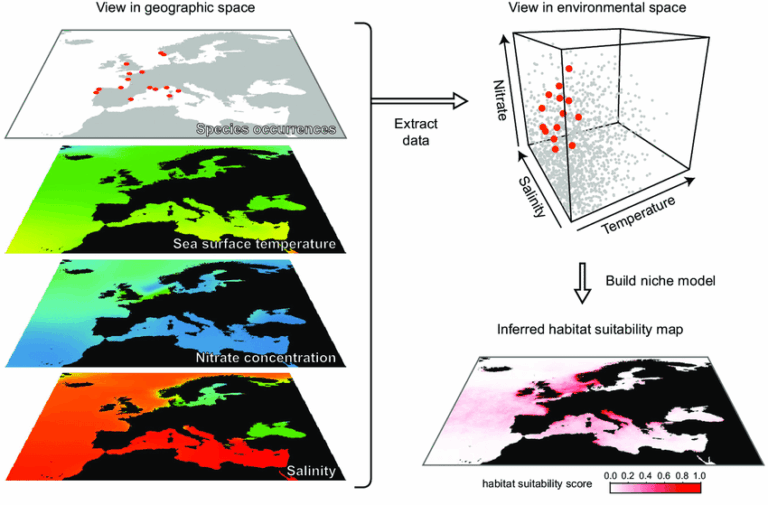
🌍 Real-World Connection: Habitat fragmentation narrows niches, often pushing species to extinction. Conservation biologists must understand niche requirements to design reserves and corridors.
📌 Niches in Community Structure
- Niches structure communities by distributing species across resource gradients.
- Greater niche diversity often correlates with greater biodiversity.
- Overlap between niches may result in competition unless partitioned.
- Mutualisms (pollinators and flowers) create interdependent niche networks.
- Energy flow in ecosystems is structured by trophic niches (producer, consumer, decomposer).
🔍 TOK Perspective: Niches are conceptual models. TOK issue: Are niches “real entities” or human constructs to simplify complex ecological interactions?