B1.2.3 – SPECIALISED PROTEINS AND FUNCTIONAL SIGNIFICANCE
📌Definition Table
| Term | Definition |
|---|---|
| Enzyme | A biological catalyst, usually a globular protein, that speeds up reactions by lowering activation energy. |
| Hormone | A signaling molecule, often protein-based (e.g., insulin), that regulates physiological processes. |
| Antibody | A protein (immunoglobulin) produced by B cells that binds specifically to antigens to defend against pathogens. |
| Hemoglobin | A transport protein in red blood cells that binds and carries oxygen. |
| Collagen | A fibrous protein forming connective tissue, providing strength and elasticity. |
| Motor protein | Protein such as actin or myosin that produces movement within cells or tissues. |
📌Introduction

While all proteins share the same fundamental building blocks, their folding, interactions, and specializations give rise to functions as diverse as catalysis, transport, defense, and movement. Specialized proteins are finely tuned to perform particular biological roles essential for survival. From enzymes that sustain metabolism to antibodies that protect against infection, the diversity of protein function illustrates the central role proteins play in all forms of life.
📌 Enzymes as Specialized Proteins
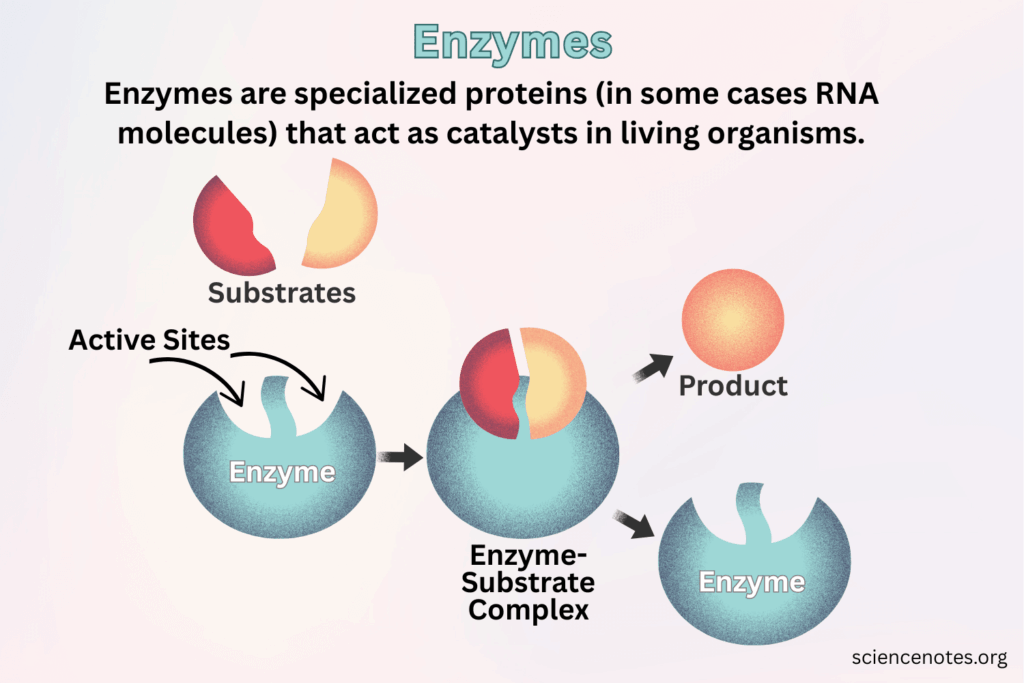
- Enzymes are highly specific globular proteins that accelerate metabolic reactions by lowering the activation energy required.
- The active site of an enzyme is complementary in shape to its substrate, ensuring specificity. Substrate binding often involves hydrogen bonds, ionic bonds, and hydrophobic interactions.
- Enzymes work under mild conditions of temperature and pH, making them ideal for biological processes.
- Examples include catalase (decomposes hydrogen peroxide), amylase (breaks down starch), and DNA polymerase (synthesizes DNA).
- Enzyme activity is regulated by inhibitors, activators, and environmental conditions, reflecting the need for precise cellular control.
🧠 Examiner Tip: When describing enzyme function, always connect structure to specificity — the shape of the active site determines which substrate is bound and what reaction occurs. Avoid vague statements like “enzymes speed up reactions” without mechanistic explanation.
📌 Transport and Regulatory Proteins
- Hemoglobin is a globular protein with four polypeptide subunits, each containing a heme group with an iron atom that binds oxygen. Its quaternary structure allows cooperative binding, enabling efficient oxygen uptake and release.
- Insulin is a protein hormone secreted by the pancreas that regulates blood glucose by promoting uptake into cells and stimulating glycogen synthesis. Deficiency or resistance leads to diabetes mellitus.
- Membrane proteins act as channels, pumps, and receptors, controlling what enters and exits cells, ensuring homeostasis.
🧬 IA Tips & Guidance: Practical investigations could involve testing enzyme activity at different temperatures or pH levels. More advanced projects could model hemoglobin’s oxygen dissociation curve or simulate the effect of enzyme inhibitors.
📌 Defense Proteins
- Antibodies (immunoglobulins) are Y-shaped proteins produced by B cells, each with highly variable regions that specifically bind to unique antigens.
- They neutralize pathogens by marking them for destruction, blocking toxins, or activating complement proteins.
- Their enormous diversity arises from rearrangements in DNA, allowing the immune system to recognize millions of potential antigens.
- Specialized defense proteins highlight the adaptability of protein structure to external challenges.
🌐 EE Focus: An EE could examine how structural differences in antibodies influence antigen binding, or how protein engineering is used to design therapeutic antibodies for cancer and infectious diseases.
📌 Structural and Motor Proteins
- Collagen is a fibrous protein forming triple-helical fibers with enormous tensile strength, making it critical in connective tissue, tendons, skin, and cartilage.
- Keratin provides mechanical strength in hair, nails, and feathers, protecting organisms from physical damage.
- Actin and myosin are motor proteins that interact to generate muscle contraction and enable movement at both cellular and organismal levels.
- Specialized structural proteins ensure that organisms maintain form, mobility, and resilience.
❤️ CAS Link: Students could design a fitness and health awareness project explaining the roles of proteins in muscle function and nutrition, highlighting how exercise and diet influence protein needs.
🌍 Real-World Connection: Specialized proteins are at the heart of medicine and biotechnology. Insulin is produced by genetically modified bacteria to treat diabetes. Monoclonal antibodies are engineered to target cancer cells. Structural proteins like collagen are used in wound healing and tissue engineering. Enzymes are applied in industry for food processing, detergents, and biofuel production.
📌 Functional Significance of Protein Diversity
- Proteins carry out most essential life processes, from catalysis and transport to immunity and movement.
- Their diversity is a direct result of amino acid sequence variation, folding patterns, and the ability to form complex quaternary structures.
- Specialized proteins illustrate how a single class of biomolecules can be adapted to virtually every role in biology, underpinning the complexity and adaptability of life.
🔍 TOK Perspective: Specialized proteins raise questions about the relationship between structure and function. TOK reflection: If protein structure determines function, to what extent can we predict function from structure alone, and how does uncertainty shape our scientific knowledge?