A3.1.2 – DOMAINS AND KINGDOMS OF LIFE
📌Definition Table
| Term | Definition |
|---|---|
| Domain | The highest taxonomic rank, grouping all life into broad categories based on fundamental genetic and cellular differences. |
| Archaea | Domain of prokaryotic organisms distinct from bacteria, often living in extreme environments. |
| Bacteria | Domain of prokaryotic organisms with diverse metabolisms, including many important in ecology and medicine. |
| Eukarya | Domain containing all organisms with eukaryotic cells (nucleus and membrane-bound organelles). |
| Kingdom | Taxonomic level below domain, grouping organisms with shared fundamental characteristics. |
📌Introduction
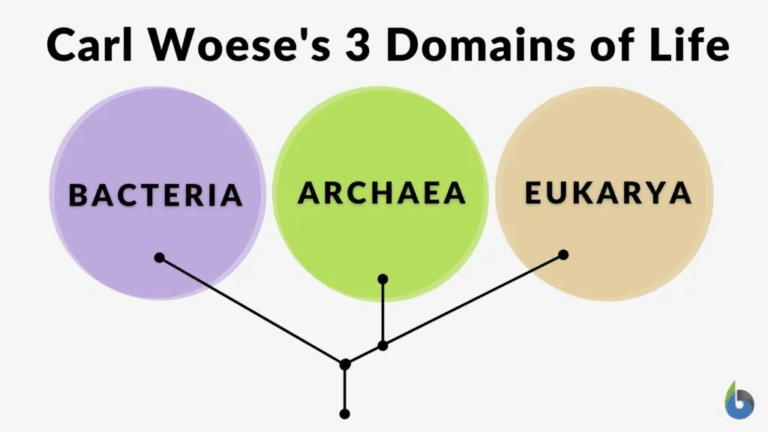
The classification of life into domains and kingdoms reflects the deepest evolutionary divisions among organisms. The three-domain system — Bacteria, Archaea, and Eukarya — is based on molecular and genetic evidence, particularly ribosomal RNA sequences. Within each domain, organisms are further divided into kingdoms, reflecting key structural, metabolic, and evolutionary traits. This system captures both ancient divergences in life’s history and the diversity of forms and functions that have evolved since.
📌 The Three Domains
- Bacteria: Prokaryotes with peptidoglycan cell walls, circular DNA, and diverse metabolisms. Examples: Escherichia coli, Streptococcus.
- Archaea: Prokaryotes lacking peptidoglycan, often extremophiles (thermophiles, halophiles, methanogens). Unique membrane lipids and gene expression mechanisms.
- Eukarya: All organisms with eukaryotic cells, including protists, fungi, plants, and animals.
- Domain differences are supported by rRNA sequence comparisons and molecular biology evidence.
- Domains represent the most ancient evolutionary splits, over 3 billion years ago.
- Archaea and Eukarya share more recent common ancestry than either does with Bacteria.
🧠 Examiner Tip: In domain comparisons, always mention cell wall composition, ribosome type, and rRNA sequence differences.
📌 Kingdoms within Domains
- Domain Bacteria: Often grouped into one kingdom (Eubacteria).
- Domain Archaea: Often grouped into one kingdom (Archaebacteria).
- Domain Eukarya: Contains multiple kingdoms:
- Protista: Mostly unicellular eukaryotes, diverse in form and nutrition.
- Fungi: Multicellular or unicellular heterotrophs with chitin cell walls.
- Plantae: Multicellular autotrophs with cellulose cell walls, photosynthetic.
- Animalia: Multicellular heterotrophs without cell walls, complex body plans.
- Modern research suggests Protista is paraphyletic, with groups reclassified based on molecular data.
- Kingdom classification can vary depending on system used (e.g., 5-, 6-, or more kingdoms).
🧬 IA Tips & Guidance: A possible IA could investigate environmental conditions affecting growth rates of representative organisms from different domains.
📌 Characteristics of Domains and Kingdoms
- Bacteria: Binary fission reproduction, 70S ribosomes, sensitive to traditional antibiotics.
- Archaea: Resistant to most antibiotics, unique lipid monolayers in membranes, ability to survive extreme conditions.
- Eukarya: Mitotic and meiotic cell division, 80S ribosomes in cytoplasm, membrane-bound organelles.
- Fungi: Absorptive nutrition, decomposers, important in symbiosis (mycorrhizae).
- Plantae: Photosynthetic autotrophs, alternation of generations life cycle.
- Animalia: Nervous and muscular systems for rapid response and movement.
🌐 EE Focus: An EE could compare molecular phylogenies of organisms from different domains to test evolutionary relationships suggested by rRNA evidence.
📌 Evolutionary Basis of Domains
- Carl Woese introduced the three-domain system in the late 20th century.
- Based on sequencing of the 16S and 18S rRNA genes.
- Revealed Archaea are genetically closer to Eukarya than to Bacteria.
- Supports the idea of a universal common ancestor.
- Highlights the importance of molecular data in reshaping classification.
- Suggests early life experienced horizontal gene transfer, complicating lineage tracing.
❤️ CAS Link: A CAS activity could involve creating an illustrated timeline of the evolutionary emergence of
🌍 Real-World Connection:
Domain and kingdom classification helps scientists track emerging diseases, identify extremophiles for biotechnology, and guide conservation of biodiversity.
📌 Applications of Domain and Kingdom Classification
- Medical: distinguishing between bacterial and archaeal pathogens for correct treatment.
- Environmental: identifying microbial communities in extreme environments.
- Evolutionary research: tracing the origin of complex cellular features.
- Conservation: cataloguing biodiversity for protection.
- Biotechnology: selecting species with useful enzymes (e.g., thermostable DNA polymerase from Thermus aquaticus in Archaea).
- Education: simplifying biological diversity into a teachable structure.
🔍 TOK Perspective: The division of life into domains shows how advances in technology (DNA sequencing) can reshape scientific classification systems and challenge traditional frameworks.