A2.3.3 – ORIGIN AND EVOLUTION OF VIRUSES
📌Definition Table
| Term | Definition |
|---|---|
| Virus Origin Hypotheses | Theories explaining how viruses first appeared, including progressive, regressive, and coevolution hypotheses. |
| Progressive Hypothesis | Suggests viruses evolved from mobile genetic elements (e.g., plasmids, transposons) that gained the ability to move between cells. |
| Regressive Hypothesis | Proposes viruses evolved from more complex parasitic cells that lost genes over time, becoming dependent on hosts. |
| Coevolution Hypothesis | Suggests viruses evolved alongside the first cellular life forms from self-replicating molecules. |
| Viral Quasispecies | A group of viruses with related but genetically varied genomes, arising from high mutation rates, especially in RNA viruses. |
📌Introduction
The origin of viruses remains a subject of debate, as they leave no fossil record and their nature blurs the boundary between living and non-living entities. Several hypotheses attempt to explain their emergence, including evolution from mobile genetic elements (progressive), degeneration from more complex ancestors (regressive), or coevolution with the earliest life forms. Viruses have been present for billions of years, evolving alongside their hosts, influencing genetic diversity, and playing significant roles in ecosystems. Their rapid mutation rates and capacity for horizontal gene transfer make them key drivers of evolution.
📌 Progressive Hypothesis
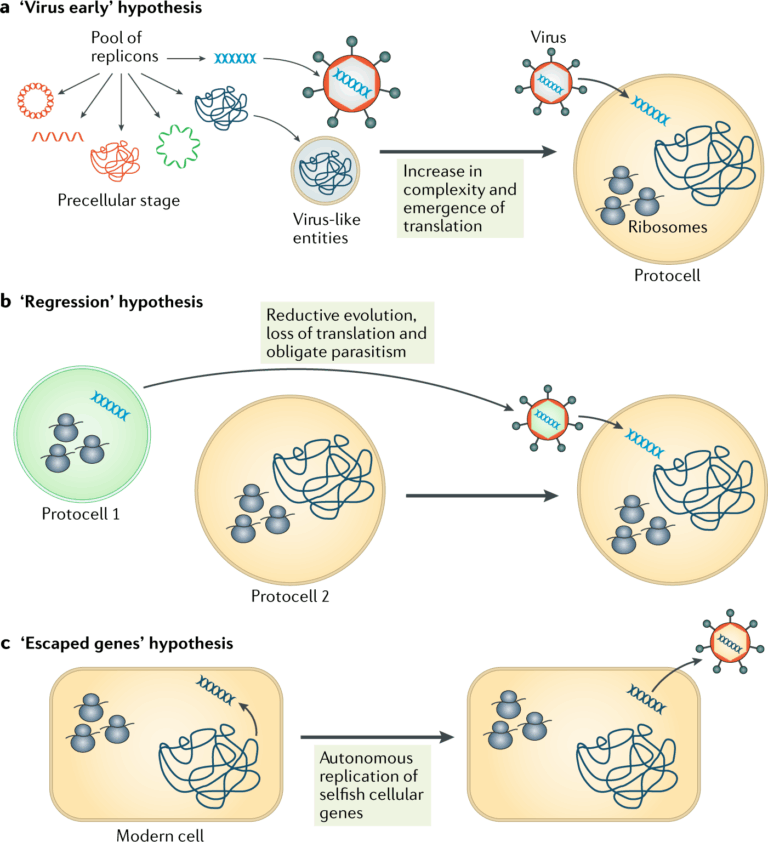
- Viruses originated from fragments of cellular genetic material, such as plasmids or transposons.
- These mobile genetic elements gained the ability to exit one cell and enter another, possibly via protein coats.
- Explains similarities between some viral genes and host cell genes.
- Supported by the existence of retrotransposons, which share mechanisms with retroviruses.
- Suggests viruses are derived from their hosts, not ancient life forms.
- Fits well with RNA viruses, which may have arisen from RNA-based replicators in early cells.
🧠 Examiner Tip: If asked to compare hypotheses, always mention supporting evidence and key limitations — IB rewards balanced evaluation.
📌 Regressive Hypothesis
- Proposes that viruses were once free-living, parasitic cells that lost genes over time.
- As dependence on hosts increased, unnecessary genes for metabolism and independent survival were discarded.
- Explains large DNA viruses like mimiviruses, which have genes similar to cellular organisms.
- Suggests a continuum between viruses and intracellular parasites.
- Limited by lack of direct fossil or molecular evidence.
- Implies multiple independent origins for different virus groups.
🧬 IA Tips & Guidance: A literature-based IA could compare genomic features of giant viruses and parasitic bacteria to investigate gene loss patterns.
📌 Coevolution Hypothesis
- Suggests viruses arose from self-replicating molecules in the pre-cellular “RNA world.”
- Viruses and cells may have evolved together, influencing each other’s development.
- Implies viruses are as ancient as life itself.
- Supported by similarities between some viral enzymes and those in ancient cellular lineages.
- Could explain unique viral proteins with no known cellular counterpart.
- Suggests an ancient role for viruses in shaping genetic systems.
🌐 EE Focus: An EE could explore whether coevolutionary evidence supports a universal viral ancestor or multiple independent origins.
📌 Viral Evolutionary Dynamics
- RNA viruses evolve rapidly due to high mutation rates.
- Genetic recombination between viruses and hosts occurs frequently.
- Viruses can acquire host genes, influencing host evolution.
- Viral quasispecies ensure adaptability to changing environments.
- Coevolutionary “arms races” occur between viruses and host immune systems.
- Some viral sequences have been incorporated into host genomes (endogenous retroviruses).
❤️ CAS Link: A CAS project could involve creating an educational documentary explaining how viruses shape biodiversity and evolution.
🌍 Real-World Connection:
Understanding viral origins informs pandemic preparedness by helping predict potential emergence of new viral diseases from animal reservoirs.
📌 Evidence and Challenges
- No direct fossil record, but viral structures can be inferred from molecular data.
- Ancient viral DNA found integrated into host genomes offers evolutionary clues.
- Comparative genomics reveals relationships between viral and cellular genes.
- Lack of universal viral genes makes determining a single origin difficult.
- Likely that different virus families have different evolutionary pathways.
- Studying viruses from extreme environments may reveal ancient features.
🔍 TOK Perspective: The debate over viral origins highlights how different interpretations of the same evidence can lead to competing theories in science.