A2.1.2 – EVOLUTION OF CELLS
📌Definition Table
| Term | Definition |
|---|---|
| Protocell | A primitive, membrane-bound droplet capable of basic metabolic processes but lacking fully evolved genetic systems. |
| RNA World Hypothesis | Theory that early life used RNA as both genetic material and catalyst before DNA and proteins evolved. |
| Vesicle | Small membrane-bound compartment formed spontaneously from amphipathic molecules. |
| Amphipathic Molecule | A molecule with both hydrophilic and hydrophobic regions, enabling membrane formation. |
| Metabolism-First Theory | Hypothesis that self-sustaining chemical reaction networks arose before genetic material. |
| Gene-First Theory | Hypothesis that self-replicating nucleic acids appeared before metabolic systems and membranes. |
📌Introduction
The origin of the first cells marks a pivotal transition from non-living chemistry to biological systems. Early Earth provided an environment where organic molecules could assemble into protocells—structures capable of growth, division, and primitive heredity. These protocells eventually evolved into true cells with DNA genomes, protein enzymes, and phospholipid membranes, setting the stage for all modern life.
📌 Key Stages in the Origin of Cells
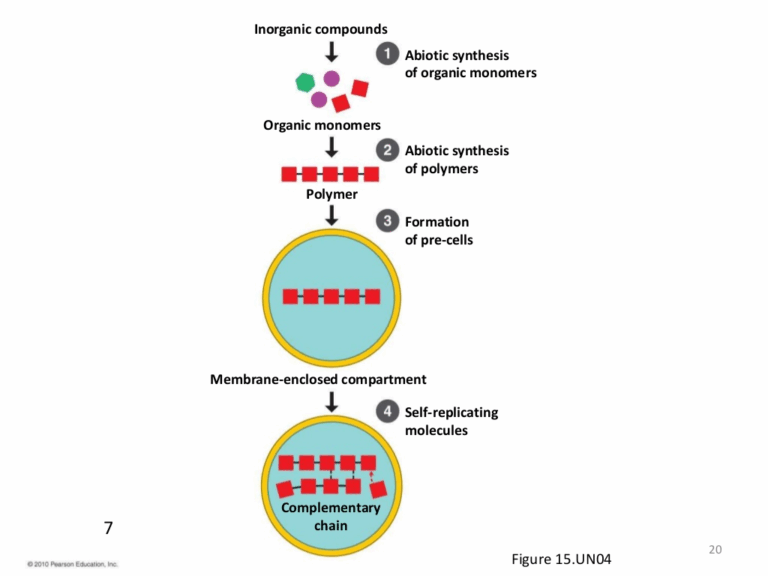
- Abiotic synthesis of small organic molecules under early Earth conditions, facilitated by energy sources like UV light, lightning, and volcanic heat.
- Polymerisation of monomers into macromolecules such as proteins and nucleic acids, often aided by mineral catalysts.
- Emergence of self-replicating RNA molecules that could store information and catalyse reactions.
- Spontaneous formation of fatty-acid membranes enclosing a microenvironment distinct from the surroundings.
- Evolution of metabolic networks within protocells, allowing sustained energy use and molecular turnover.
- Transition to DNA as the primary genetic material due to its stability and to proteins for catalysis due to their versatility.
🧠 Examiner Tip:
Be able to state the four key requirements for life’s origin: abiotic synthesis of organic molecules, polymerisation into macromolecules, self-replication, and membrane formation.
📌 Theories for the Origin of Cells
- Protocell-first: Membrane-bound droplets capable of metabolism arose before genetic material; genetic systems evolved later.
- Gene-first: Self-replicating RNA molecules emerged first, followed by membranes and metabolism.
- Metabolism-first: Life began as self-sustaining chemical cycles that later incorporated genetic material.
- All three require energy sources such as UV light, hydrothermal heat, or chemical gradients.
- Each theory attempts to explain how self-replication, metabolism, and compartmentalisation originated.
- None can yet be proven, but they can be partially tested with lab simulations.
🧬 IA Tips & Guidance: If modelling protocell formation, focus on controlling pH, lipid composition, and salt concentration to replicate realistic prebiotic environments.
📌 Membrane Formation (Vesicles)
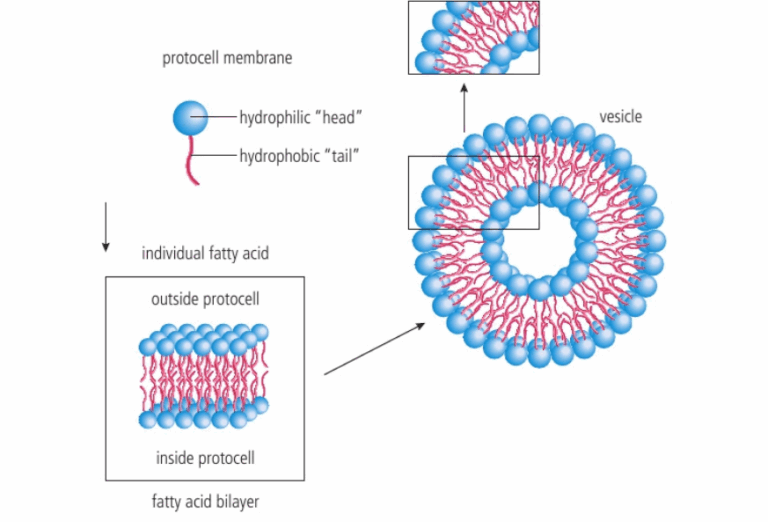
- Fatty acids naturally form monolayers and bilayers in water due to their amphipathic nature.
- Bilayers can spontaneously curve into vesicles, creating enclosed compartments.
- Early vesicles likely trapped RNA, proteins, or metabolic molecules inside.
- Over time, fatty acids may have been replaced by phospholipids for greater stability.
- Compartmentalisation allowed different reactions to occur without interference.
- This was a critical evolutionary step toward complex cells.
🌐 EE Focus: A possible EE could compare stability and permeability of fatty acid vs phospholipid vesicles under simulated hydrothermal vent conditions.
📌 RNA as First Genetic Material
- RNA can both store genetic information and catalyse chemical reactions (ribozymes).
- It can form spontaneously from nucleotides under certain conditions.
- Ribozymes in modern cells support the idea that RNA had catalytic roles before proteins.
- DNA likely replaced RNA as the main genetic material due to greater stability.
- Proteins replaced RNA’s catalytic functions due to greater efficiency.
- Evidence: ribose synthesis from methanal in prebiotic simulations; deoxyribose production from ribose in cells.
❤️ CAS Link: A CAS project could involve creating interactive models or animations of the RNA world hypothesis for a school science fair.
🌍 Real-World Connection:
Research into the origin of cells informs the study of potential life on exoplanets and icy moons such as Europa and Enceladus. Understanding protocell formation helps astrobiologists predict what life’s building blocks might look like in extraterrestrial environments.
📌 Challenges in Testing Theories
- Conditions on early Earth cannot be replicated exactly in the lab.
- No direct fossil evidence of the first cells exists.
- Scientists test individual processes (e.g., monomer synthesis, vesicle formation) rather than the entire origin event.
- Results must be pieced together from chemistry, molecular biology, and geology.
- Theories remain provisional but become stronger with interdisciplinary evidence.
- Understanding cell origin helps frame research into life beyond Earth.
🔍 TOK Perspective: This topic shows the difficulty of testing historical scientific theories — we rely on indirect evidence and models, so knowledge claims are often supported by multiple smaller experiments rather than a single definitive proof.