A2.1.1 – FORMATION OF CARBON COMPOUNDS & EARLY ORGANIC MOLECULES
📌Definition Table
| Term | Definition |
|---|---|
| Primordial Soup Hypothesis | Theory by Oparin and Haldane suggesting that organic molecules formed in Earth’s early oceans from simple inorganic compounds. |
| Greenhouse Effect | Warming of a planet’s surface due to atmospheric gases trapping infrared radiation. |
| UV Radiation | High-energy electromagnetic radiation from the Sun, which can break chemical bonds and cause DNA damage. |
| Organic Molecule | Carbon-based compound found in living organisms, including amino acids, sugars, nucleotides, and fatty acids. |
| Polymer | A large molecule composed of repeating subunits (monomers). |
| Miller–Urey Experiment | 1953 laboratory experiment simulating early Earth’s conditions to test the formation of organic molecules from inorganic gases. |
📌Introduction
The formation of carbon compounds on early Earth was a critical step in the origin of life. Conditions on the young planet were harsh, with a hot atmosphere rich in methane and carbon dioxide, no ozone layer to block harmful UV radiation, and frequent lightning storms. These extreme conditions may have driven chemical reactions that produced organic molecules — the building blocks of life — from simple inorganic compounds.
📌 Conditions on Early Earth
- Higher atmospheric temperatures due to large amounts of CO₂ and CH₄ trapping heat via the greenhouse effect.
- Absence of free oxygen prevented the formation of an ozone layer, allowing intense UV radiation to reach the surface.
- UV light and heat could catalyse the formation of simple organic compounds such as amino acids, sugars, nucleotides, and fatty acids.
- Energy sources included UV radiation, volcanic heat, and lightning discharges.
- The ‘primordial soup’ hypothesis proposed that oceans were a warm, nutrient-rich mixture of organic molecules.
- Over time, these molecules could polymerise into more complex structures like proteins and nucleic acids.
🧠 Examiner Tip:
You should be able to explain why early Earth’s lack of oxygen both hindered life (due to UV damage) and promoted organic synthesis (as oxygen would have oxidised organic molecules).
📌 Evidence – The Miller–Urey Experiment
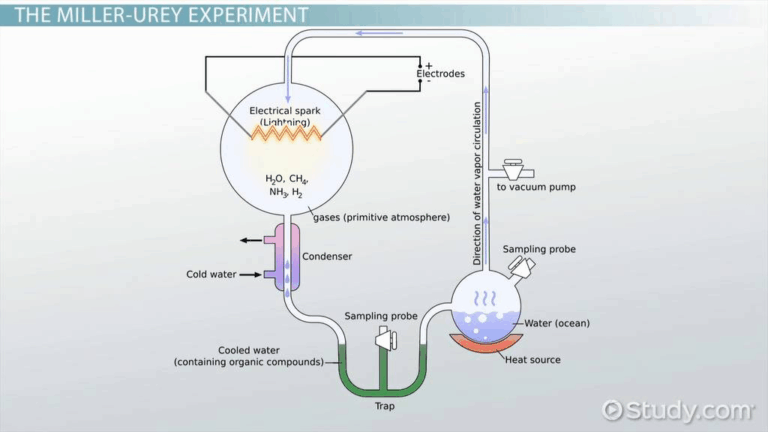
- Recreated early Earth’s atmosphere with water vapour, methane, hydrogen, and ammonia.
- Boiled water to simulate evaporation from early oceans.
- Added electrical sparks to mimic lightning as an energy source.
- Cooling system condensed the vapour, simulating rainfall.
- After one week, the apparatus contained amino acids and other organic molecules.
- Demonstrated that abiotic synthesis of life’s building blocks was possible under certain conditions.
🧬 IA Tips & Guidance:
Link this topic to practical work by designing a safe simulation of atmospheric chemistry, or by analysing chemical pathways for abiotic synthesis using molecular modelling software.
📌 Sub topic 3
🌐 EE Focus:
🌍 Real-World Connection: Understanding the abiotic synthesis of organic molecules supports research into astrobiology and the search for life on other planets, such as Mars or moons like Europa and Enceladus, which may have similar prebiotic conditions.
📌 Limitations of the Miller–Urey Experiment
- Early atmosphere may have contained less methane than assumed.
- Used electrical discharge rather than UV light, which may have played a larger role in reality.
- Amino acids tend to remain as monomers in watery environments, challenging polymerisation under such conditions.
- Failed to produce nucleotides, requiring alternative synthesis pathways.
- More recent experiments show additional energy sources (e.g., hydrothermal vents) could be important.
- Highlights the evolving nature of scientific understanding about early Earth.
🔍 TOK Perspective:
This experiment illustrates how scientific models are influenced by assumptions — changes in our understanding of early Earth’s atmosphere lead to new interpretations of Miller–Urey’s results. It also raises epistemological questions about reconstructing events from billions of years ago with limited evidence.