A1.2.1 – STRUCTURE OF NUCLEIC ACIDS
📌Definition Table
| Term | Definition |
|---|---|
| Nucleic Acid | Large biomolecules (DNA & RNA) composed of nucleotide monomers that store and transmit genetic information. |
| Nucleotide | Basic unit of nucleic acids consisting of a pentose sugar, a phosphate group, and a nitrogenous base. |
| Nitrogenous Base | Organic molecule with nitrogen atoms that forms base pairs in nucleic acids (purines & pyrimidines). |
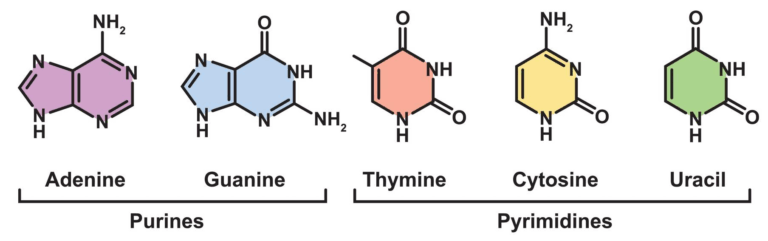
| Purines | Double-ring nitrogenous bases (Adenine & Guanine). |
| Pyrimidines | Single-ring nitrogenous bases (Cytosine, Thymine in DNA, Uracil in RNA). |
| Sugar-Phosphate Backbone | Repeating structure of alternating sugar and phosphate groups linked by covalent bonds in nucleic acids. |
📌Introduction
Nucleic acids, DNA and RNA, are the fundamental molecules that store, transmit, and express genetic information in living organisms. They are polymers of nucleotides, joined via covalent phosphodiester bonds to form long chains. DNA is the primary genetic material in most organisms, whereas RNA plays a central role in protein synthesis and, in some viruses, acts as the genetic material itself. The structure of these molecules is key to their ability to store vast amounts of information, maintain stability, and allow for precise replication.
📌 DNA and RNA as Genetic Material
- DNA contains the genetic blueprint for all cellular activities, stored as sequences of nitrogenous bases arranged along two antiparallel strands in a double helix.
- Found mainly in the nucleus of eukaryotic cells, DNA is also present in mitochondria and chloroplasts, and in the cytoplasm of prokaryotes.
- RNA exists in several forms — mRNA, tRNA, and rRNA — each with specific roles in transcription and translation.
- Certain viruses, such as SARS-CoV-2 and influenza, use RNA as their genetic material, providing exceptions to DNA-based heredity.
- Viruses lack cellular structures and cannot self-replicate, depending on host cells to reproduce.
- The universality of DNA as genetic material across life forms suggests a common evolutionary origin.
🧠 Examiner Tip:
Know how to differentiate DNA and RNA by sugar type, nitrogenous base composition, and strand structure. You should also be able to identify and label DNA diagrams, including sugar-phosphate backbones, complementary base pairs, and hydrogen bonds.
📌 Nucleotide Components
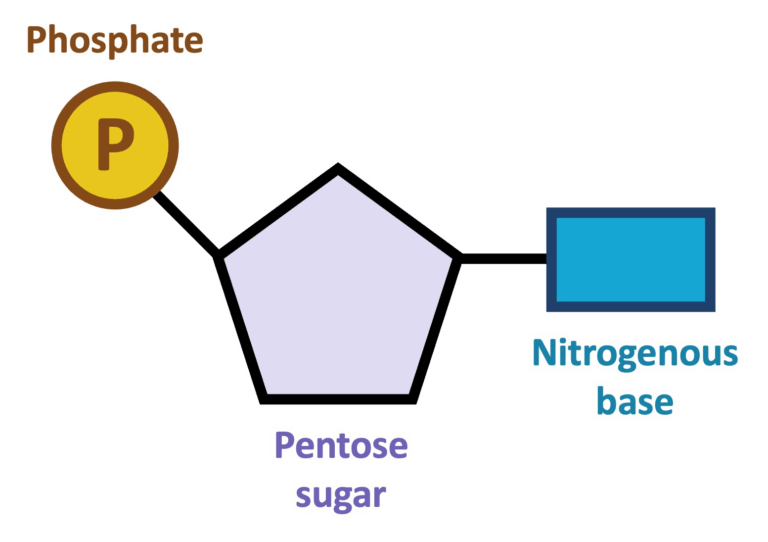
- Both DNA and RNA are polymers made of nucleotides, each consisting of a pentose sugar, a phosphate group, and a nitrogenous base.
- The nitrogenous bases are grouped into purines (A, G) and pyrimidines (C, T in DNA, U in RNA).
- The phosphate group is acidic and negatively charged, covalently bonded to the sugar.
- In DNA, the sugar is deoxyribose; in RNA, it is ribose, differing by one oxygen atom at the 2′ carbon.
- Bases attach to the sugar at the 1′ carbon; phosphate groups attach at the 5′ carbon.
- Diagrams in IB exams can use simple shapes (pentagon for sugar, circle for phosphate, rectangle for base).
🧬 IA Tips & Guidance:
You can link this topic to experimental skills by modelling nucleotides using physical or digital tools, investigating DNA extraction methods, or measuring DNA concentrations in biological samples.
📌 Linking Nucleotides into Strands
- Nucleotides join via condensation reactions, forming phosphodiester bonds between the phosphate of one nucleotide and the 3′ OH group of another.
- This forms the sugar-phosphate backbone, with nitrogenous bases projecting inward.
- DNA is double-stranded; RNA is usually single-stranded.
- Base sequences vary infinitely, enabling the storage of diverse genetic information.
- The 5′ end of a strand contains a phosphate group; the 3′ end has a free OH group.
- The order of bases on one strand determines the complementary strand sequence.
🌐 EE Focus:
Students could investigate nucleotide composition in different species or use bioinformatics tools to compare conserved genetic sequences across organisms to study evolutionary relationships.
📌 RNA Structure
- RNA molecules are shorter than DNA, typically ranging from hundreds to a few thousand nucleotides.
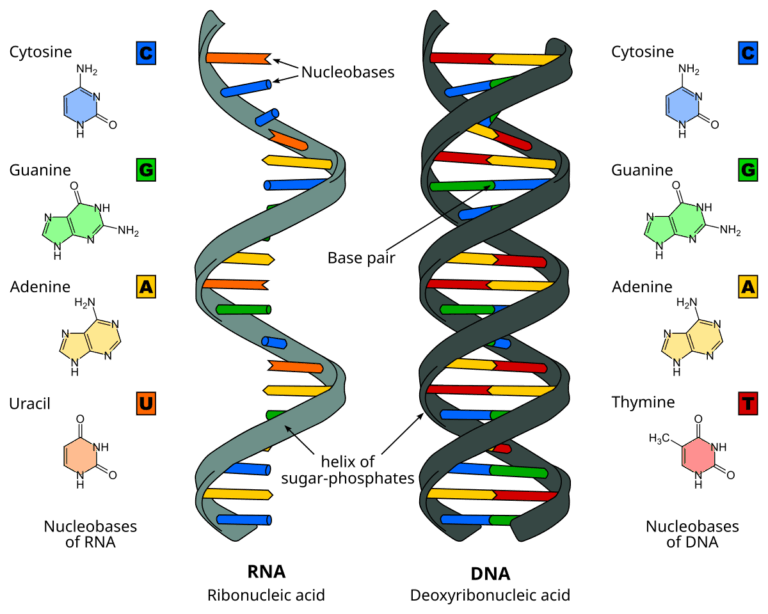
- They are usually single-stranded and contain ribose instead of deoxyribose.
- RNA nucleotides use uracil (U) instead of thymine (T).
- Three main types: mRNA (carries genetic information from DNA), tRNA (transfers amino acids during protein synthesis), and rRNA (forms part of ribosomes).
- Phosphodiester bonds link nucleotides in RNA through condensation reactions.
- Orientation is important: RNA is synthesized in the 5′ to 3′ direction.
❤️ CAS Link:
A CAS project could involve creating interactive models or educational resources to teach younger students about DNA and RNA structure.
📌 DNA structure
- DNA consists of two antiparallel strands in a right-handed double helix.
- Each strand is made of a sugar-phosphate backbone with bases pointing inward.
- Complementary base pairing rules: A–T (two hydrogen bonds), C–G (three hydrogen bonds).
- The antiparallel arrangement ensures proper base pairing and replication fidelity.
- DNA’s double-helix model was elucidated by Watson and Crick in 1953.
- Stability is enhanced by hydrogen bonding and base stacking interactions
🔍 TOK Perspective:
The discovery of DNA’s structure reflects the collaborative and iterative nature of scientific progress, where models are refined based on experimental evidence and technological advances (e.g., X-ray crystallography).