A1.2.2 – FUNCTION AND ROLE OF THE GENETIC CODE
📌Definition Table
| Term | Definition |
|---|---|
| Genetic Code | The set of rules by which the sequence of nucleotide bases in DNA or mRNA is translated into amino acid sequences in proteins. |
| Codon | A triplet of nucleotide bases in mRNA that codes for a specific amino acid or a stop signal during translation. |
| Coding Strand | The DNA strand whose base sequence matches the mRNA (except T is replaced by U). |
| Anticodon | A triplet of bases on tRNA complementary to a codon in mRNA. |
| Universal Code | The principle that the same codons specify the same amino acids in almost all organisms. |
| Conserved Sequence | DNA or protein sequences that have remained largely unchanged during evolution due to their critical biological functions. |
📌Introduction
The genetic code is the molecular language that translates DNA sequences into functional proteins. Encoded as triplets of nitrogenous bases, it ensures that genetic information is expressed with precision, allowing the synthesis of specific amino acid chains. This universal system applies to nearly all known life forms, enabling genetic information to be read, interpreted, and transferred across species.
📌 The Genetic Code: Structure and Reading
- DNA contains sequences of four bases (A, T, C, G) that encode genetic information.
- One strand of the DNA double helix (the coding strand) holds the sequence used during transcription.
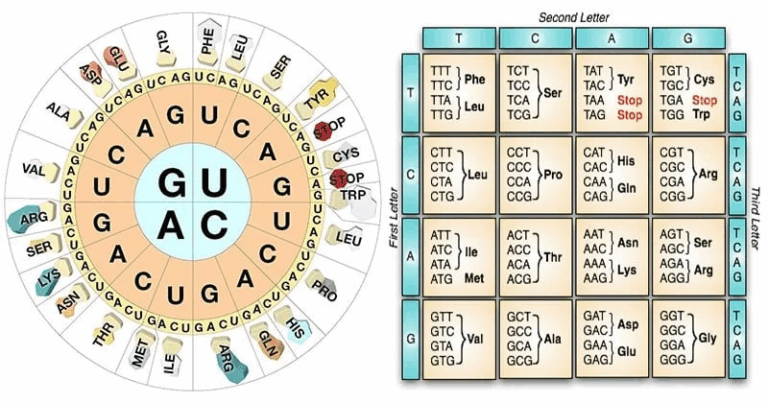
- Each codon consists of three bases, which collectively specify one amino acid or a stop signal.
- With 64 possible codons and 20 amino acids, the genetic code is redundant (multiple codons can specify the same amino acid).
- The base sequence in genes determines the primary structure of proteins, which in turn defines their 3D structure and function.
- Translation of the code is directional, proceeding from the 5′ to 3′ end of mRNA.
🧠 Examiner Tip:
Be able to identify the coding and template strands of DNA in a diagram, transcribe DNA into mRNA, and then translate mRNA codons into amino acids using a codon table.
📌📌 Conservation and Universality of the Genetic Code
- The genetic code is nearly universal across all organisms, from bacteria to humans, with only minor exceptions in some mitochondrial DNA and rare species.
- The same codon specifies the same amino acid in almost all living systems.
- This universality allows genes from one species to be expressed in another, forming the basis for genetic engineering and recombinant DNA technology.
- Evidence of a shared common ancestor is supported by the conservation of coding sequences across diverse taxa.
- Many coding sequences have remained unchanged for millions of years, especially those involved in core processes like transcription and translation.
- Highly conserved sequences include histone proteins and rRNA genes, indicating their fundamental biological roles.
🧬 IA Tips & Guidance:
You could design an investigation into base composition and codon usage in different organisms using online genetic databases, linking it to bioinformatics and evolutionary biology.
📌 Mutations and Genetic Variation
- Mutations are changes in the base sequence of DNA that can alter codons, potentially changing amino acids in proteins.
- Some mutations are silent (no change in amino acid), while others may alter protein structure or function.
- Beneficial mutations can drive adaptation, while harmful ones can cause genetic disorders.
- Mutations in non-coding sequences may affect gene regulation rather than protein structure.
- Mutations in highly conserved regions are more likely to be deleterious, as these regions are critical to survival.
- Mutagenic factors include radiation, chemical exposure, and errors during DNA replication.
🌐 EE Focus:
A student could explore the effect of codon bias on gene expression efficiency in different organisms, connecting molecular biology to biotechnology applications.
📌 From Gene to Protein
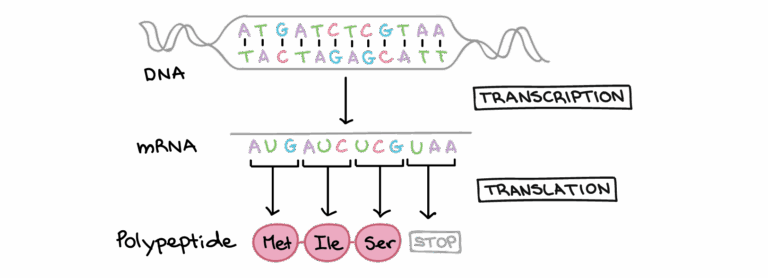
- Transcription copies the coding sequence of DNA into mRNA using complementary base pairing.
- mRNA leaves the nucleus and binds to ribosomes in the cytoplasm.
- tRNA molecules with complementary anticodons deliver amino acids to the ribosome.
- Ribosomes catalyse peptide bond formation between amino acids, producing a polypeptide chain.
- The sequence of amino acids determines the protein’s folding and function.
- Errors in transcription or translation can lead to dysfunctional proteins, affecting the organism’s phenotype.
❤️ CAS Link:
Developing an educational workshop to teach younger students how DNA sequences translate into proteins using 3D models or interactive software.
📌Importance in Biotechnology
- Understanding the genetic code allows scientists to modify organisms through genetic engineering.
- It is essential for producing recombinant proteins like insulin, growth hormones, and vaccines.
- Codon optimization is used in synthetic biology to enhance gene expression in host organisms.
- CRISPR-Cas9 genome editing relies on precise targeting of DNA sequences.
- DNA barcoding uses conserved gene sequences to identify species.
- Gene therapy depends on accurate delivery and expression of functional genes.
🌍 Real-World Connection:
The universality of the genetic code underpins advances in medicine, agriculture, and forensic science, from producing transgenic crops to developing personalised cancer treatments.
🔍 TOK Perspective:
The universality of the genetic code challenges traditional definitions of species boundaries and prompts ethical debates on genetic modification. It also illustrates how shared biological systems provide strong evidence for evolutionary theory.