A1.2.3 – HISTORICAL EXPERIMENTS AND SCIENTIFIC ADVANCES
📌Definition Table
| Term | Definition |
|---|---|
| Hershey–Chase Experiment | 1952 study proving that DNA, not protein, is the hereditary material by tracking radioactive isotopes in bacteriophages. |
| Radioisotope Labelling | Technique using radioactive elements to trace molecules in biological systems. |
| Chargaff’s Rules | Observations that in DNA, A = T and C = G, indicating base pairing regularity. |
| Tetranucleotide Hypothesis | An early, incorrect theory proposing DNA was composed of repeating units of four nucleotides. |
| Double Helix Model | 3D structure of DNA proposed by Watson & Crick in 1953, showing antiparallel strands and complementary base pairing. |
| Complementary Base Pairing | Specific pairing of A–T and C–G in DNA through hydrogen bonds. |
📌Introduction
The journey to understanding the structure and function of nucleic acids was shaped by decades of experimentation and technological progress. From disproving early misconceptions like the tetranucleotide hypothesis to proving DNA’s role in heredity, historical breakthroughs have laid the foundation for modern molecular biology. Key contributions from Hershey & Chase, Chargaff, and Watson & Crick revolutionised our understanding of genetic material.
📌 Hershey & Chase Experiment (1952)
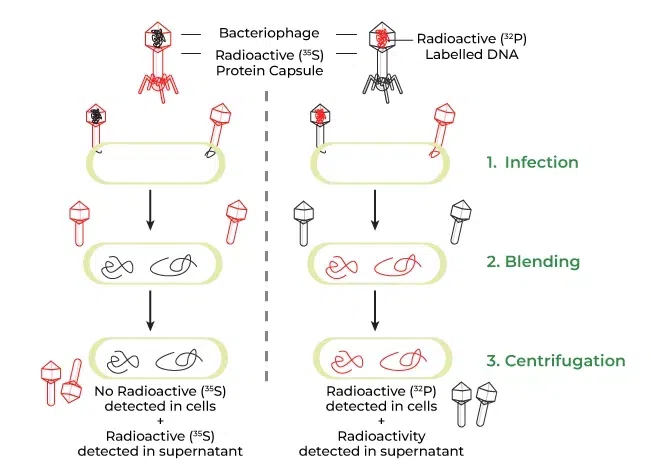
- Used bacteriophages (viruses infecting bacteria) containing DNA and a protein coat to determine the molecule of heredity.
- DNA was labelled with radioactive phosphorus (^32P), while protein was labelled with radioactive sulfur (^35S).
- After infecting E. coli, the viral coats were removed using a blender, and bacteria were separated from viral debris via centrifugation.
- Only the bacteria infected with ^32P-labelled viruses became radioactive, indicating DNA entered the host cells.
- Demonstrated unequivocally that DNA, not protein, is the genetic material.
- Showed the importance of radioisotopes as research tools in molecular biology.
🧠 Examiner Tip:
Be able to explain the experimental setup and outcome of the Hershey–Chase experiment, and wh
📌 Chargaff’s Data (1940s)
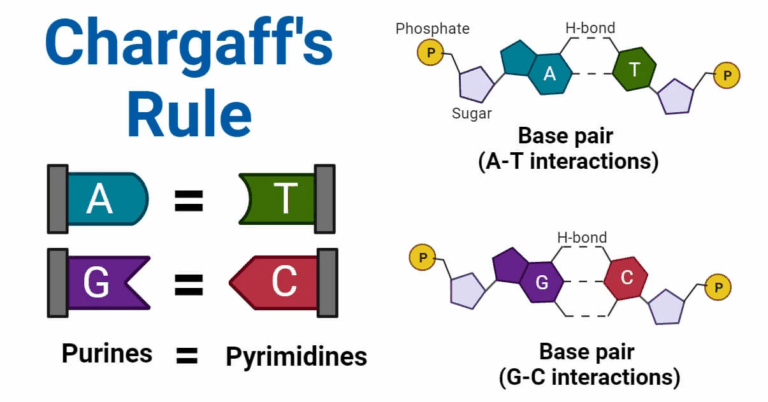
- Erwin Chargaff analysed DNA composition in multiple species and found that A = T and C = G in molar ratios.
- This indicated purine–pyrimidine pairing, providing key evidence for base complementarity.
- Falsified the tetranucleotide hypothesis proposed by Phoebus Levene, which suggested DNA was repetitive and lacked variation.
- Demonstrated species-specific variation in base composition, showing that DNA could store complex genetic information.
- Provided essential input for Watson and Crick’s double helix model.
- Illustrated the role of falsification in scientific progress (Karl Popper’s philosophy).
🧬 IA Tips & Guidance:
This topic links well to modelling investigations — you could use software or kits to recreate the Hershey–Chase experiment or compare base compositions across species using genome database
📌 Watson & Crick’s Double Helix Model (1953)
- Proposed DNA’s 3D structure as a right-handed double helix with two antiparallel strands.
- Built on Rosalind Franklin’s X-ray crystallography images, which revealed DNA’s helical nature and uniform width.
- Explained how complementary base pairing allows accurate replication of genetic material.
- Showed that A–T pairs form two hydrogen bonds, while C–G pairs form three, maintaining consistent helix width.
- Directionality (5′ to 3′ and 3′ to 5′ strands) is crucial for replication and transcription processes.
- Revolutionised molecular biology, influencing genetics, medicine, and biotechnology.
🌐 EE Focus:
An Extended Essay could investigate how technological advancements (e.g., X-ray crystallography, radioisotope tracing) enabled breakthroughs in nucleic acid research, linking NOS (Nature of Science) concepts with experimental evidence.
📌 Technological Advances Enabling Discoveries
- X-ray diffraction imaging (Franklin & Wilkins) revealed DNA’s repeating helical structure.
- Availability of radioisotopes post–World War II enabled molecular tracing in experiments like Hershey–Chase.
- Improved biochemical analysis allowed accurate measurement of nucleotide ratios.
- Model-building techniques (Watson & Crick) helped visualise molecular interactions.
- Bioinformatics tools now enable DNA structure analysis at atomic resolution.
- Advances in microscopy and molecular modelling have extended these foundational findings into applied science.
❤️ CAS Link:
Create a museum-style exhibit or interactive timeline showcasing major milestones in DNA discovery, including models, photos, and simplified explanations for public education.
📌 Impact on Modern Biology
- Confirmed DNA as the universal genetic material, transforming genetics from a descriptive to a molecular science.
- Led to the development of recombinant DNA technology, PCR, genome sequencing, and synthetic biology.
- Enabled gene cloning, forensic DNA analysis, and targeted therapies.
- Provided evidence supporting the theory of evolution through shared genetic mechanisms.
- Inspired the Human Genome Project and personalised medicine.
- Continues to inform research into epigenetics and gene regulation.
🔍 TOK Perspective:
The history of DNA discovery illustrates the collaborative, sometimes competitive, nature of science. It also highlights the importance of falsifiability, technologi