A1.2.2 – FUNCTION AND ROLE OF THE GENETIC CODE
📌Definition Table
| Term | Definition |
|---|---|
| Genetic Code | The set of rules by which nucleotide sequences are translated into amino acid sequences in proteins. |
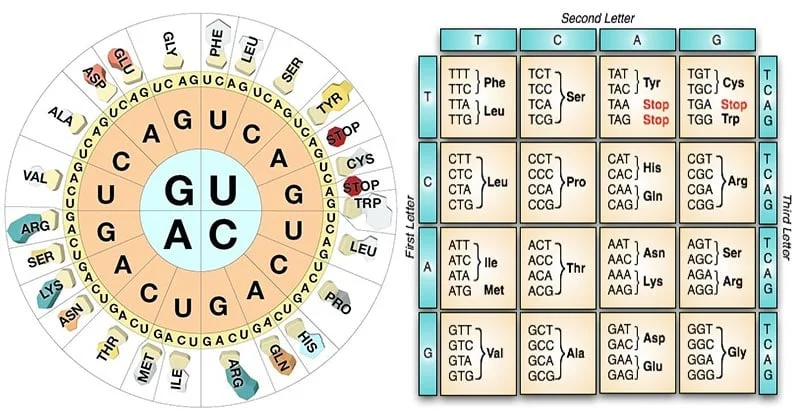
| Codon | A triplet of nucleotides in mRNA that codes for a specific amino acid or a stop signal. |
| Start Codon | AUG; signals the start of translation and codes for methionine. |
| Stop Codon | UAA, UAG, UGA; signals the end of translation. |
| Degeneracy | Multiple codons can code for the same amino acid. |
| Reading Frame | The way nucleotides are grouped into codons during translation. |
📌Introduction
The genetic code is a universal molecular language linking DNA sequences to protein structures. It ensures accurate transfer of genetic instructions from DNA to functional proteins through transcription and translation.
📌 Properties of the Genetic Code
- Triplet Nature: Each amino acid is specified by a three-nucleotide codon.
- Degenerate: Most amino acids have more than one codon, reducing mutation effects.
- Unambiguous: Each codon codes for only one amino acid.
- Non-Overlapping: Codons are read sequentially without sharing bases.
- Universal: Shared by almost all organisms (with minor exceptions in mitochondria).
- Start/Stop Signals: AUG starts translation; UAA, UAG, UGA stop it.
🧠 Examiner Tip: Always specify the start codon (AUG) and stop codons in answers about translation.
📌 Role in Transcription
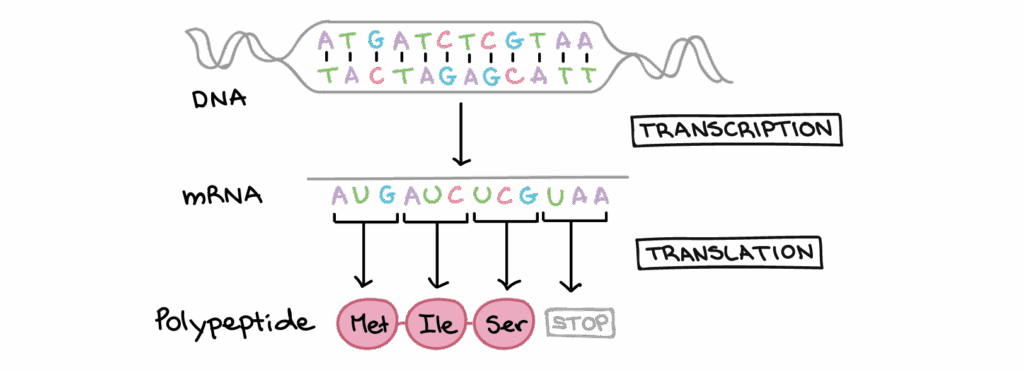
- DNA sequence is copied into mRNA by RNA polymerase.
- Uses complementary base pairing (A–U, G–C).
- Only one strand (template strand) is transcribed.
- Promoter regions control where transcription begins.
- mRNA produced is complementary to the DNA template strand.
- Errors in transcription can lead to incorrect proteins.
🧬 IA Tips & Guidance: Measure transcription rates under different temperature or pH conditions using in vitro transcription systems.
📌 Role in Translation
- Ribosomes read mRNA codons in the 5′ → 3′ direction.
- tRNA molecules carry specific amino acids to the ribosome.
- Anticodon in tRNA pairs with codon in mRNA.
- Peptide bonds form between amino acids.
- Process continues until a stop codon is reached.
- Produces a specific polypeptide chain.
🌐 EE Focus: Investigate how codon bias affects translation efficiency in different organisms.
📌 Start and Stop Codons
- Start: AUG — codes for methionine; establishes reading frame.
- Stops: UAA, UAG, UGA — do not code for amino acids.
- Misreading start/stop sites can produce non-functional proteins.
- Mutations in these sites can disrupt protein synthesis.
- Alternative start codons exist in rare cases.
❤️ CAS Link: Create a classroom activity where students decode amino acid sequences from mRNA codons.
📌 Degeneracy and Mutation Protection
- Reduces harmful effects of point mutations.
- Silent mutations often occur at the third codon position.
- Codon families group codons with the same amino acid outcome.
- Evolutionary adaptation to minimize protein errors.
- Some codons are more common (codon bias).
🌍 Real-World Connection: Codon optimization is used in biotechnology to improve protein expression in recombinant DNA systems.
📌 Universality and Evolution
- Shared by most life forms — evidence for common ancestry.
- Minor variations exist in mitochondrial and some microbial codes.
- Supports evolutionary conservation of molecular machinery.
- Changes in code are rare due to complexity of translation system.
🔍 TOK Perspective: Universality of the genetic code raises questions about whether life shares a single origin or if convergent evolution could produce the same code.