B3.3.3 – LOCOMOTION AND JOINT MOVEMENT
📌Definition Table
| Term | Definition |
|---|---|
| Locomotion | Active movement of an organism from one place to another using its own energy. |
| Goniometer | Device used to measure the range of motion at a joint in degrees. |
| Range of Motion (ROM) | The extent of movement a joint is capable of, measured in terms of flexion, extension, rotation, and other specific motions. |
| Migration | Seasonal movement of animals from one region to another, often for breeding or resource availability. |
| Adaptation for Locomotion | Structural or physiological traits enhancing efficiency and survival during movement. |
📌Introduction
Locomotion is essential for many animals to survive, reproduce, and interact with their environment. It involves a combination of skeletal, muscular, and nervous systems working together to generate coordinated movement. The efficiency of locomotion depends on joint flexibility, muscle strength, lever mechanics, and adaptations suited to an organism’s ecological niche. Range of motion and locomotor patterns are determined by both anatomy and lifestyle.
❤️ CAS Link: Collaborate with the sports department to conduct a school-wide flexibility and movement workshop using goniometers, teaching participants how joint mobility impacts performance.
📌 Reasons for Locomotion
- Foraging — Movement to obtain food resources, such as predators hunting prey or herbivores searching for plants.
- Escape from Predators — Rapid movement, camouflage relocation, or shelter seeking to avoid predation.
- Mating and Reproduction — Travel to breeding grounds or displaying courtship movements to attract mates.
- Migration — Seasonal long-distance movements to exploit changing environmental resources.
- Territorial Defence — Patrolling and marking territory boundaries to deter competitors.
🧠 Examiner Tip: When asked about migration, always mention triggering cues such as temperature, photoperiod, and food availability.
📌 Joint Movement and Range of Motion
- Joint movement depends on joint type, ligament elasticity, muscle length, and tendon flexibility.
- Synovial joints allow various motions: hinge (flexion/extension), ball-and-socket (rotation, abduction/adduction), pivot (rotation), saddle, and gliding movements.
- ROM can be measured with a goniometer for clinical or sports performance purposes.
- Flexibility training can increase ROM, while injury or arthritis can reduce it.
- Different sports place varying demands on ROM (e.g., gymnasts require extreme flexibility, sprinters prioritise explosive force).
🌍 Real-World Connection: Physiotherapists use ROM measurements to track recovery after injuries such as ACL tears or shoulder dislocations.
📌 Locomotor Adaptations
- Aquatic Animals — Streamlined bodies reduce drag; fins/flippers act as paddles or hydrofoils (e.g., dolphins, seals).
- Flying Animals — Lightweight skeletons, wing adaptations, and strong flight muscles (e.g., birds, bats, insects).
- Terrestrial Runners — Long limbs for stride efficiency; springy tendons store and release energy (e.g., cheetahs, horses).
- Burrowers — Strong forelimbs with claws for digging (e.g., moles, armadillos).
- Climbers — Prehensile tails, opposable digits, and flexible joints for grip (e.g., monkeys, geckos).
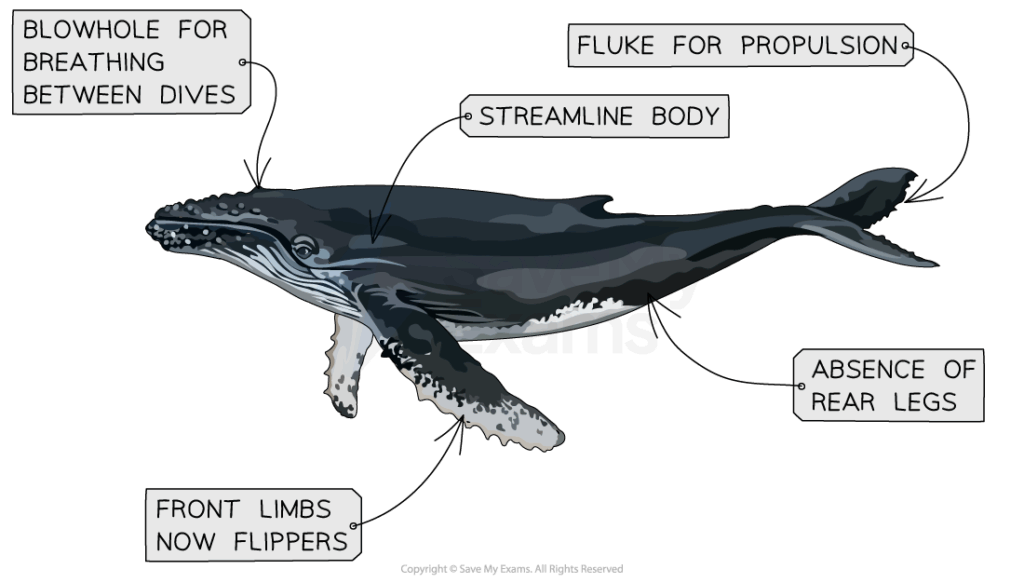
🔍 TOK Perspective: Classifying locomotion into distinct categories is a human-made system; in nature, many species blur the boundaries (e.g., penguins swim and walk).
📌 Measurement of Movement in Research
- Goniometers measure angles at joints during movement.
- Motion capture systems track detailed body movement for biomechanical studies.
- Force plates measure the power and direction of forces exerted during locomotion.
- High-speed cameras reveal muscle and joint function in fast movements.
- Data informs medical rehabilitation, sports training, and robotic design.
⚗️ IA Tips & Guidance: An IA could measure how footwear type (barefoot, cushioned, cleated) affects ankle ROM during running to investigate biomechanical efficiency.
📌 Link Between Locomotion and Joint Structure
- Joint structure is optimised for specific movement types (e.g., shoulder joint sacrifices stability for flexibility; hip joint prioritises stability).
- Ligament and tendon arrangement influences both mobility and injury risk.
- Muscle fibre type distribution (fast-twitch vs. slow-twitch) affects endurance vs. speed performance.
- Lever mechanics determine whether movement prioritises force or speed.
- Evolution shapes locomotor features based on environmental pressures and lifestyle needs.