B3.1.3 – VENTILATION AND GAS TRANSPORT
📌Definition Table
| Term | Definition |
|---|---|
| Ventilation | Movement of air or water over the respiratory surface to maintain a concentration gradient. |
| Respiratory Pigment | Molecule that increases the oxygen-carrying capacity of blood (e.g., haemoglobin, myoglobin). |
| Haemoglobin | Iron-containing protein in red blood cells that binds oxygen reversibly for transport. |
| Oxygen Dissociation Curve | Graph showing the percentage saturation of haemoglobin at various partial pressures of oxygen. |
| Bohr Effect | Reduction in haemoglobin’s oxygen affinity in the presence of high CO₂, aiding oxygen unloading in tissues. |
📌Introduction
Ventilation ensures a constant supply of oxygen and removal of carbon dioxide by maintaining steep concentration gradients across respiratory surfaces. In animals with complex respiratory systems, ventilation is closely linked with circulatory transport via respiratory pigments. The mechanisms of oxygen loading, transport, and unloading — along with CO₂ carriage — are vital for meeting the metabolic demands of active tissues.
❤️ CAS Link: Host a sports science fair where students measure breathing rates and oxygen saturation before and after exercise, linking human ventilation patterns to athletic performance.
📌 Ventilation Mechanisms in Animals
- Mammals — Negative pressure breathing driven by diaphragm contraction and intercostal muscle movement; exhalation may be passive (elastic recoil) or active (forced exhalation).
- Fish — Buccal and opercular pumping creates a unidirectional water flow over gills; ram ventilation in fast swimmers.
- Insects — Body movements pump air through spiracles into tracheal tubes, assisted by diffusion.
🧠 Examiner Tip: Always connect the ventilation method to how it maintains a diffusion gradient for efficient gas exchange.
📌 Oxygen Transport
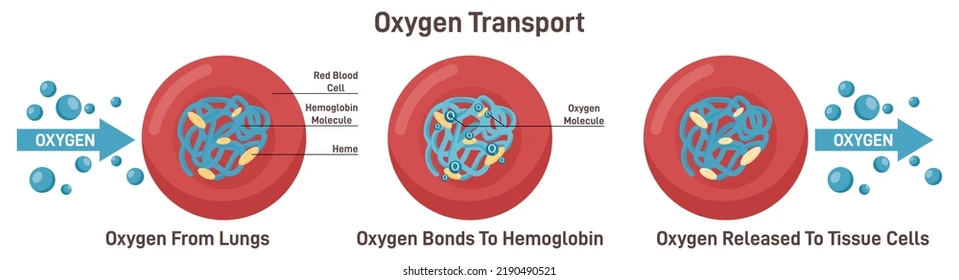
- Haemoglobin — Found in red blood cells; binds oxygen in lungs where partial pressure is high, releases it in tissues where partial pressure is low.
- Oxygen Dissociation Curve — S-shaped due to cooperative binding; steep middle region allows rapid oxygen unloading in tissues.
- Bohr Effect — Higher CO₂ concentration and lower pH reduce haemoglobin’s oxygen affinity, aiding delivery to active tissues.
🌍 Real-World Connection: Pulse oximeters, widely used in healthcare, measure oxygen saturation in haemoglobin — essential in managing respiratory illnesses like COVID-19.
📌 Carbon Dioxide Transport
- Dissolved in plasma (~7%).
- Bound to haemoglobin as carbaminohaemoglobin (~23%).
- Converted to bicarbonate ions in red blood cells (~70%) via carbonic anhydrase; bicarbonate moves into plasma for transport.
- Reverse reaction occurs in lungs for CO₂ exhalation.
🔍 TOK Perspective: The choice of representing gas transport as percentages, concentrations, or partial pressures can affect interpretation and clarity in scientific communication.
📌 Adaptations in Specialised Organisms
- High-altitude animals — Haemoglobin with higher oxygen affinity.
- Diving mammals — High myoglobin concentrations for oxygen storage in muscles.
- Endotherms — Higher ventilation rates to support elevated metabolic demands.
🌐 EE Focus: An EE could investigate the relationship between haemoglobin oxygen affinity and altitude in different species, using literature data to explore evolutionary adaptation.
📌 Integration with Circulation
- Efficient gas transport requires close coupling of respiratory and circulatory systems.
- High metabolic rates demand rapid ventilation and strong circulatory output.
- Feedback control from chemoreceptors adjusts ventilation rate based on blood CO₂, O₂, and pH levels.