B2.3.3 -SPECIALISED CELLS AND THEIR ADAPTATIONS
📌Definition Table
| Term | Definition |
|---|---|
| Specialised Cell | A cell with specific structural and biochemical features that enable it to perform a particular function. |
| Structural Adaptation | Physical features of a cell that enhance its ability to carry out its function. |
| Functional Adaptation | Specialised processes or biochemical mechanisms that optimise a cell’s role. |
| Pneumocyte | Epithelial cell in the alveoli of the lungs specialised for gas exchange or surfactant secretion. |
| Myocyte | Muscle cell specialised for contraction to produce movement or maintain tension. |
📌Introduction
Specialised cells are the result of differentiation and are adapted to perform distinct roles essential for the survival of the organism. Their adaptations can be structural, biochemical, or both, and are directly linked to the cell’s function. Studying specialised cells reveals how structure–function relationships underpin biological efficiency and provides insight into how evolution shapes cellular design for environmental and functional demands.
❤️ CAS Link: Organise a school biology exhibition where students prepare models of different specialised cells, highlighting structural adaptations with labelled diagrams.
📌 Increasing SA:V — Adaptations for Exchange
- Red blood cells (erythrocytes) — biconcave shape increases surface area for oxygen diffusion; thin plasma membrane reduces diffusion distance; no nucleus allows more haemoglobin storage.
- Proximal convoluted tubule cells — microvilli increase reabsorptive surface; numerous mitochondria supply ATP for active transport; tight junctions prevent leakage.
- Intestinal epithelial cells — dense microvilli enhance nutrient uptake; enzymes embedded in membranes for digestion at the surface.
🧠 Examiner Tip: For high-mark answers, explicitly link a structural feature to its exact functional outcome (e.g., “microvilli → more surface area → increased glucose absorption rate”).
📌 Gas Exchange Specialisation
Gas exchange surfaces must optimise diffusion while preventing collapse.
- Type I pneumocytes — extremely thin squamous cells that cover ~95% of alveolar surface, minimising diffusion distance for oxygen and carbon dioxide.
- Type II pneumocytes — cuboidal cells that secrete pulmonary surfactant to reduce surface tension, preventing alveoli from collapsing during exhalation.
🌍 Real-World Connection: Respiratory distress syndrome in premature infants results from insufficient surfactant production, making breathing difficult. Artificial surfactants are administered to reduce mortality.
📌 Muscle Cell Adaptations
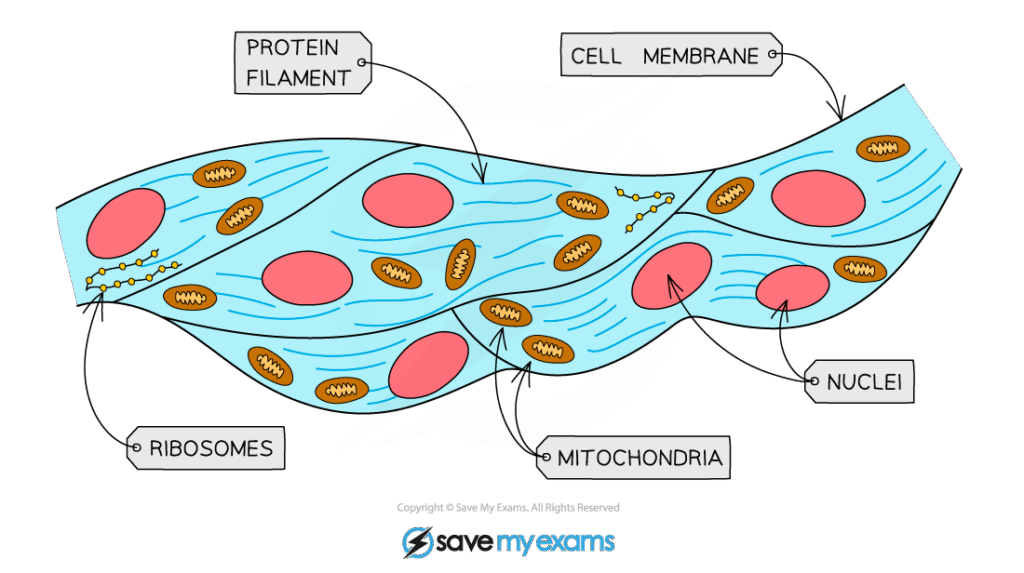
- Muscle cells are adapted for contraction, energy generation, and coordination.
- Skeletal muscle fibres — long multinucleated cells packed with myofibrils containing actin and myosin filaments for contraction; sarcoplasmic reticulum stores calcium ions; numerous mitochondria supply ATP for repeated contractions.
- Cardiac muscle cells — branched fibres with intercalated discs containing gap junctions for rapid signal transmission; abundant mitochondria for continuous contraction; resistant to fatigue due to high oxygen supply.
- Smooth muscle cells — spindle-shaped, adapted for slow, sustained contractions in organs such as intestines and blood vessels.
🔍 TOK Perspective: The classification of muscles by structure (striated vs. non-striated) versus function (voluntary vs. involuntary) demonstrates how different classification systems can shape biological understanding.
📌Reproductive Cell Adaptations
- Reproductive cells are adapted for fertilisation and early development.
- Sperm cells — streamlined to reduce drag; flagellum powered by ATP from mitochondria in the midpiece; acrosome containing enzymes to penetrate egg’s zona pellucida.
- Egg cells (ova) — large cytoplasm with nutrients for embryo development; cortical granules release chemicals to block polyspermy; zona pellucida for species-specific sperm recognition.
⚗️ IA Tips & Guidance: An IA could track sperm motility over time under different temperature conditions, linking adaptation to fertilisation efficiency.
📌 Other Specialised Cells
- Neurons — long axons for fast signal transmission; dendrites for multiple inputs; myelin sheath and nodes of Ranvier for saltatory conduction.
- Guard cells — uneven wall thickness for stomatal opening and closing; chloroplasts to generate ATP for active transport of ions, altering turgor pressure.
- White blood cells (e.g., neutrophils) — flexible shape for squeezing through tissues; lysosomes packed with hydrolytic enzymes for pathogen destruction.