B2.3.2 – CELL SPECIALISATION AND CONSTRAINTS ON CELL SIZE
📌Definition Table
| Term | Definition |
|---|---|
| Cell Specialisation | Process by which generic cells develop into cells with specific structures and functions. |
| Differentiation | Process involving the activation or repression of specific genes to produce specialised cell types. |
| Division of Labour | Distribution of different tasks among different cell types in a multicellular organism. |
| Surface Area-to-Volume Ratio (SA:V) | Ratio of a cell’s surface area to its volume, influencing exchange rates with the environment. |
| Diffusion Distance | The distance over which substances must move; smaller cells have shorter diffusion distances. |
| SA:V Constraint | The limitation on cell size caused by the decrease in SA:V as size increases. |
📌Introduction
Multicellular organisms depend on cell specialisation to perform the wide range of functions needed for survival. Specialisation is achieved through differentiation, where cells switch on or off specific genes, producing proteins suited for a particular role. This division of labour increases efficiency and allows organisms to develop complex tissues and organ systems. However, cell size is constrained by surface area-to-volume ratio — larger cells have relatively less surface area for exchange, making it harder to meet metabolic demands. This biological principle influences not only the size of single cells but also the structure of entire tissues and organs.
❤️ CAS Link: Collaborate with a science museum or school open day to design an interactive activity demonstrating the SA:V concept using agar cube diffusion.
📌 Cell Specialisation and Division of Labour
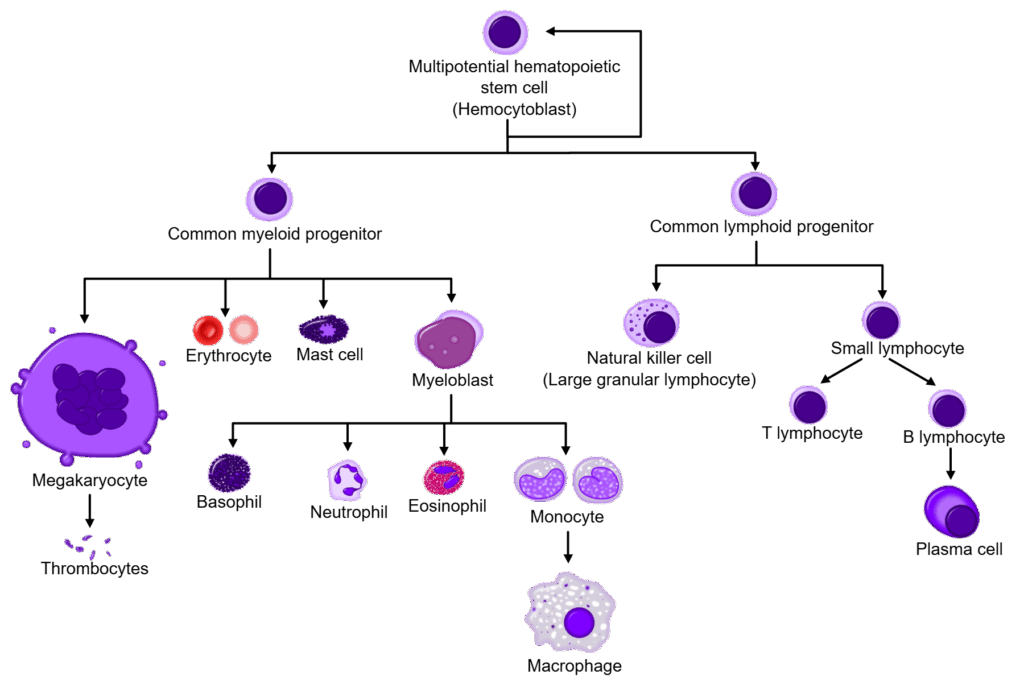
- Specialisation enables multicellular organisms to optimise functions — for example, neurons transmit signals, red blood cells transport oxygen, and goblet cells secrete mucus.
- Division of labour ensures that no single cell performs every function; instead, cells are adapted structurally and biochemically for efficiency.
- Differentiation is driven by changes in gene expression — only a subset of a cell’s genes are expressed, producing a specific proteome.
- Stem cells differentiate progressively into more restricted cell types during development, with final cell types having a fixed function.
🧠 Examiner Tip: When describing cell specialisation in Paper 2, always link structure to function with clear examples.
📌 Variation in Cell Size as an Adaptation
- Some cells are extremely small to maintain a high SA:V ratio (e.g., bacteria).
- Others are large but adapted to overcome SA:V limitations by being elongated or having internal transport systems (e.g., muscle fibres, nerve cells).
- Large cells often have folded membranes or microvilli to increase SA:V without compromising volume.
- Multinucleated cells (e.g., skeletal muscle fibres) distribute genetic control over large cytoplasmic volumes.
🌍 Real-World Connection: Ostrich eggs are among the largest single cells in nature — their size is possible because metabolic needs are met by surrounding maternal tissues during development.
📌 Constraints on Cell Size — SA:V Principle
- SA:V ratio decreases as cell size increases; metabolic demand (volume) grows faster than exchange capacity (surface area).
- Small cells have large SA:V, enabling efficient diffusion of nutrients, gases, and waste products.
- Larger cells risk slower exchange rates and may overheat due to reduced heat dissipation.
- Solutions to overcome SA:V constraints include:
- Specialised exchange surfaces (alveoli in lungs, villi in intestines).
- Internal transport systems (circulatory system).
- Cell shape adaptations (flattened or elongated cells).
🌐 EE Focus: An EE could experimentally investigate the relationship between SA:V and diffusion efficiency using agar cubes soaked in indicator solutions with varying pH penetration times.
📌 The Agar Cube Diffusion Model
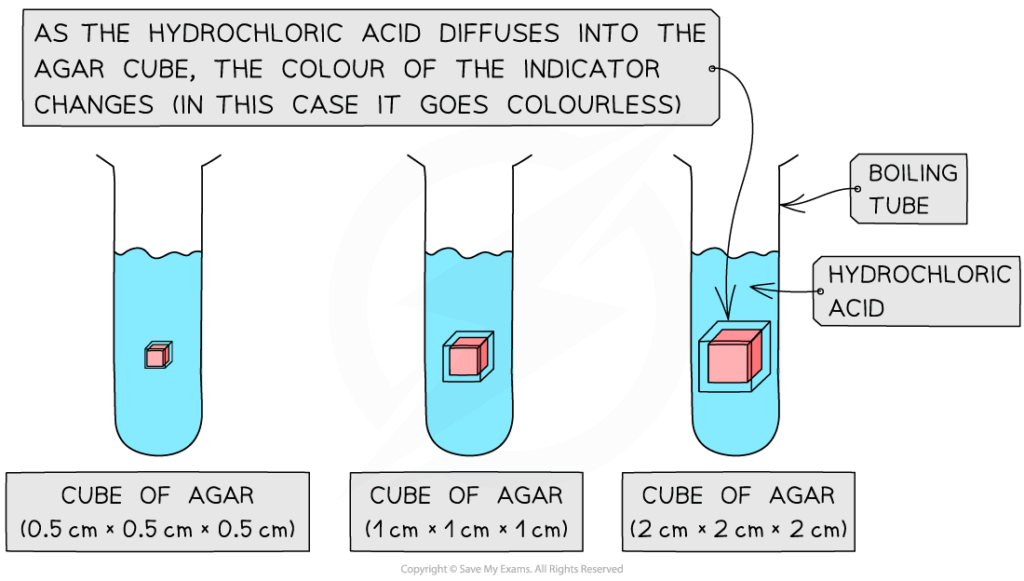
- Common school model to demonstrate SA:V limitations.
- Agar cubes contain a pH indicator (e.g., phenolphthalein); placed in acid to observe diffusion rate by colour change.
- Smaller cubes change colour faster, illustrating greater relative surface area for exchange.
- Variables: cube size, temperature, acid concentration.
- Applications: relates to real cells and why transport adaptations evolve in multicellular organisms.
🔍 TOK Perspective: How do models (e.g., SA:V agar cubes) help us understand living systems, and what are their limitations in representing biological complexity?
📌 Linking Structure and Function in Specialisation
- Nerve cells — long axons for rapid signal conduction; myelin sheath for insulation.
- Root hair cells — elongated extension for increased water and nutrient absorption; thin cell wall for easy diffusion.
- Erythrocytes — biconcave shape increases SA for oxygen uptake; lack of nucleus maximises space for haemoglobin.
- Goblet cells — abundant rough ER for mucin production; secretory vesicles for mucus release.