A4.2.1 – BIODIVERSITY AND ITS IMPORTANCE
📌Definition Table
| Term | Definition |
|---|---|
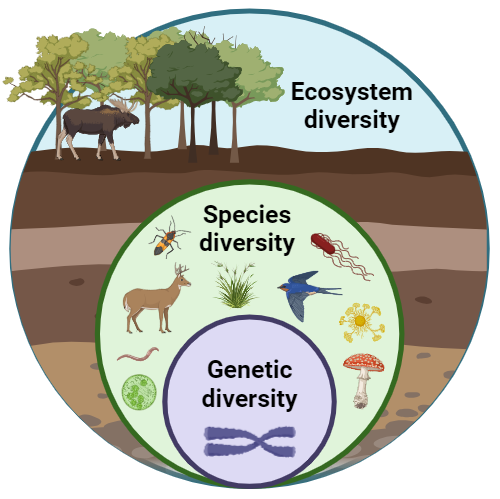
| Biodiversity | Variety of life at all levels: genetic, species, and ecosystem. |
| Genetic Diversity | Variation of alleles within a population’s gene pool. |
| Species Diversity | Variety of species in an ecosystem, measured by richness and evenness. |
| Species Richness | Number of different species present in a given area. |
| Species Evenness | Relative abundance of each species in an ecosystem. |
| Ecosystem Diversity | Variety of habitats, communities, and ecological processes in the biosphere. |
| Endemism | Species found only in a specific geographic location. |
📌Introduction
Biodiversity encompasses the full range of life forms on Earth and the natural patterns they form. It exists at three main levels — genetic, species, and ecosystem — and is vital for ecological stability, resilience, and the provision of ecosystem services. High biodiversity generally means greater ecosystem resilience, while low biodiversity can make systems more vulnerable to disturbances.
❤️ CAS Link: Partner with a local park authority to create an illustrated biodiversity map of the area, showcasing species richness and endemism
📌 Levels of Biodiversity
- Genetic Diversity — High genetic variation allows species to adapt to environmental change and resist diseases.
- Species Diversity — Measured by:
- Richness (number of species present).
- Evenness (balance of population sizes among species).
- Ecosystem Diversity — Range of different habitats and communities within a region, e.g., tropical rainforest vs. desert.
🧠 Examiner Tip: When given data, use both richness and evenness to assess biodiversity — not just species counts.
📌 Examples of High vs. Low Biodiversity
- High biodiversity: Coral reefs (many species, balanced abundances, high genetic diversity).
- Low biodiversity: Monoculture crop fields (few species, low genetic variation).
- Biodiversity hotspots are regions with high species richness and high levels of endemism (e.g., Madagascar, Amazon rainforest).
🌍 Real-World Connection: Conservation International identifies 36 global biodiversity hotspots covering 2.3% of Earth’s land surface yet hosting over 50% of endemic plant species.
📌Biodiversity Over Time
- Biodiversity changes through speciation (formation of new species) and extinction.
- Natural extinctions are balanced by speciation over geological timescales.
- Mass extinction events dramatically reduce biodiversity but can be followed by adaptive radiation.
- Current biodiversity loss rates are 100–1000× the natural background rate due to human activities.
🔍 TOK Perspective: Biodiversity measures are human-defined — debates exist on whether priority should be given to species count or ecosystem health.
📌 Classification Approaches and Biodiversity Recording
- Scientists group species using taxonomic principles, but classification approaches differ:
- Lumpers — place similar organisms into fewer, broader groups.
- Splitters — create more categories based on subtle differences.
- Accurate classification is essential for biodiversity monitoring, especially for conservation decisions.
- Pattern recognition is used to identify relationships and track changes in diversity.