A4.1.2- SPECIATION AND ISOLATION MECHANISMS
📌Definition Table
| Term | Definition |
|---|---|
| Speciation | Formation of new species from existing ones. |
| Population | Group of individuals of the same species living in the same area. |
| Reproductive Isolation | Mechanisms that prevent gene flow between populations. |
| Allopatric Speciation | Speciation due to physical/geographic separation of populations. |
| Sympatric Speciation | Speciation within the same geographic area, often due to ecological or behavioural differences. |
| Prezygotic Barrier | Isolation mechanisms that occur before fertilisation, preventing mating or fertilisation. |
| Postzygotic Barrier | Isolation mechanisms after fertilisation that prevent hybrid viability or fertility. |
| Hybrid | Offspring resulting from mating between two different species or populations. |
📌Introduction
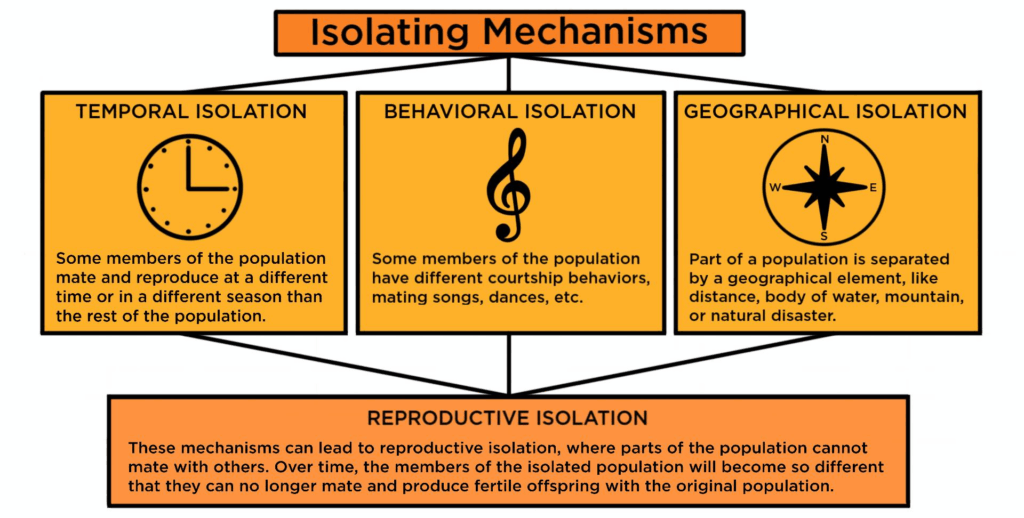
Speciation is the evolutionary process by which populations diverge into distinct species. It occurs when gene flow between populations is reduced or eliminated, often through reproductive isolation. Mechanisms of isolation can be geographical, behavioural, temporal, or genetic. Over time, these differences accumulate, leading to the emergence of new species.
❤️ CAS Link: Organise a nature reserve observation project where students record potential cases of speciation in bird populations based on behaviour and habitat differences.
📌 Reproductive Isolation
- Prezygotic barriers prevent fertilisation:
- Temporal isolation — breeding seasons differ.
- Behavioural isolation — mating signals or rituals differ.
- Mechanical isolation — physical incompatibility of reproductive structures.
- Ecological isolation — species occupy different niches in the same area.
- Gametic isolation — gametes fail to fuse.
- Postzygotic barriers occur after fertilisation:
- Hybrid inviability — embryo fails to develop.
- Hybrid sterility — hybrid grows but is sterile (e.g., mule).
- Hybrid breakdown — first-generation hybrids are viable, but later generations have reduced fitness.
🧠 Examiner Tip: State whether a barrier is prezygotic or postzygotic and give a clear example.
📌 Allopatric Speciation
- Occurs when a population is split by a physical barrier (mountains, rivers, habitat fragmentation).
- Gene flow stops, and populations evolve independently due to natural selection, genetic drift, and mutations.
- Over time, differences accumulate until the populations can no longer interbreed.
- Example: Squirrel species on opposite sides of the Grand Canyon.
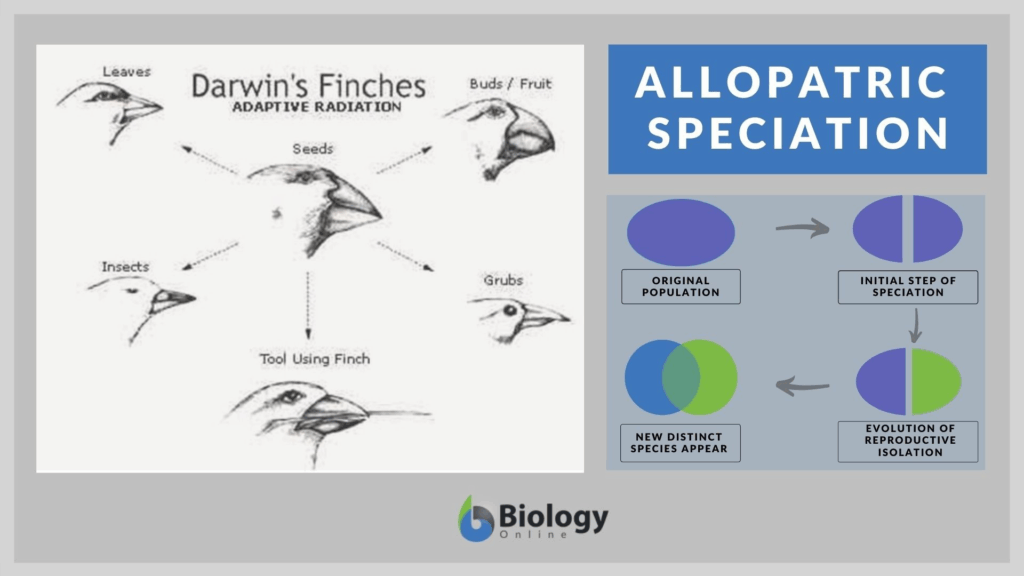
🌍 Real-World Connection: Allopatric speciation is common on islands, where populations are separated by water.
📌 Sympatric Speciation
- Occurs without geographical separation.
- Often due to ecological niche specialisation or behavioural differences within a shared habitat.
- Can result from polyploidy in plants — doubling chromosome numbers creates instant reproductive isolation.
- Example: Cichlid fish species in the same African lake evolved into multiple species with different feeding strategies.
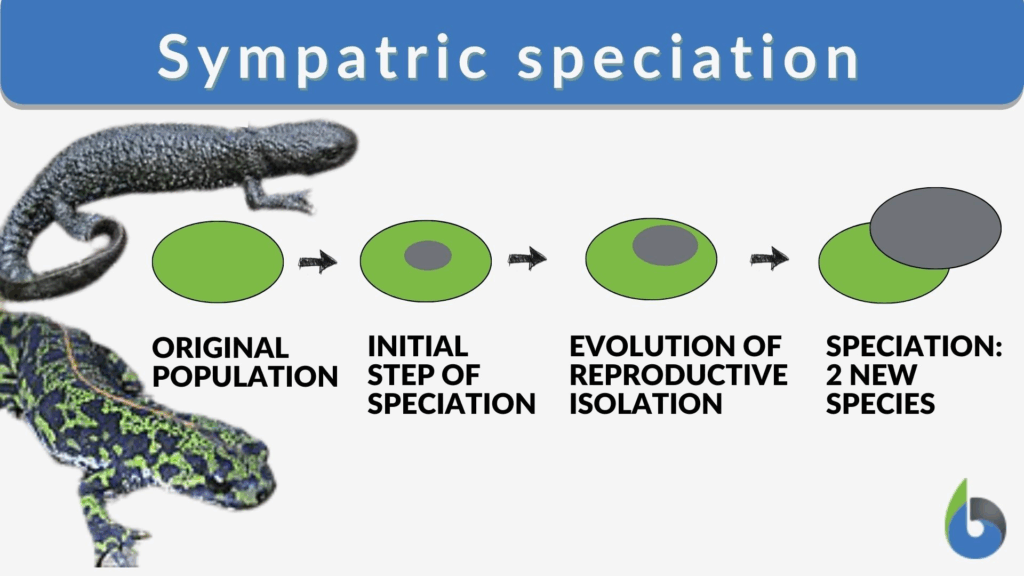
🔍 TOK Perspective: Sympatric speciation challenges the intuitive idea that physical barriers are necessary for new species to arise.
📌 Preventing Hybridisation
- Hybridisation can occur when closely related species meet again.
- Reinforcement — natural selection strengthens reproductive barriers to prevent hybrids with low fitness.
- Habitat preference and mate choice act as behavioural barriers.
- Genetic incompatibility can quickly reduce hybrid success.