A3.2.3 – RECLASSIFICATION & SYSTEM
📌Definition Table
| Term | Definition |
|---|---|
| Reclassification | Changing the classification of an organism based on new evidence. |
| Paraphyletic Group | A group containing a common ancestor but not all of its descendants. |
| Domain | Highest taxonomic rank, above kingdoms, based on fundamental genetic differences. |
| Archaea | Domain of single-celled prokaryotes distinct from bacteria and eukaryotes. |
| Eubacteria | Domain of true bacteria, prokaryotic organisms with peptidoglycan in their cell walls. |
| Eukaryote | Domain of organisms with membrane-bound organelles and a nucleus. |
| Convergent Evolution | Evolution of similar traits in unrelated species due to similar environments. |
📌Introduction
Reclassification occurs when new evidence, particularly from molecular data, reveals that the current taxonomy does not accurately reflect evolutionary relationships. DNA sequencing has shown that many traditional groupings, based on morphology alone, do not form true clades. This has led to splitting, merging, and reorganising taxa. One major outcome has been the development of the three-domain system, recognising fundamental differences between Archaea, Eubacteria, and Eukaryotes.
❤️ CAS Link: Host a student science fair where groups research and present a reclassification case study, such as the figwort family.
📌 Why Reclassification Happens
- New molecular evidence (DNA, mRNA, protein sequences) can contradict morphology-based groupings.
- Traditional taxonomy sometimes placed unrelated organisms together due to convergent evolution.
- Correct clade-based classification ensures groups contain only close evolutionary relatives.
- Reclassification can involve moving species between families, splitting large groups, or merging smaller ones.
🧠 Examiner Tip: When explaining reclassification, always reference new evidence and clade accuracy.
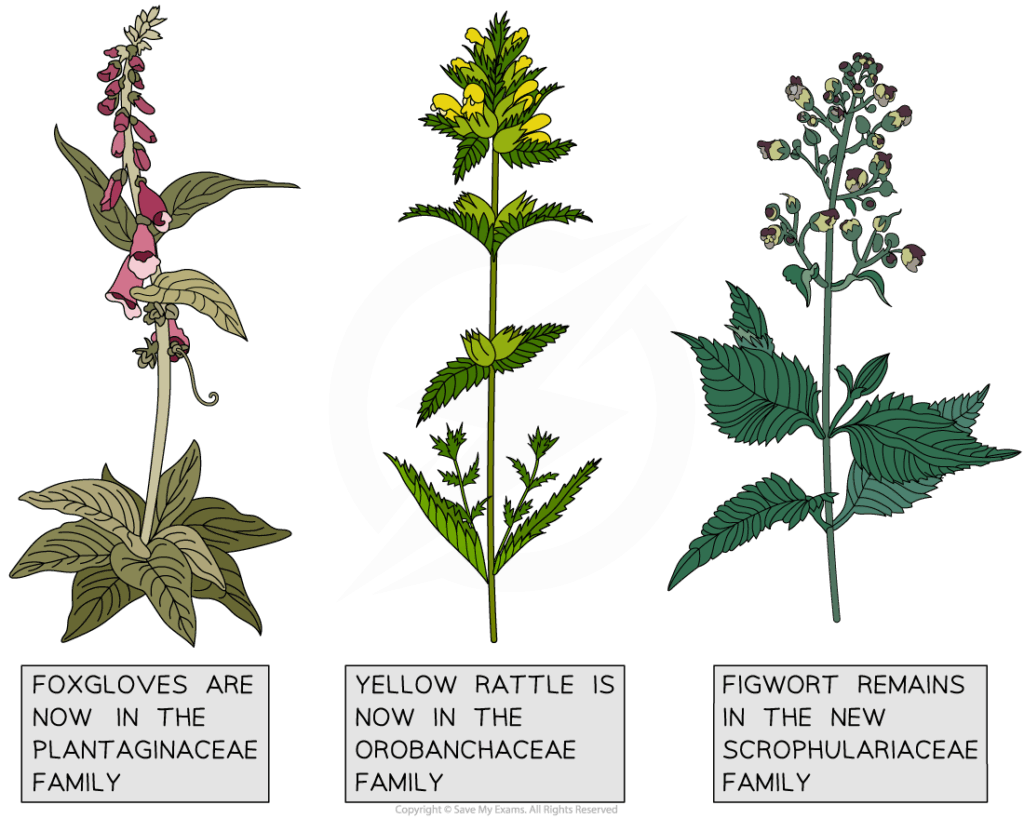
📌 Case Study: The Figwort Family
- Originally classified in the late 1700s based on shared morphological traits (e.g., tube-shaped flowers).
- Grew to over 275 genera in the Scrophulariaceae family.
- DNA analysis of three chloroplast genes revealed the group was paraphyletic.
- Resulted in:
- Creation of new families.
- Movement of genera into existing families.
- Reduction of the figwort family to less than half its original size.
- Demonstrates how morphological similarity can be due to convergent evolution, not shared ancestry.
🌍 Real-World Connection: Archaeal enzymes from thermophiles are used in high-temperature industrial processes like PCR.
📌 The Three-Domain System
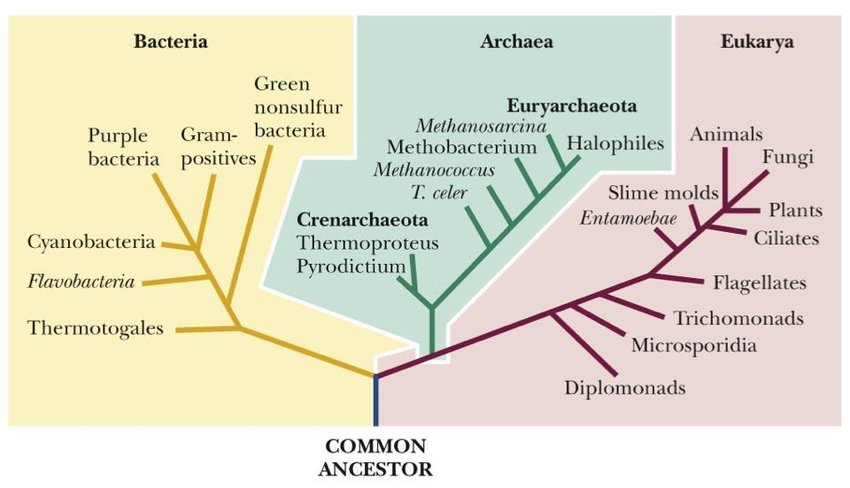
- Developed after rRNA analysis revealed two distinct groups of prokaryotes.
- Domains are the largest taxonomic rank:
- Archaea – Prokaryotes living in extreme environments; unique cell wall and membrane composition; ribosomes more similar to eukaryotes.
- Eubacteria – True bacteria with peptidoglycan cell walls.
- Eukaryotes – Organisms with a nucleus and membrane-bound organelles.
🔍 TOK Perspective: Scientific theories are provisional — new evidence can falsify established ideas, leading to paradigm shifts.
📌 Key Differences Between Domains
| Feature | Archaea | Eubacteria | Eukaryotes |
|---|---|---|---|
| Cell Type | Prokaryotic | Prokaryotic | Eukaryotic |
| Chromosome | Circular | Circular | Linear (plus circular in mitochondria/chloroplasts) |
| Cell Wall | Without peptidoglycan | With peptidoglycan | Sometimes present, never with peptidoglycan |
| Membrane Lipids | Glycerol-ether | Glycerol-ester | Glycerol-ester |
| Ribosomes | 70S (subunit similar to eukaryotes) | 70S | 80S (cytoplasm) & 70S (organelles) |
| Histones | Present | Absent | Present |
| Introns | Sometimes | Rare | Present |