A3.2.2 – CLADISTICS
📌Definition Table
| Term | Definition |
|---|---|
| Cladistics | Method of classifying organisms based on shared ancestry and evolutionary relationships. |
| Clade | A group of organisms that have all descended from a common ancestor. |
| Monophyletic Group | A clade containing all descendants of a single common ancestor. |
| Primitive Trait | A characteristic that evolved early in the history of a clade and is shared by all its members. |
| Derived Trait | A characteristic that evolved later in some members of a clade, but not all. |
| Molecular Clock | The concept that mutations accumulate at a relatively constant rate, allowing estimation of divergence times. |
| Parsimony Principle | The idea that the simplest explanation, involving the fewest evolutionary changes, is preferred. |
📌Introduction
Cladistics focuses on grouping organisms into clades based solely on evolutionary descent from a common ancestor, rather than superficial similarity. Advances in molecular biology, especially DNA sequencing, have made it possible to reconstruct phylogenies with greater accuracy. Cladograms, the visual representation of these relationships, are hypotheses that are continually refined as new evidence emerges.
❤️ CAS Link: Create a school-wide “evolutionary tree mural” showing local species arranged into clades using genetic and morphological data.
📌 Principles of Cladistics
- Groups organisms into clades based on common ancestry.
- Every member of a clade shares a most recent common ancestor not shared with any outside group.
- Clades are monophyletic — all descendants of the common ancestor are included.
- Taxonomy names and organises species; cladistics focuses purely on evolutionary links.
- Correct taxonomy should match clades, but historical errors often cause mismatches.
🧠 Examiner Tip: In questions comparing taxonomy and cladistics, emphasise ancestry vs. appearance.
📌 Evidence Used in Cladistics
- Sequence Data – DNA, mRNA, and amino acid sequences; greater similarity means closer relationship.
- Molecular Clock – Number of sequence differences estimates time since divergence.
- Morphology – Observable traits, used with caution due to convergent evolution.
- Primitive vs. Derived Traits –
- Primitive: Present in all members of a clade (e.g., all vertebrates have spinal cords).
- Derived: Evolved later in some members (e.g., feathers in birds vs. fur in mammals).
🌍 Real-World Connection: Cladistics is used in forensic science to trace the evolutionary source of pathogens in criminal cases.
📌 Constructing Cladograms
- Cladograms show probable order of divergence and relationships.
- Nodes represent common ancestors; the root represents the oldest ancestor of all species shown.
- Built using parsimony principle — fewest evolutionary changes for the simplest tree.
- Sequence data from multiple genes increases reliability.
- Cladograms are hypotheses and may change with new evidence.
🔍 TOK Perspective: Different datasets can produce different cladograms — highlights how scientific conclusions depend on chosen evidence and methods.
📌 Analysing Cladograms
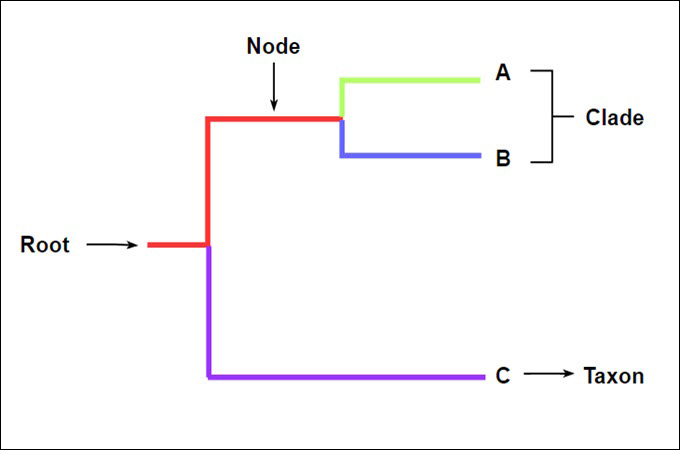
- Nodes closest to two clades show a more recent common ancestor.
- Greater branch length or more sequence differences indicates greater evolutionary distance.
- Some diagrams include a timescale; others show only branching patterns.
- Numbers on branches may represent base or amino acid changes, usable as a molecular clock.
- Relationships are relative — a cladogram shows closeness, not exact divergence dates without molecular data.