3.3 CONSERVATION AND REGENERATION
📌 Definitions Table
| Term | Definition |
|---|---|
| Flagship Species | Charismatic species used to raise public awareness and support for biodiversity conservation. |
| Keystone Species | A species with a disproportionately large effect on ecosystem structure and function relative to its abundance. |
| Sluices | Water-control structures that regulate flow, often used in wetland or floodplain management. |
| Target Species | Species specifically monitored or managed in conservation programs or ecological studies. |
| Viable Populations | Populations that are sufficiently large and genetically diverse to survive and reproduce in the long term. |
| Microclimates | Localized climate conditions that differ from the surrounding area, often influenced by vegetation, topography, or structures. |
| Gene Flow | The transfer of genetic material between populations, promoting genetic diversity and adaptability. |
| Apex Predators | Top-level predators with no natural enemies, regulating populations of other species and maintaining ecosystem balance. |
| Communities | All interacting populations of different species living in the same habitat at the same time. |
| Succession | The gradual process of change in species composition and ecosystem structure over time. |
| Earth System | The interacting physical, chemical, and biological components of Earth, including the atmosphere, hydrosphere, lithosphere, and biosphere. |
| Holocene Epoch | The current geological epoch, beginning around 11,700 years ago, characterized by relative climatic stability. |
| Biosphere Integrity | The maintenance of biodiversity and ecosystem functions critical to Earth system stability. |
| Environmental Justice | The fair treatment and meaningful involvement of all people in environmental decision-making, regardless of race, income, or nationality. |
- 🧠 Exam Tips:
Use examples (e.g., wolves as keystone species, tigers as flagship species) when asked to justify or evaluate.
For biosphere integrity and environmental justice, link to sustainability and systems interconnections.
📌 Preserving Biodiversity
- There are many reasons for maintaining and preserving biodiversity, including:
- Aesthetic reasons
- Ecological reasons
- Economic reasons
- Ethical reasons
- Social reasons
Aesthetic reasons
- Humans find great joy and pleasure in the beauty of nature
- It provides inspiration for human creativity, including photography, poetry, music and art
- There is a strong argument for preserving biodiversity because of its aesthetic benefits
Ecological reasons
- Species and habitats contribute to vital ecological processes and services
- E.g. pollination, water purification, climate regulation and maintaining soil fertility
- Biodiversity has a major effect on the stability and resilience of an ecosystem
- A more diverse ecosystem is better able to recover from disturbances and adapt to environmental changes or threats
- For example, if the temperature of a species-rich lake rises due to global warming:
- Some species of fish in the ecosystem are unable to cope with the change while others can or may be able to adapt
- The fish that are able to cope or adapt will survive, reproduce and keep contributing to the ecosystem, allowing the ecosystem to continue to function
- Within communities, there are keystone species that have a larger impact on the ecosystem than others
- When these species are lost there are knock-on effects
- Bush elephants in the African savannah are a keystone species
- They graze in a very extreme way, knocking over and eating several species of tree
- This destruction of vegetation actually helps to maintain the ecosystem by preventing any one plant species from dominating, creating habitats for other species and increasing biodiversity
- Elephant dung also provides a habitat for many important fungi and insect species
- In cases where elephants have been illegally poached for their ivory and their numbers greatly reduced, ecologist have observed major negative impacts on the savannah ecosystem
Economic reasons
- Ecotourism is a major source of income for many countries
- Natural areas attract tourists, generating revenue for local economies and providing jobs
- E.g. many tourists travel to and spend money in National parks so they can see wildlife
- Natural areas attract tourists, generating revenue for local economies and providing jobs
- Natural capital:
- Natural ecosystems provide resources like timber, fish and clean water
- Maintaining these resources supports long-term economic prosperity
- Genetic resources:
- Wild species are sources of genes for crop improvement, medicine, and biotechnology
- Preserving this genetic diversity could be essential for future innovations and food security
- Many of the medicines used today have originated from plants, fungi and bacteria
- For example, the cancer-fighting drug paclitaxel is sourced from Pacific and Himalayan Yew Trees
- The Himalayan Yew has declined in numbers due to over-harvesting for fuel and medicine
- Due to the large number of drugs that have already been sourced from nature it is reasonable to assume that there are many other drug still to be found in nature that could be used in the future
- For example, the cancer-fighting drug paclitaxel is sourced from Pacific and Himalayan Yew Trees
Ethical reasons
- Many people believe that species and habitats have intrinsic value (i.e. they have inherent worth, independent of their usefulness to humans)
- Many believe that humans have a moral obligation to prevent the loss of biodiversity that results from human activities
- Humans share the planet with millions of other species and many people hold the view that they have no right to cause the extinction of other species
- As humans are the most intelligent, dominant and powerful species on the planet, many believe that it is our responsibility to protect and value all organisms on Earth
- Many believe that is also our ethical obligation to preserve nature for future generations
Social reasons
- Many people enjoy spending time in the natural environment
- There are many activities that people can do together in nature, e.g. birdwatching, walking, climbing
- Access to natural spaces improves mental and physical health
- Such environments may be lost if their biodiversity is not conserved, resulting in the loss of the social benefits that they can bring
🔍 TOK Tip: Should species be conserved based on ecological value or emotional appeal (e.g. flagship species)?
📌 Conservation Strategies
- Conservation strategies are methods used to protect and preserve biodiversity
- These strategies can be divided into:
- Species-based conservation
- Habitat-based conservation
- Mixed approaches
- These strategies can be divided into:
Species-based conservation
- Species-based conservation focuses on protecting individual species, especially those that are endangered
- This often involves ex situ strategies
- This means conservation actions are taken outside the natural habitat of the species
Ex situ strategies
- Botanic gardens:
- Botanic gardens are specially designed areas where a wide variety of plants are grown for scientific, educational and ornamental purposes
- Botanic gardens cultivate and maintain plant species outside their natural habitats
- They provide a safe environment for endangered plants and facilitate research and education.
- For example, Kew Gardens in London holds over 30 000 different plant species.
- Zoos:
- Zoos keep and breed animals in captivity, often focusing on endangered species
- They play a role in education, research and breeding programmes to reintroduce species into the wild
- Captive breeding is the process of breeding animals in controlled environments, such as zoos, aquariums, or wildlife sanctuaries
- These programmes are often used to help restore populations of endangered species that have declined in the wild
- For example, the San Diego Zoo in the United States runs breeding programmes for species like the California Condor
- Zoos also play a role in conservation by raising public awareness and funding other conservation efforts
- Convention on International Trade in Endangered Species of Wild Fauna and Flora (CITES):
- CITES is an international agreement that aims to ensure that international trade in wild animals and plants does not threaten their survival
- It regulates and monitors the trade of endangered species through a licensing system
- For example, CITES has helped to protect many species, including elephants, rhinos and tigers
- Seed banks:
- Seed banks are places where seeds of different plant species are stored to preserve genetic diversity
- They act as a backup against the loss of plants in their natural habitats
- For example, the Svalbard Global Seed Vault in Norway holds seeds from all around the world
Habitat-based conservation
- Habitat-based conservation focuses on protecting and restoring habitats to support the species that live there
- This often involves in situ strategies
- This means conservation actions are taken within the natural habitat of the species
In situ measures
- National parks:
- National parks protect large areas of natural habitat, preserving the ecosystems and species within them
- They also provide opportunities for research, tourism and education
- For example, Yellowstone National Park in the USA protects a variety of ecosystems and species, including grizzly bears and wolves
- Reserves and sanctuaries:
- Wildlife reserves and sanctuaries are areas set aside for the protection of particular species and their habitats
- They often involve community participation and sustainable use of resources
- For example, the Maasai Mara National Reserve in Kenya protects a range of species including lions, elephants and wildebeest
Mixed conservation approach
- A mixed conservation approach combines species-based and habitat-based strategies
- This approach often focuses on flagship or keystone species to justify the conservation of entire ecosystems
Flagship species
- Flagship species are charismatic species that are well-known and popular with the public, such as elephants, pandas or tigers
- They can be used as symbols for conservation efforts and can help to raise awareness and supportfor conservation efforts
- By protecting charismatic species, their habitats and other species in the same ecosystem may also be protected
- An example of a flagship species is the mountain gorilla (Gorilla beringei beringei)
- These primates are found in the Virunga Mountains, which span Rwanda, Uganda, and the Democratic Republic of Congo
- The mountain gorilla population has faced threats from habitat destruction, poaching, and human conflict
- By focusing on the conservation of mountain gorillas and their habitat, conservation organisations have been able to protect not only this species but also the many other plants and animals that share their ecosystem
Keystone species
- Keystone species are species that have a disproportionate effect on the structure and function of their ecosystem.
- Their removal can cause significant changes in the ecosystem, including the loss of other species
- By protecting keystone species, the integrity of the ecosystem can be maintained, which can in turn benefit other species in the ecosystem
- For example, the sea otter is a keystone species in the kelp forest ecosystem in the Pacific Northwest of the United States
- It feeds on sea urchins
- This helps to control the population of sea urchins, which are herbivores that can significantly damage the kelp forests
Case Study
Chengdu Research Base of Giant Panda Breeding
- The Chengdu Research Base of Giant Panda Breeding in China is a good example of a mixed conservation approach, combining species-based and habitat-based strategies to protect the giant panda
Objectives and strategies:
- Captive breeding: running a breeding program to increase the giant panda population.
- Habitat restoration: restoring and expanding bamboo forests, the natural habitat of giant pandas
- Public education and awareness: educating the public through tours, programs and exhibits to generate support for conservation
- Research and collaboration: conducting research on panda biology and collaborating with international organisations
Facilities:
- Breeding centres: areas for breeding and raising panda cubs
- Veterinary hospital: provides medical care for pandas
- Enclosures and habitats: naturalistic spaces for pandas to live and play
- Research laboratories: equipped for scientific research on panda conservation
Achievements:
- Increased panda population: successful breeding programs have raised the number of giant pandas
- Genetic diversity: genetic diversity have been maintained through careful breeding
- Habitat protection: has played a key role in restoring and protecting panda habitats
- Wider ecosystem and species conservation: by focusing on this flagship species, the base has also helped to protect the broader ecosystem and other species within it
🧠 Examiner Tips:
Make sure you know the definitions of the terms ex situ and in situ in the context of conservation strategies.
Be prepared to give examples of both the types of strategies.
Convention on Biological Diversity
- The Convention on Biological Diversity (CBD) is a United Nations treaty aimed at promoting sustainable development and conserving biodiversity
- It was signed at the Earth Summit in Rio de Janeiro in Brazil in 1992
- Objectives:
- The conservation of biodiversity by use of a variety of different conservation methods
- The sustainable use of biological resources
- Identify and protect marine areas beyond national jurisdictions
- Nagoya Protocol:
- The CBD also includes the Nagoya Protocol, which is the part that ensures fair sharing of benefits arising from the use of genetic resources
- The countries that signed the convention agreed to:
- Design and implement national strategies for the conservation and sustainable use of biodiversity
- Organise international cooperation and further international meetings
📌 Habitat Management and Designing Protected Areas
Habitat management
- Habitat conservation strategies aim to protect species by preserving and managing their natural environments
- This may involve the protection of wild areas or active management
- These strategies are crucial for maintaining biodiversity and ensuring the survival of various species
Protection of wild areas
- Protecting wild areas involves:
- Setting aside land that is left in its natural state
- Ensuring this land remains free from significant human interference
- This helps to maintain the habitat necessary for the survival of many species, allowing ecosystems to function naturally
- For example, large areas of the Amazon Rainforest are protected to preserve the rich biodiversity found there
Active management
- Active management refers to human intervention to maintain or restore habitats to a desired condition
- Methods include:
- Controlled burning: this can be used to manage grasslands and forests, promoting the growth of desired plant species
- Reforestation: planting trees to restore deforested areas
- Invasive species control: removing non-native species that threaten local biodiversity
Case Study
Ecosanctuary with pest-exclusion fencing: Zealandia, New Zealand
- Location: Wellington, New Zealand
- Habitat type: forest and scrubland
- Conservation strategies:
- Pest-exclusion fencing: a predator-proof fence encircles the sanctuary to keep out invasive species like rats, stoats and possums
- These are major threats to New Zealand’s native species
- Reintroduction of native species: species such as the little spotted kiwi and tuatara have been reintroduced to the area
- These reintroduction efforts have helped boost populations of species that had declined drastically due to predation by invasive species
- Pest-exclusion fencing: a predator-proof fence encircles the sanctuary to keep out invasive species like rats, stoats and possums
- Surrounding land use: the sanctuary is located near urban areas but is isolated by the fence, creating a safe habitat for native wildlife
Factors in conservation area design
- Effective conservation of biodiversity in conservation areas depends on:
- A detailed understanding of the biology of the target species
- The size and shape of the conservation area
- These factors help ensure that the ecosystem or habitat:
- Meets the needs of the species
- Maintains ecological processes
Biology of target species
- Habitat requirements: understanding what specific conditions the species needs to thrive, such as food, water, shelter and breeding sites
- Home range: knowing the area size that individual animals or groups need to roam and find resources
- Life cycle: understanding the different life stages of the species and their varying habitat requirements
- Threats: identifying natural and human threats to the species, such as predation, disease, habitat destruction and climate change
Size and shape of conservation areas
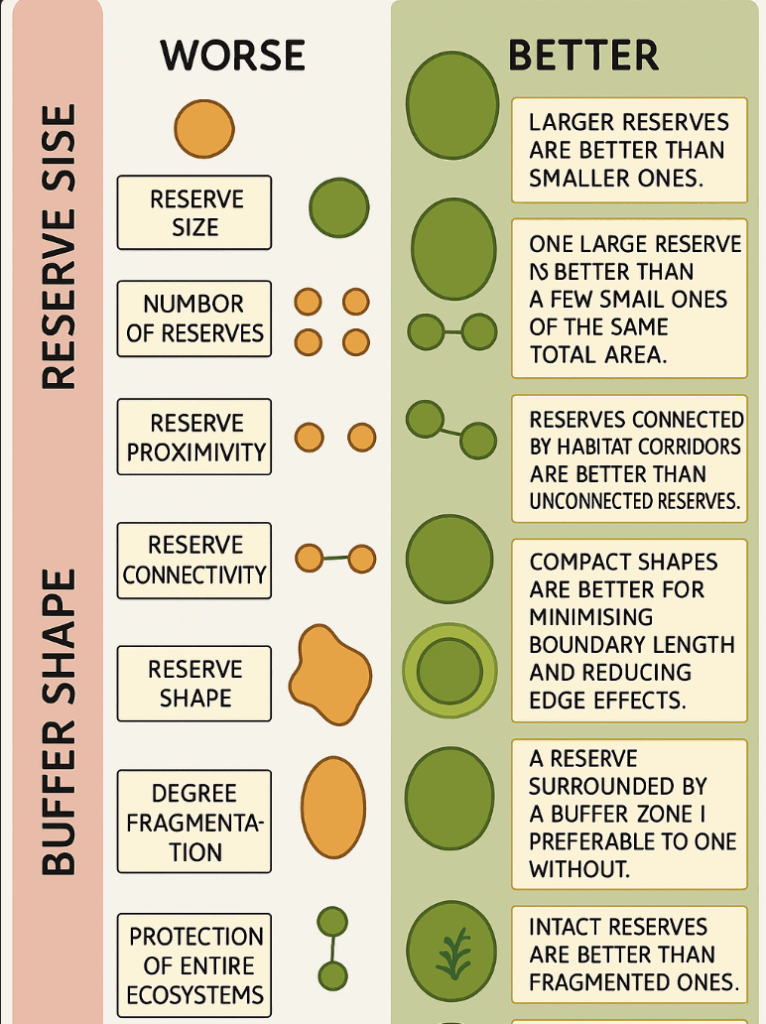
- Factors that need to be considered when designing protected areas include:
- Size
- Shape
- Edge effects
- Corridors
- Proximity to potential human influence
Protected Area Design Factors
| Criteria for designing protected area | Explanation |
|---|---|
| Size | Larger areas can support more species, have larger populations and provide a greater range of habitatsThe size should be large enough to maintain viable populations of target species |
| Shape | The shape of a protected area can affect its biodiversity by influencing the distribution of habitats and the movement of organismsA complex shape can increase edge effects, while a simple shape may not provide enough habitat varietyIrregular shapes that follow natural features like rivers and ridges can provide better connectivity and help ecological processes |
| Edge effects | Edge effects refer to the changes that occur at the boundary between two different habitats or land-use types, e.g. at the boundary of a protected areaProtected areas with high edge-to-area ratios can have negative effects on biodiversity due to increased exposure to human disturbances, invasive species and variable microclimatesMinimising edge effects can be achieved by creating protected areas with simple shapes or using buffer zones around the edges |
| Corridors | Corridors are narrow strips of land that connect otherwise isolated areas of habitatThey can facilitate the movement of organisms and allow for gene flow between populationsCorridors can also provide additional habitat and increase the effective size of a protected areaThe effectiveness of corridors depends on their width, length and the surrounding land use |
| Proximity to potential human influence | Human activities can have negative impacts on biodiversityProtected areas that are close to human settlements or infrastructure may be subject to habitat destruction, pollution and huntingIt is important to balance the need for accessibility and the potential for human impact when designing protected areas |
Surrounding land use
- Agricultural land: risk of pollution (e.g. via nutrient runoff), habitat fragmentation and human-wildlife conflicts
- Urban areas: higher risk of human disturbance and spread of invasive species, but can provide education and recreational opportunities
- Industrial areas: potential pollution and habitat destruction
Distance from urban centres
- Close proximity: easier access for management and public education, but higher human pressure and disturbance
- Remote locations: less human disturbance, better preservation of natural states, but harder for conservation workers to access and manage
📌 Rewilding
- Human activities such as deforestation and overharvesting of resources can disrupt, damage and destabilise ecosystems
- Conservation efforts at the ecosystem level aim to restore ecosystem stability by restoring natural ecosystem processes
- These processes may include:
- Predator-prey relationships
- Seed dispersal
- Nutrient cycling
- These processes may include:
- This type of ecosystem restoration project is also known as rewilding
- Restoration strategies may involve:
- Species reintroduction
- Reintroduction of apex predators will reduce herbivore populations and allow the restoration of habitat vegetation
- This may boost the diversity of plant species
- This, in turn, enhances total biodiversity
- For example, wolves were reintroduced to Yellowstone National Park, USA
- The wolves help to control deer populations
- This has allowed certain types of vegetation to recover
- Reintroducing keystone species can improve the structure of an ecosystem
- For example, beavers have been reintroduced to parts of the UK
- Beavers build dams
- These dams create large wetland areas that support diverse wildlife
- Improving habitat connectivity
- This involves connecting fragmented habitats to allow free movement of species
- Creating wildlife corridors, such as hedgerows on farmland, connects small pockets of habitat
- This allows wildlife to roam over larger areas, increasing the resources available
- This allows larger population sizes to establish
- Stopping agriculture
- Allowing land previously used for farming to return to its natural state
- For example, the Knepp Estate in England has been rewilded
- This former farmland now supports wild ponies, pigs and longhorn cattle
- These species promote biodiversity by disturbing soils, dispersing seeds and grazing on vegetation, so no single plant species dominates
- Allowing land previously used for farming to return to its natural state
- Limiting human influence
- This may involve preventing the harvesting of resources, e.g. by logging or fishing
- Ecological management techniques, e.g. controlled grazing or burning, may be used to restore a habitat
- The aim is to minimise direct human management and let ecosystems self-regulate as much as possible
- Species reintroduction
📌 Biodiversity Planetary Boundary
- The planetary boundaries model outlines nine critical processes and systems that have regulated the stability and resilience of the Earth system during the Holocene epoch
- The model identifies the level of human disturbance on certain fundamental ecological processes and systems
- It aims to highlight where action is needed in order to avoid abrupt and irreversible changes
- The biodiversity planetary boundary refers to the limits within which humanity can safely operate to maintain the Earth’s biodiversity
- The boundary is often referred to as biosphere integrity
- Protecting biosphere integrity means preventing the loss of species (and therefore genetic diversity) and the loss of ecosystem functioning
- This is important as biodiversity loss can have significant negative impacts on human life and the planet’s health
Current state of the biodiversity planetary boundary
- Biodiversity loss is occurring at an alarming rate due to human activities such as deforestation, pollution and overfishing, as well as human-induced climate change
- Scientists estimate that we have already crossed the biodiversity planetary boundary
- This means the current rate of species extinction is higher than the safe limit
- Conservation and ecosystemregeneration measures can be used to reverse this decline in biodiversity
- The aim is to move back towards a safe operating space for humanity within the biodiversity planetary boundary
- In order for this to be achieved, these measures will need to be implemented at all levels, including:
- Individual behaviours, e.g.
- Reduce, reuse, recycle
- Sustainable consumption
- Collective actions, e.g.
- Local conservation projects, such as tree planting or habitat restoration,
- Increase understanding of biodiversity issues within communities through workshops and educational programmes
- National measures, e.g.
- Establish national parks and wildlife reserves
- Enforce laws that prevent illegal logging, poaching and trade in endangered species
- Providing financial incentives for businesses and farmers to adopt environmentally friendly practices
- International efforts, e.g.
- Participate in international treaties and agreements, such as the Convention on Biological Diversity (CBD)
- Contribute to international funds that support biodiversity projects in developing countries
- Sharing scientific knowledge and technologies across borders to enhance conservation efforts
- Individual behaviours, e.g.
📌 Conservation Perspectives
Impact of environmental perspectives and value systems
- Environmental perspectives and value systemsinfluence the choice of conservation strategies
- Ecocentric perspectives:
- Focus on the intrinsic value of biodiversity
- Prioritise low-intervention in situ strategies
- This refers to conservation strategies that involve minimal human interference and are implemented within the natural habitats or ecosystems where species live
- Example: setting aside large areas of land as wilderness reserves or national parks, such as the Cairngorms National Park in Scotland (UK)
- Anthropocentric/technocentric perspectives:
- Focus on the economic and societal value of biodiversity
- Encourage scientific interventions, zoos, gene banks and ecotourism
- Example: conservation breeding programme for European bison at the Highland Wildlife Park in Scotland (UK)
- Ecocentric perspectives:
Factors influencing conservation success
- The success of conservation and regeneration measures depends on:
- Community support:
- Engaging local communities in conservation efforts
- Getting volunteers to help complete projects
- Example: Snowdonia National Park Authority has a successful partnership with local farmers in Wales (UK) to manage and conserve the upland landscapes of Snowdonia National Park (known as Eryri)
- Adequate funding:
- Securing financial resources for conservation projects
- Example: the National Lottery Heritage Fund supports biodiversity conservation projects across the UK
- Education and awareness:
- Raising public awareness about conservation issues
- Example: millions of people watched the BBC’s Blue Planet II documentary series, which highlighted the effects of plastic pollution on marine ecosystems
- Appropriate legislation:
- Implementing laws and regulations to protect biodiversity
- Example: the Wildlife and Countryside Act 1981 in the UK provides legal protection to endangered species and habitats
- Scientific research:
- Informing conservation decisions through scientific knowledge.
- Example: the British Trust for Ornithology (BTO) conducts extensive research on bird populations to guide conservation efforts
- Community support:
Environmental justice considerations
- It is also important to consider issues of environmental justice in conservation efforts
- Conservation efforts should try to ensure that different social groups receive a fair share of conservation benefits and burdens
- For example, the Marine Conservation Zones (MCZs) in the UK are established to protect marine habitats and species while also considering the livelihoods of local communities
- Stakeholders, including fishermen, conservationists and local residents, are involved in the decision-making process to balance ecological protection with economic and social needs
- This collaborative approach helps ensure that the benefits of conservation, such as improved fish stocks and healthier ecosystems, are shared among different social groups
- At the same time, the potential burdens to certain groups, like restrictions on fishing, are fairly managed
🔍 TOK Tip: How does language shape how we value nature?