D2.3.3 WATER MOVEMENT IN PLANTS
📌Definition Table
| Term | Definition |
|---|---|
| Apoplast pathway | Movement of water through cell walls and intercellular spaces. |
| Symplast pathway | Movement of water through cytoplasm via plasmodesmata. |
| Transmembrane pathway | Movement of water across cell membranes repeatedly via aquaporins. |
| Cohesion-tension theory | Explains upward water transport in xylem via cohesion and transpiration pull. |
| Transpiration | Loss of water vapour from leaves through stomata. |
| Root pressure | Osmotic pressure in roots that pushes water upward in xylem. |
📌Introduction
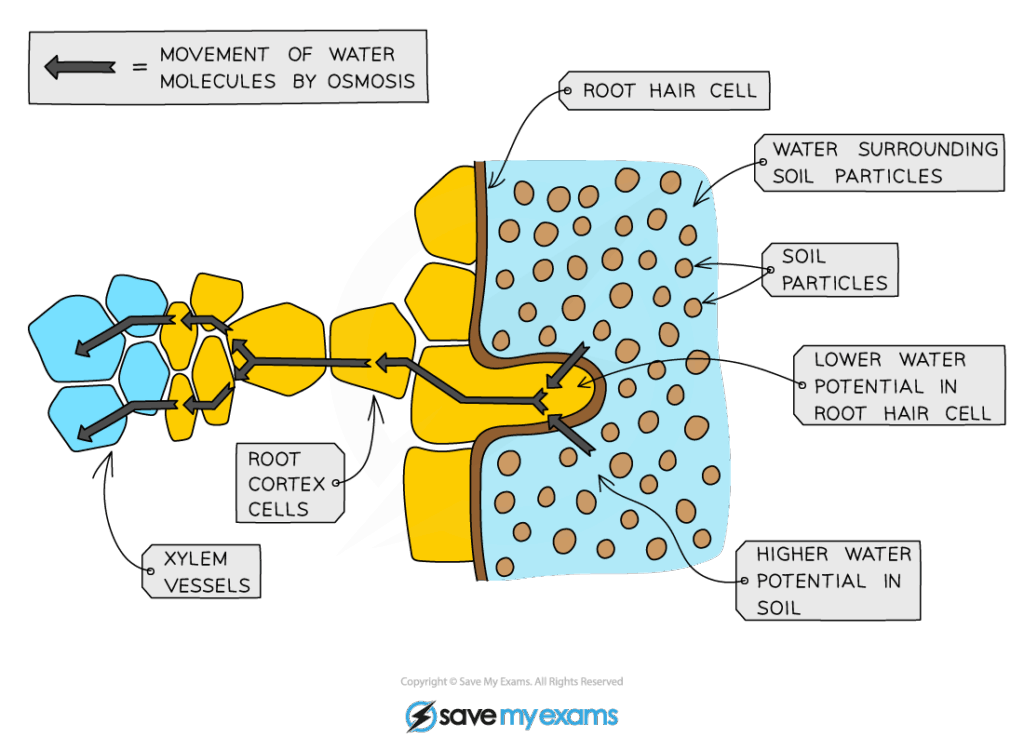
Water transport in plants occurs from roots to leaves through integrated pathways, driven by water potential gradients. Root absorption, xylem transport, and transpiration are coordinated by physical and biological processes. Cohesion, adhesion, and tension explain how water columns remain continuous despite being pulled upwards against gravity
📌 Pathways of Water Movement
- Apoplast pathway: fast movement through cell walls until Casparian strip blocks entry.
- Symplast pathway: water flows cell-to-cell via plasmodesmata.
- Transmembrane pathway: aquaporins regulate selective water movement.
- Casparian strip ensures all water entering xylem crosses a plasma membrane.
- Multiple pathways allow redundancy and regulation.
🧠 Examiner Tip: Always mention the Casparian strip as a checkpoint — this ensures selective uptake of ions and prevents harmful substances from freely entering the xylem.
📌 Driving Forces of Transport
- Root pressure: minor contributor, generated by osmotic uptake in roots.
- Cohesion-tension theory: transpiration pull creates negative pressure in xylem.
- Cohesion between water molecules maintains continuous column.
- Adhesion to xylem walls prevents collapse under tension.
- Negative pressure gradient drives water upwards passively.
🧬 IA Tips & Guidance: A simple IA could measure transpiration using a potometer under varying light, humidity, or wind conditions to show environmental effects on water movement.
📌 Transpiration Stream

- Evaporation from mesophyll cells creates negative pressure.
- Pulls water from xylem into leaf tissue.
- Supplies minerals dissolved in water.
- Helps cool plant by evaporative cooling.
- Rate regulated by stomatal opening and cuticle thickness.
🌐 EE Focus: An EE could compare transpiration rates in sun vs shade plants, linking water transport efficiency to ecological adaptations.
📌 Regulation and Adaptations
- Stomata regulate water loss vs CO₂ uptake.
- Xerophytes: thick cuticles, sunken stomata, CAM photosynthesis reduce water loss.
- Hydrophytes: large air spaces aid gas exchange and buoyancy.
- Mesophytes: balanced features for moderate environments.
- Shows diversity of structural/physiological adaptations.
❤️ CAS Link: Students could build potometers for school/community gardens to demonstrate practical plant physiology.
🌍 Real-World Connection: Understanding water transport is critical for agriculture under climate change. Crop breeding now focuses on water-use efficiency to maintain yields in drought.
📌 Xylem Structure and Function
- Lignified walls provide support under negative pressure.
- Vessel elements and tracheids adapted for efficient water transport.
- Pits allow lateral movement between xylem elements.
- Dead cells reduce resistance by removing organelles.
- Structure-function correlation illustrates plant engineering for water movement.
🔍 TOK Perspective: The cohesion-tension theory is widely accepted, but direct observation is impossible. TOK issue: To what extent should models be trusted when they cannot be directly proven, only inferred?