D2.3.2 PRESSURE POTENTIAL AND CELL TURGOR
📌Definition Table
| Term | Definition |
|---|---|
| Pressure potential (Ψp) | Hydrostatic pressure exerted by cell contents against cell wall. |
| Turgor pressure | Internal pressure that keeps plant cells rigid and tissues upright. |
| Incipient plasmolysis | Point where Ψp = 0 and plasma membrane detaches from cell wall. |
| Wall pressure | Force exerted by cell wall back on the protoplast, balancing turgor. |
| Flaccid cell | Cell with no net pressure, soft and limp. |
| Wilting | Loss of turgor in plant tissues due to water deficit. |
📌Introduction
Pressure potential is the second key component of water potential, arising from the physical pressure inside plant cells. Together with solute potential, it determines the direction of water flow. Turgor pressure is vital for maintaining cell rigidity, supporting plant structure, and driving growth through cell expansion
📌 Role of Pressure Potential (Ψp)
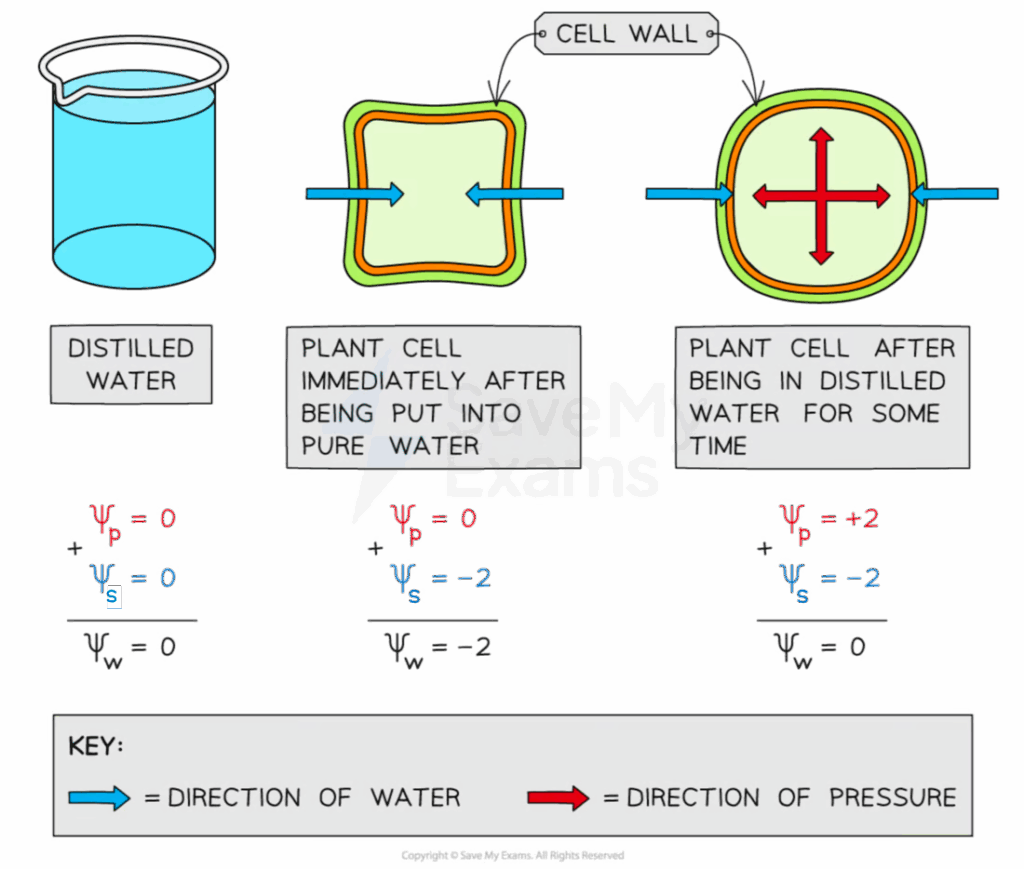
- Positive pressure builds up as water enters a cell in hypotonic solution.
- Provides counterforce to Ψs, preventing excessive water entry.
- Keeps plant cells turgid → structural support without skeleton.
- Enables growth by cell expansion, as pressure stretches the wall.
- Loss of Ψp leads to wilting, reduced photosynthesis, and metabolic slowdown.
🧠 Examiner Tip: Many students forget Ψp can be positive or zero, but never negative in living cells. Ψs is always negative.
📌 Turgor Pressure in Plant Physiology
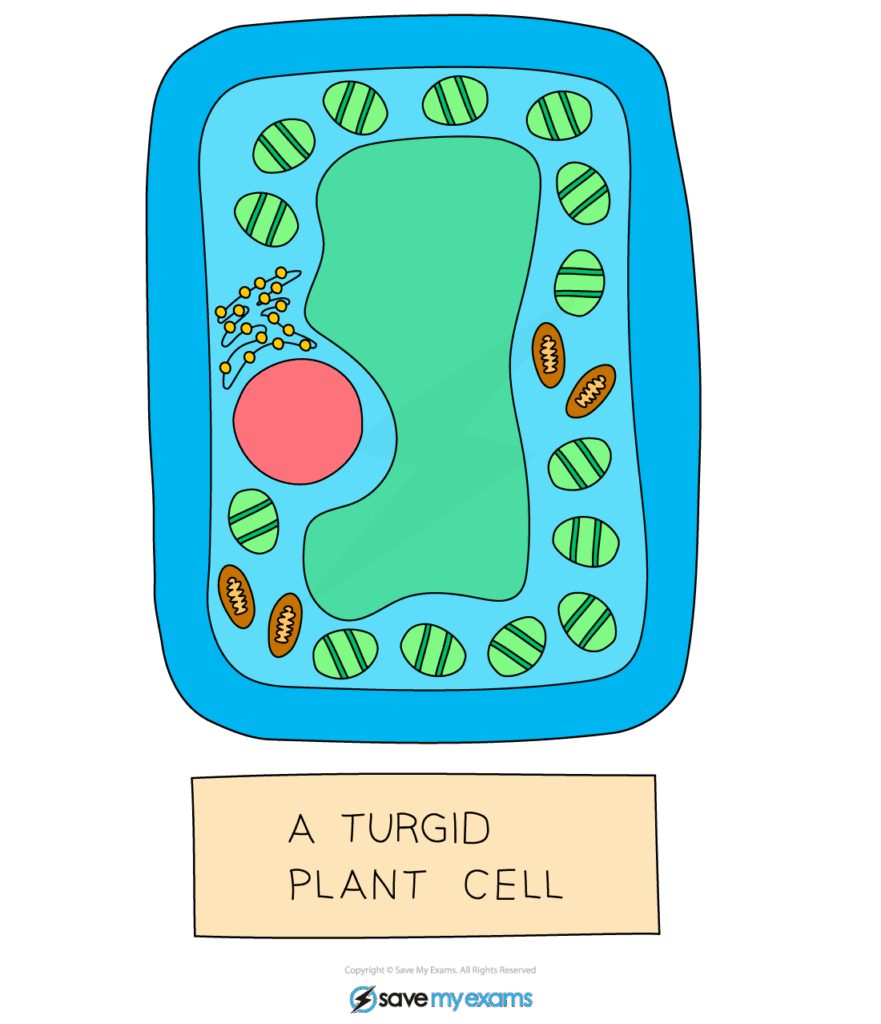
- Guard cells: turgor changes open/close stomata to regulate gas exchange.
- Leaf movements: turgor-driven changes in pulvini cells control nyctinasty (sleep movements).
- Growth zones: elongation requires local wall loosening under turgor force.
- Provides resistance to wilting in drought-tolerant plants.
- Turgor collapse is reversible if water is restored before permanent plasmolysis.
🧬 IA Tips & Guidance: Students can use a pressure probe to measure Ψp in plant cells or compare wilting rates under different humidity/light conditions.
📌 Interaction of Ψs and Ψp
- Water potential equation Ψ = Ψs + Ψp explains water status.
- At full turgor: Ψp balances Ψs, preventing further uptake.
- At incipient plasmolysis: Ψp = 0, water potential determined solely by Ψs.
- Explains osmotic adjustment in drought-stressed plants.
- Allows quantification of water relations in tissues.
🌐 EE Focus: An EE could analyse adaptations in desert plants that maintain Ψp, such as osmotic adjustment by accumulating solutes.
📌 Agricultural and Ecological Relevance
- Irrigation practices must prevent Ψp collapse through soil water deficits.
- Wilting reduces crop yield; recovery depends on restoring Ψp quickly.
- High turgor required for fruit enlargement and storage root swelling.
- Stomatal regulation under water stress balances Ψp with photosynthetic needs.
- Ecological distribution of species often linked to ability to maintain Ψp.
❤️ CAS Link: Students could create an awareness project on watering schedules and plant wilting for school/community gardens.
🌍 Real-World Connection: Pressure potential is crucial in post-harvest biology; loss of turgor explains wilting of vegetables and cut flowers. Solutions in floriculture aim to restore Ψp to prolong freshness.
📌 Cell Wall–Turgor Interplay
- Cell wall provides resistance to overexpansion.
- Dynamic remodeling allows controlled growth.
- Mutants with weak walls show irregular swelling under turgor.
- Wall–turgor interactions key in tropic responses.
- Balance ensures structural integrity of plants.
🔍 TOK Perspective: The concept of Ψp is measured indirectly; TOK issue: To what extent do models of “invisible forces” like turgor pressure help us understand plant physiology, despite not being directly observable?