D1.2.1 TRANSCRIPTION AND RNA PROCESSING
📌Definition Table
| Term | Definition |
|---|---|
| Transcription | Process of synthesizing mRNA from a DNA template strand. |
| RNA polymerase | Enzyme that catalyzes the synthesis of RNA from DNA. |
| Promoter | Non-coding DNA sequence where RNA polymerase binds to initiate transcription. |
| Intron | Non-coding sequence in pre-mRNA that is removed during RNA processing. |
| Exon | Coding sequence of pre-mRNA that remains in mature mRNA after splicing. |
| Splicing | Process of removing introns and joining exons to form mature mRNA. |
📌Introduction
Transcription is the first step of protein synthesis, converting the genetic code of DNA into a complementary RNA sequence. In eukaryotes, this occurs in the nucleus, where RNA polymerase synthesizes pre-mRNA that undergoes post-transcriptional modifications such as capping, polyadenylation, and splicing. These modifications protect RNA from degradation, regulate export from the nucleus, and increase proteome diversity through alternative splicing.
📌 Mechanism of Transcription
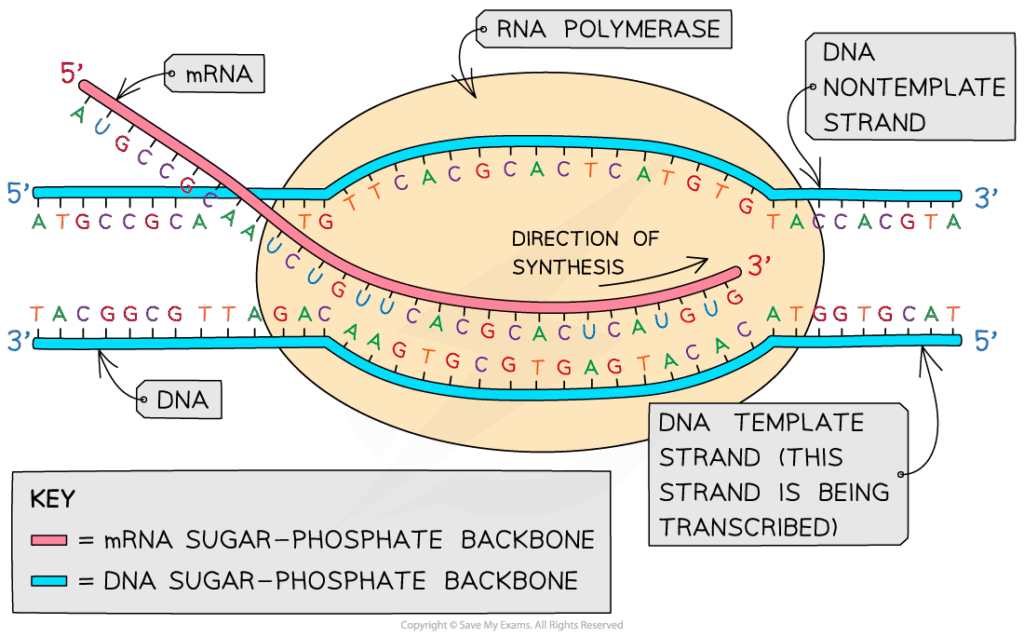
- DNA double helix unwinds and hydrogen bonds break at the gene region.
- RNA polymerase binds to the promoter and synthesizes RNA in a 5′→3′ direction using the template strand.
- Complementary base pairing occurs, with uracil replacing thymine.
- Transcription is divided into initiation, elongation, and termination phases.
- The resulting pre-mRNA contains both introns and exons.
🧠 Examiner Tip: Do not confuse RNA polymerase (used in transcription) with DNA polymerase (used in replication).
📌 RNA Processing and Gene Expression
- Pre-mRNA undergoes modification before leaving the nucleus.
- Addition of a 5′ methyl cap protects mRNA from degradation.
- Addition of a poly-A tail at the 3′ end enhances stability and transport.
- Splicing removes introns and joins exons; alternative splicing allows a single gene to produce multiple proteins.
- Processed mRNA leaves the nucleus through nuclear pores for translation.
🧬 IA Tips & Guidance: An IA could investigate how transcription inhibitors (e.g., antibiotics like rifampicin) affect bacterial growth, linking molecular processes to observable outcomes.
📌 Gene Regulation via Transcription
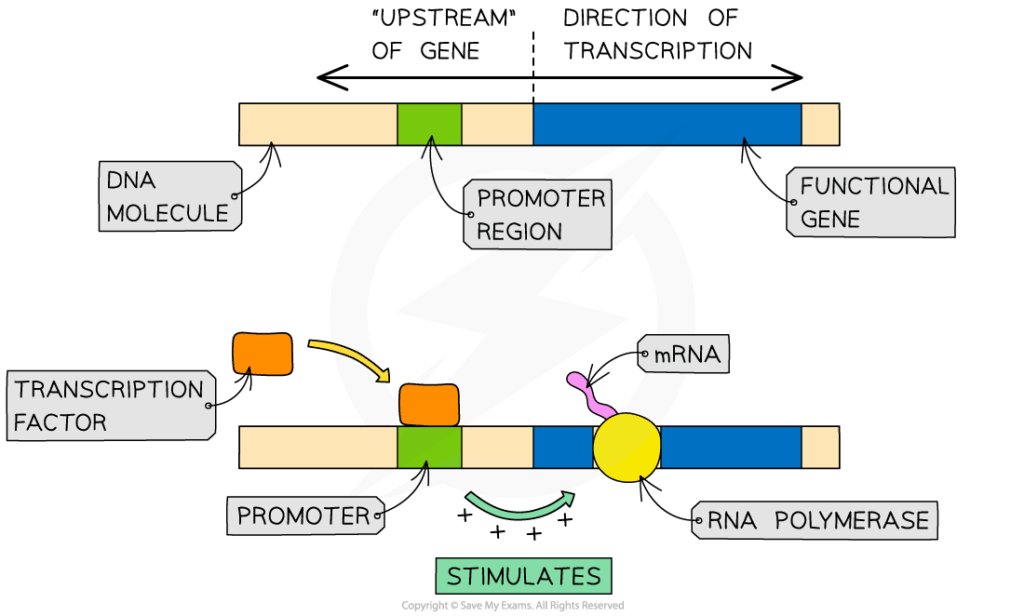
- Not all genes are expressed in all cells; transcription is the main control point.
- Transcription factors regulate RNA polymerase binding to promoters.
- Enhancers and silencers modulate gene activity, enabling cell specialization.
- Epigenetic modifications such as DNA methylation influence transcription levels.
- Misregulation of transcription is linked to diseases like cancer.
🌐 EE Focus: An EE could explore alternative splicing and its role in expanding the proteome, or investigate how transcription errors contribute to genetic diseases.
📌 RNA Processing and Proteome Diversity
- Alternative splicing creates different proteins from a single gene.
- Example: tropomyosin gene generates distinct isoforms in muscle vs. non-muscle cells.
- RNA editing can chemically alter nucleotides, changing the resulting protein.
- Regulation at this stage increases adaptability and complexity in eukaryotes.
- Defects in splicing machinery can cause genetic disorders (e.g., spinal muscular atrophy).
❤️ CAS Link: Students can create models of transcription and RNA processing using colored beads or string to demonstrate how exons and introns are rearranged, linking molecular biology to classroom creativity.
🌍 Real-World Connection: Errors in RNA processing can lead to serious diseases such as β-thalassemia, where splicing mutations cause faulty hemoglobin. Many modern therapies, including mRNA vaccines, rely on understanding RNA processing to ensure stability and translation efficiency. Antisense oligonucleotide therapies target splicing errors, showing how knowledge of RNA biology directly informs medical treatments.
📌 Integration with Genetic Expression
- Transcription and RNA processing are tightly coupled with gene expression.
- Control at this level ensures that proteins are produced only where and when needed.
- RNA modifications also impact translation efficiency and protein stability.
- These processes highlight the complexity of the central dogma beyond the simple DNA → RNA → Protein pathway.
- Research into RNA regulation has expanded into RNA interference (RNAi) and microRNAs.
🔍 TOK Perspective: Much of transcription and RNA processing is studied indirectly using molecular markers, gels, or sequencing. TOK reflection: To what extent can we claim certainty about unseen molecular events, and how does technological interpretation shape our knowledge?