D1.1.3 ACCURACY, ERRORS AND REPAIR IN DNA REPLICATION
📌Definition Table
| Term | Definition |
|---|---|
| Proofreading | Activity of DNA polymerases that detects and corrects mismatched bases during replication. |
| Mutation | Permanent change in DNA sequence due to replication error or DNA damage. |
| Mismatch repair | Post-replication correction system that identifies and fixes base mispairings missed by proofreading. |
| Excision repair | Mechanism that removes damaged bases or nucleotides and replaces them with correct ones. |
| Mutagen | Agent (chemical, radiation, virus) that increases mutation rate. |
| Genome stability | Maintenance of DNA sequence integrity across generations. |
📌Introduction
DNA replication must be highly accurate to preserve genetic information. Despite the enormous number of nucleotides copied in every cell division, the error rate is remarkably low (about 1 mistake per 10⁹–10¹⁰ nucleotides). This fidelity results from multiple error-prevention mechanisms, including polymerase proofreading and specialized DNA repair systems. When these systems fail, mutations accumulate, contributing to cancer, aging, and genetic diseases.
📌 Accuracy of DNA Replication
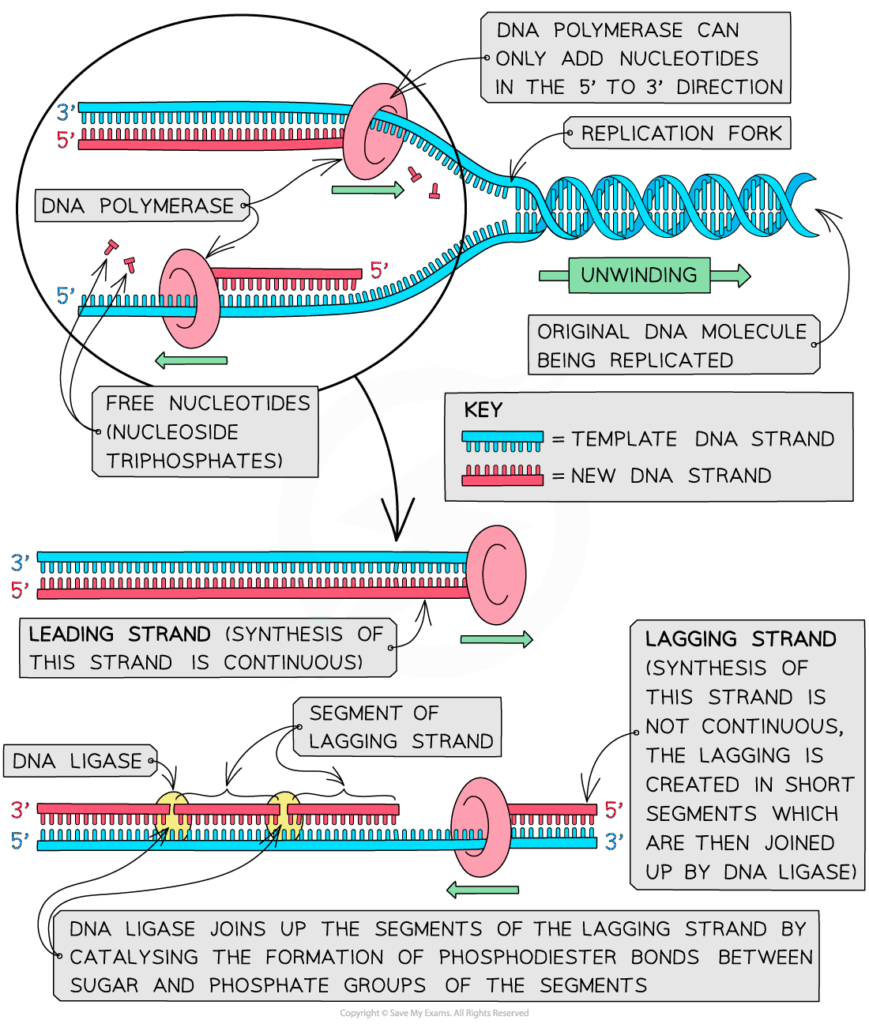
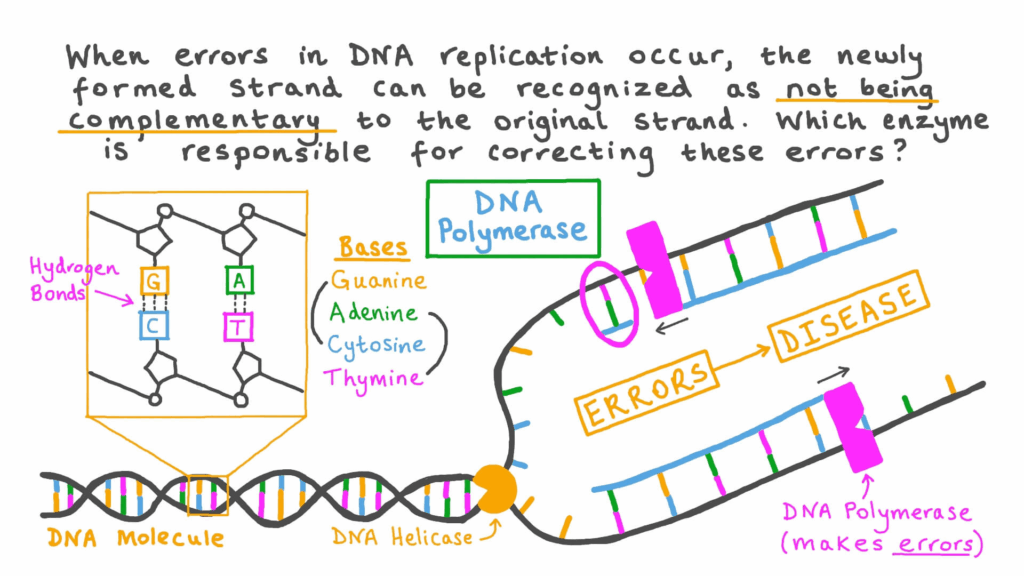
- DNA polymerase has intrinsic proofreading activity (3′→5′ exonuclease function) that removes incorrectly paired nucleotides.
- Complementary base-pairing ensures most nucleotides are added correctly in the first place.
- Error rate before proofreading = ~1 in 10⁵ nucleotides; after proofreading, reduced to ~1 in 10⁷.
- Post-replication repair mechanisms reduce the overall error rate further to ~1 in 10⁹–10¹⁰.
- High fidelity is essential for genetic stability and faithful inheritance.
🧠 Examiner Tip: Always mention proofreading by DNA polymerase and mismatch repair together for maximum marks.
📌 Sources of Errors and DNA Damage
- Replication errors: mismatched bases, insertions, or deletions.
- Chemical damage: oxidation, alkylation, cross-linking of bases.
- Radiation: UV light causes thymine dimers; ionizing radiation creates strand breaks.
- Mutagens and carcinogens: increase likelihood of errors (e.g., tobacco smoke, asbestos).
- Endogenous factors: reactive oxygen species (ROS) from metabolism damage DNA.
🧬 IA Tips & Guidance: A model IA could explore how environmental conditions (UV exposure, chemical treatments) affect DNA integrity in bacterial cultures, linking experimental outcomes to repair mechanisms.
📌 DNA Repair Mechanisms
- Proofreading (DNA polymerase): immediate correction during synthesis.
- Mismatch repair: detects distortions in helix due to base-pair mismatches; excises error and resynthesizes correct DNA.
- Base excision repair (BER): removes damaged bases (e.g., uracil misincorporation) and replaces them with correct bases.
- Nucleotide excision repair (NER): removes bulky lesions like thymine dimers caused by UV light.
- Double-strand break repair: uses homologous recombination or non-homologous end joining (NHEJ) to repair severe breaks.
- Telomere maintenance: telomerase prevents loss of important sequences at chromosome ends.
🌐 EE Focus: An EE could investigate links between defective repair systems (e.g., xeroderma pigmentosum from NER failure) and disease, or analyze mutation rates under different environmental conditions.
📌 Consequences of Replication Errors
- Silent mutations: do not change amino acid sequence, little to no effect.
- Missense mutations: change one amino acid, potentially altering protein function.
- Nonsense mutations: create premature stop codons, truncating proteins.
- Frameshift mutations: insertions or deletions shift reading frame, usually highly damaging.
- Large-scale errors: chromosomal rearrangements, duplications, or deletions.
- Accumulation of mutations contributes to cancer, aging, and heritable diseases.
❤️ CAS Link: Students could organize awareness activities on how lifestyle factors (smoking, UV exposure, diet) increase DNA mutation rates and cancer risk, linking biology to community health education.
🌍 Real-World Connection:
DNA replication errors and repair mechanisms have direct implications for medicine and biotechnology. Defective repair pathways underlie diseases such as xeroderma pigmentosum (NER failure causing UV sensitivity), Lynch syndrome (mismatch repair deficiency linked to colorectal cancer), and BRCA1/BRCA2 mutations (impaired double-strand break repair increasing cancer risk). Understanding these systems allows development of targeted therapies, such as PARP inhibitors in BRCA-related cancers. In biotechnology, DNA repair is harnessed in CRISPR gene editing, which depends on cellular repair pathways to introduce specific genetic modifications.
📌 Integration with Genome Stability and Evolution
- Repair systems ensure continuity of genetic information across generations.
- Controlled mutation provides raw material for evolution and adaptation.
- Balance between fidelity and flexibility is key: too many errors cause disease; too few limit evolution.
- Epigenetic modifications and chromatin remodeling also influence repair efficiency.
- Genome stability is a central theme in cancer biology and developmental genetics.
🔍 TOK Perspective: DNA repair mechanisms are largely inferred from indirect evidence (gel assays, radioactive labeling, sequencing). TOK reflection: To what extent can unseen molecular processes be considered “certain knowledge,” and how does reliance on indirect evidence shape scientific confidence?