D1.1.2 MECHANISM OF SEMICONSERVATIVE REPLICATION
📌Definition Table
| Term | Definition |
|---|---|
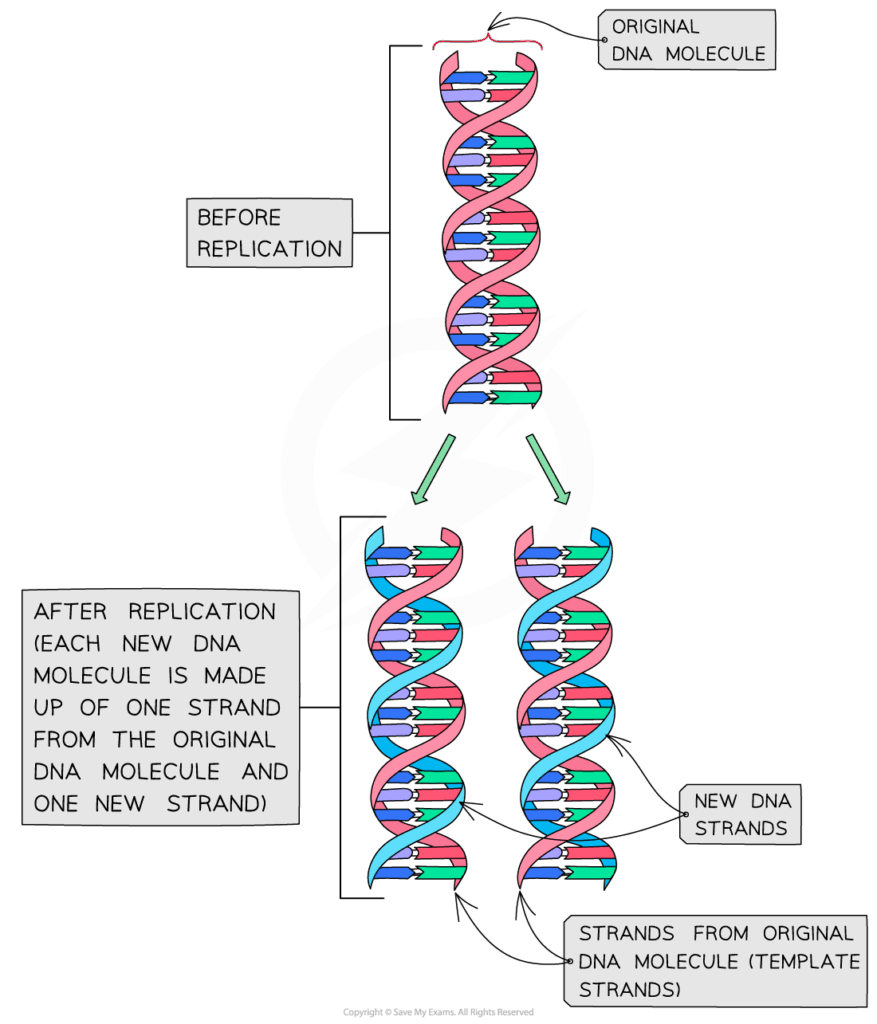
| Semi-conservative replication | DNA replication mechanism where each new double helix has one parental strand and one newly synthesized strand. |
| Replication fork | Y-shaped structure formed during unwinding of DNA where new strands are synthesized. |
| Leading strand | DNA strand synthesized continuously in the 5′→3′ direction toward the replication fork. |
| Lagging strand | DNA strand synthesized discontinuously in short Okazaki fragments away from the replication fork. |
| Okazaki fragments | Short DNA fragments synthesized on the lagging strand that are later joined by ligase. |
| Origin of replication | Specific sequence where replication begins. |
📌Introduction
The semi-conservative mechanism of DNA replication ensures that each daughter cell receives one original (template) strand and one newly synthesized strand. This method preserves genetic continuity across generations while allowing occasional mutations that fuel evolution.
.
📌 Evidence for Semi-Conservative Replication
- Proposed by Watson and Crick based on complementary base-pairing.
- Confirmed by Meselson–Stahl experiment (1958):
- Used E. coli grown in heavy nitrogen (¹⁵N) then transferred to light nitrogen (¹⁴N).
- DNA after one generation showed hybrid density (¹⁵N/¹⁴N), ruling out conservative replication.
- After two generations, both hybrid and light bands appeared, proving semi-conservative replication.
- Widely regarded as one of the most elegant experiments in biology.
🧠 Examiner Tip: Always state that Meselson–Stahl proved semi-conservative replication by density-gradient centrifugation using ¹⁵N/¹⁴N. This detail often earns marks.
📌 Steps in Semi-Conservative Replication
- Initiation
- Replication begins at origins of replication, often AT-rich regions (easier to unwind).
- Helicase unwinds DNA and forms replication forks.
- Single-stranded binding proteins (SSBs) stabilize open strands.
- Elongation – Leading strand
- DNA polymerase III adds nucleotides continuously in the 5′→3′ direction.
- Requires only one primer.
- Synthesis proceeds smoothly toward the replication fork.
- Elongation – Lagging strand
- DNA polymerase III synthesizes discontinuously away from the fork.
- Multiple primers are laid down by primase.
- Okazaki fragments form, later joined by DNA ligase.
- Termination
- DNA polymerase I removes RNA primers and replaces them with DNA.
- Ligase seals nicks in the sugar–phosphate backbone.
- Two identical DNA molecules are formed, each with one old and one new strand.
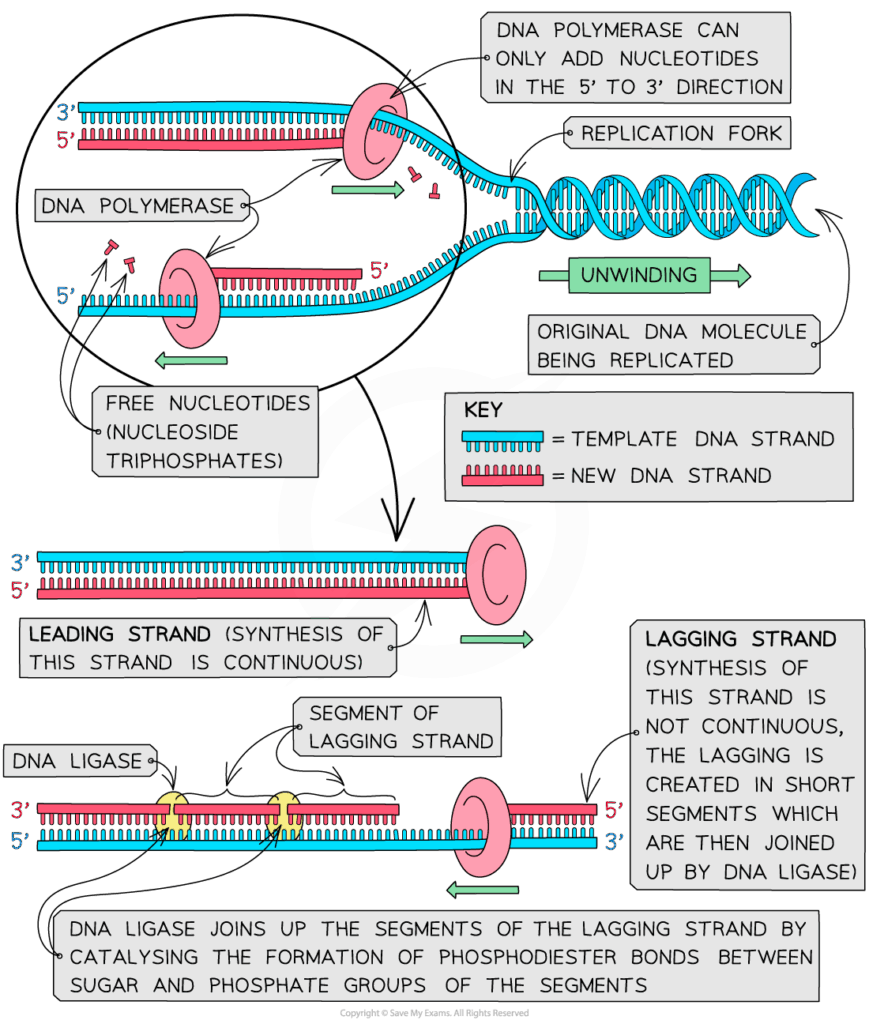
🧬 IA Tips & Guidance: A model-building IA could recreate replication forks with paper/DNA kits to demonstrate leading vs lagging strand synthesis, reinforcing understanding of semi-discontinuous replication.
📌 Directionality and Strand Differences
- DNA polymerases can only extend in the 5′→3′ direction.
- This creates asymmetry: one strand continuous (leading) and one discontinuous (lagging).
- The antiparallel nature of DNA explains why replication is semi-discontinuous.
- Okazaki fragments ensure the lagging strand is eventually completed.
- Proofreading by polymerases minimizes errors during elongation.
🌐 EE Focus: An EE could analyze how different organisms initiate replication at multiple vs single origins, or compare replication rates in prokaryotes vs eukaryotes.
📌 Key Features of Semi-Conservative Replication
- Each new molecule retains one parental strand (template).
- Ensures genetic stability and faithful transmission of information.
- Allows mutations at low frequency, driving evolution.
- Involves coordinated enzyme action at replication forks.
- Is universal across all domains of life, highlighting its evolutionary importance.
❤️ CAS Link: Students could create an educational workshop or visual models demonstrating Meselson–Stahl’s experiment, linking scientific discovery to how evidence builds biological knowledge.
🌍 Real-World Connection: Antibiotics like quinolones block bacterial DNA replication enzymes, exploiting semi-conservative replication as a drug target. In biotechnology, PCR mimics semi-conservative replication, enabling amplification of DNA for diagnostics, research, and forensic science.
📌 Integration with Cell Cycle
- Replication occurs during the S-phase of interphase.
- Accurate replication ensures proper chromosome segregation during mitosis.
- Errors in replication can cause mutations, cancer, or genetic disorders.
🔍 TOK Perspective: Meselson–Stahl’s experiment is a case study in scientific proof. TOK reflection: How do simple, elegant experiments strengthen scientific knowledge, and what makes them more convincing than complex theoretical models?