C4.1.3 ECOLOGICAL SUCCESSION AND STABILITY
📌Definition Table
| Term | Definition |
|---|---|
| Succession | The gradual change in community composition over time. |
| Primary succession | Succession starting on bare rock or newly formed surfaces with no soil. |
| Secondary succession | Succession in disturbed areas where soil remains (e.g., after fire). |
| Pioneer species | The first species to colonise new or disturbed environments. |
| Climax community | A stable, self-sustaining community at the end of succession. |
| Resilience | The ability of an ecosystem to recover after disturbance. |
📌Introduction
Ecological succession describes how communities change over time, driven by species colonisation, competition, and modification of the environment. Succession increases biodiversity and complexity until a stable climax community is established. However, disturbances such as fire, storms, or human activity can reset succession. Ecosystem stability depends on resilience — the capacity to recover after such events
📌 Primary Succession
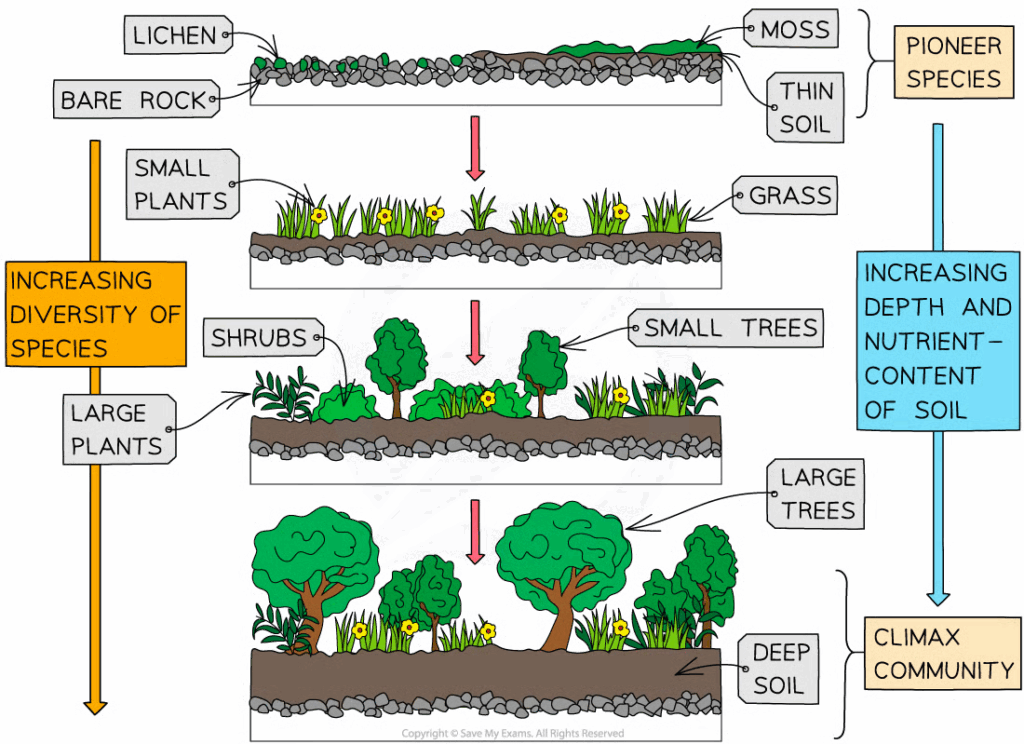
- Begins on bare rock (volcanic islands, retreating glaciers).
- Pioneer species (lichens, mosses) colonise first, breaking rock into soil.
- Soil formation allows grasses, shrubs, and eventually trees to grow.
- Increases organic matter, nutrient cycling, and habitat complexity.
- Takes hundreds to thousands of years to reach a climax community.
🧠 Examiner Tip: Distinguish clearly between primary and secondary succession — many students mix them up.
📌 Secondary Succession
- Occurs after disturbances that remove communities but leave soil intact.
- Faster than primary succession because soil and seeds remain.
- Common after forest fires, floods, or abandoned farmland.
- Communities rebuild through stages: weeds → grasses → shrubs → trees.
- Biodiversity recovers more quickly than in primary succession.
🧬 IA Tips & Guidance: Students can monitor succession in school grounds (e.g., abandoned plots) over months, recording species diversity.
📌 Climax Communities and Stability
- Climax community is the endpoint of succession: stable, high biodiversity.
- Composition depends on climate (e.g., tropical rainforest vs desert).
- Dynamic equilibrium: communities remain stable but not static.
- Disturbances (storms, fires) may shift communities into new stable states.
- Human activity (logging, farming) often prevents climax formation.
🌐 EE Focus: An EE could compare primary vs secondary succession in local ecosystems, using biodiversity indices to track recovery.
📌 Resilience and Disturbance
- Ecosystems vary in resilience — ability to bounce back after disturbance.
- High diversity often increases resilience by providing functional redundancy.
- Keystone species contribute to recovery capacity.
- Disturbance regimes (frequency, intensity) determine community pathways.
- Low resilience ecosystems risk collapse under repeated stress.
❤️ CAS Link: Students could support local ecological restoration projects, such as planting native species in degraded areas.
🌍 Real-World Connection: Succession and resilience are central to habitat restoration, rewilding, and conservation strategies. Climate change increases disturbance frequency, testing ecosystem stability.
📌 Human Impacts on Succession
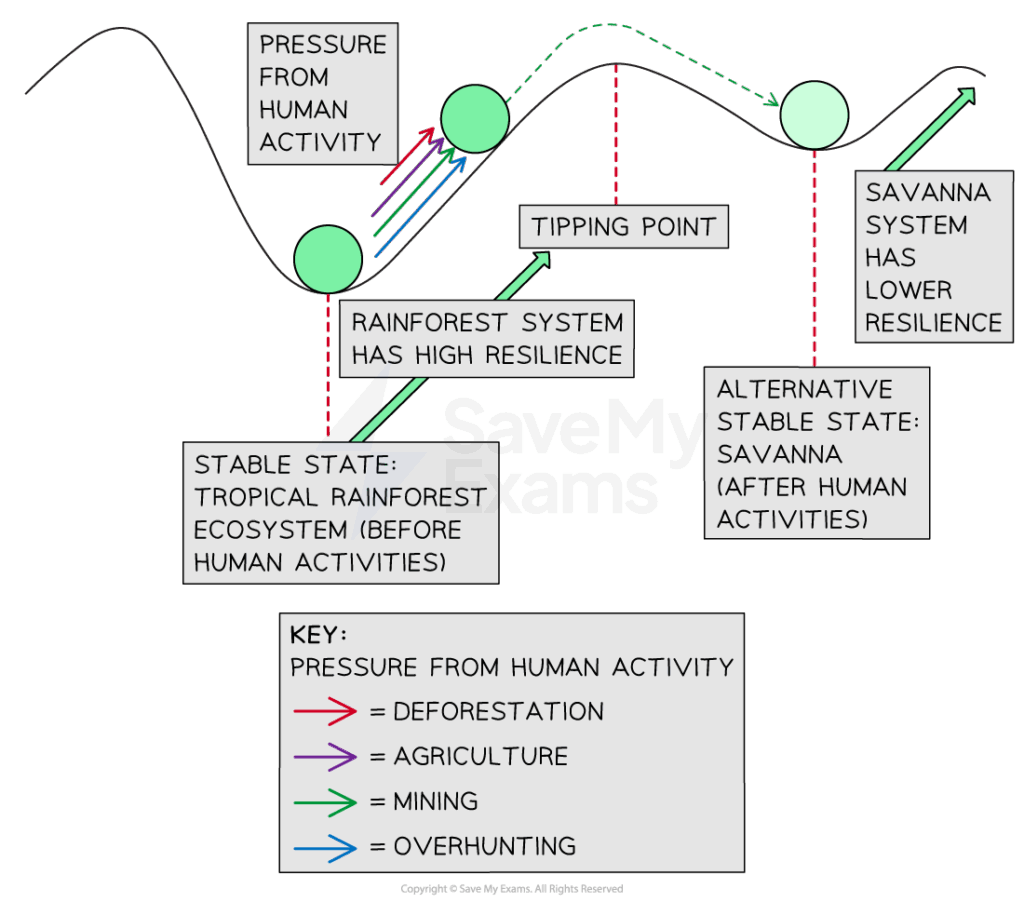
- Agriculture and urbanisation halt natural succession.
- Invasive species alter successional pathways by outcompeting natives.
- Fire suppression changes natural disturbance regimes, reducing biodiversity.
- Restoration ecology seeks to guide succession towards desired outcomes.
- Humans both hinder and manage succession processes.
🔍 TOK Perspective: Succession is often depicted as a linear pathway to climax. TOK issue: Do such models ignore the unpredictability and multiple possible outcomes of real ecosystems?