C3.2.2 ADAPTIVE IMMUNITY B AND T CELLS
📌Definition Table
| Term | Definition |
|---|---|
| Adaptive immunity | A specific immune defence that develops after exposure to a pathogen, involving memory. |
| Antigen | A foreign molecule that triggers an immune response. |
| B cells | Lymphocytes that mature in bone marrow and produce antibodies. |
| T cells | Lymphocytes that mature in the thymus, coordinating and regulating immune responses. |
| Antibody | A protein secreted by plasma cells that specifically binds to antigens. |
| Memory cells | Long-lived lymphocytes that remain after infection, providing faster responses upon re-exposure. |
📌Introduction
Adaptive immunity provides specific, long-lasting defence against pathogens. Unlike innate immunity, it tailors responses to particular antigens and creates memory for future encounters. It involves B cells, which produce antibodies, and T cells, which regulate and destroy infected cells. Adaptive immunity is slower to develop but highly effective, underpinning vaccination strategies
📌 B Cells and Antibody Production
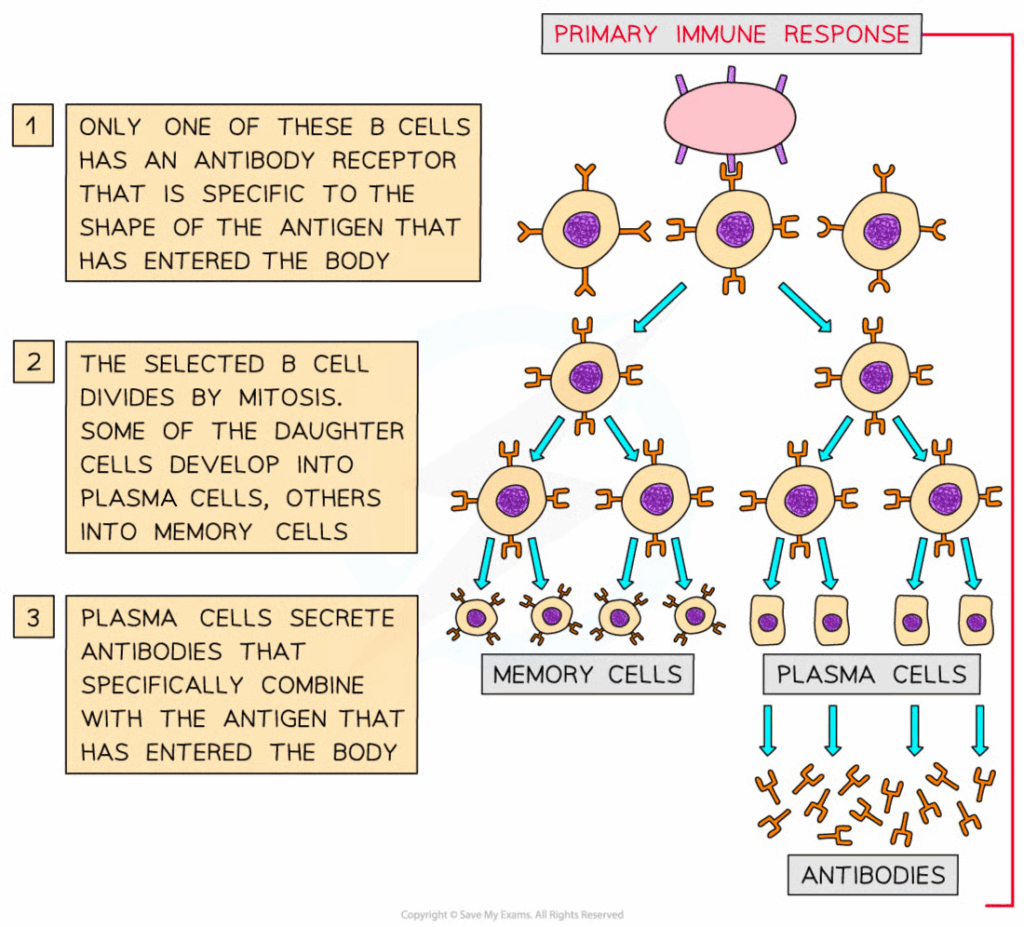
- B cells recognise antigens via surface receptors (membrane-bound antibodies).
- Once activated (with T helper cell support), they differentiate into:
- Plasma cells: secrete large amounts of antibodies.
- Memory B cells: provide long-term immunity.
- Antibodies neutralise toxins, opsonise pathogens, and activate complement.
- Different classes of antibodies (IgG, IgA, IgM) serve specialised roles.
- Antibody diversity arises from gene rearrangements during B cell development.
🧠 Examiner Tip: Don’t confuse plasma cells (short-lived, secrete antibodies) with memory B cells (long-lived, no immediate secretion).
📌 T Cells and Their Roles
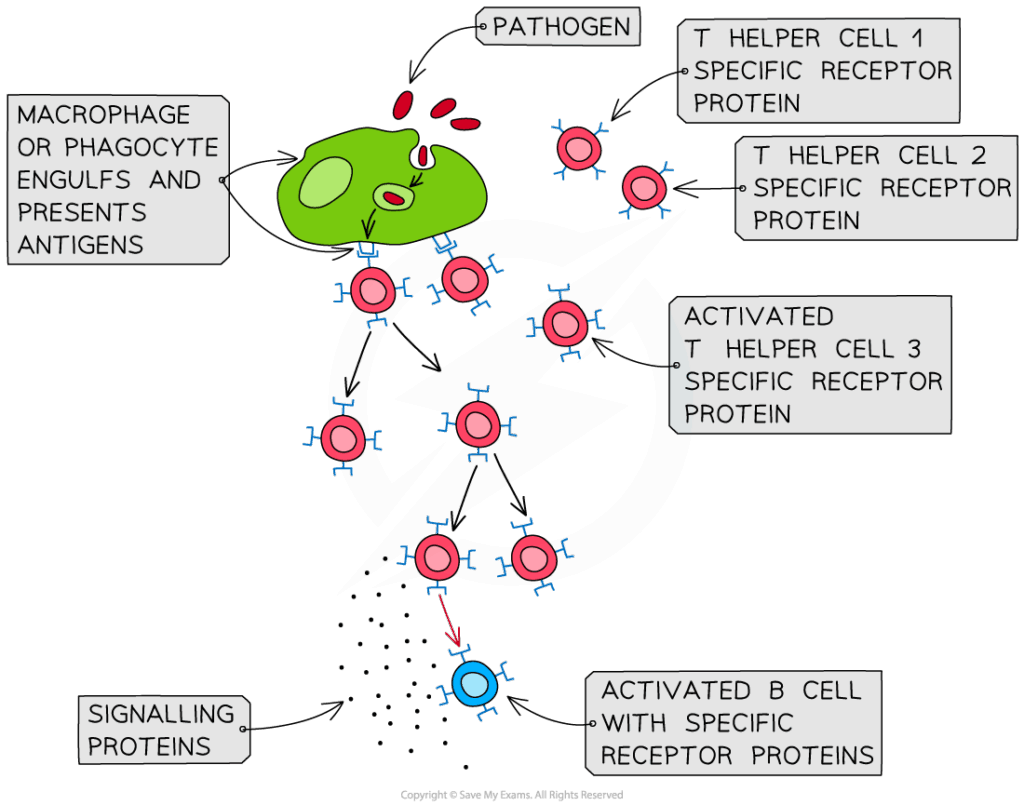
- Helper T cells (Th): release cytokines, activate B cells and cytotoxic T cells.
- Cytotoxic T cells (Tc): kill virus-infected and cancer cells by releasing perforins and granzymes.
- Regulatory T cells (Treg): suppress excessive immune responses, preventing autoimmunity.
- Memory T cells: ensure rapid responses on re-exposure.
- T cells require antigen presentation by major histocompatibility complex (MHC) molecules.
🧬 IA Tips & Guidance: Students could model antibody–antigen interactions using lock-and-key analogies, or use ELISA-based classroom kits to demonstrate antibody binding.
📌 Clonal Selection and Expansion
- Each B or T cell has unique antigen receptors generated randomly.
- When a specific antigen binds, that cell is “selected” and undergoes rapid clonal expansion.
- Creates a population of cells with the same specificity.
- This process explains the specificity and adaptability of immune responses.
- Memory cells formed during clonal expansion underpin long-term immunity.
🌐 EE Focus: An EE could examine how clonal selection theory revolutionised immunology, comparing historical and modern models of immune specificity.
📌 Integration with Innate Immunity
- Antigen-presenting cells (APCs) like dendritic cells activate T helper cells.
- Cytokines from innate immune cells influence adaptive responses.
- Adaptive responses enhance innate immunity (antibodies activate complement, opsonisation).
- Both systems are interdependent, not separate.
- Failures in integration (e.g., HIV destroying helper T cells) cripple immunity.
❤️ CAS Link: Students could create peer-to-peer teaching sessions using role-play to model immune cell interactions (e.g., APCs, B cells, T cells as characters).
🌍 Real-World Connection: HIV specifically targets helper T cells, weakening adaptive immunity. Immunotherapy for cancer harnesses T cells (CAR-T therapy), showing adaptive immunity’s medical potential.
📌 Immune Memory and Specificity
- Primary response: slower, with lower antibody levels.
- Secondary response: faster, stronger, due to memory B and T cells.
- This principle underlies vaccination strategies.
- Specificity ensures pathogens are targeted precisely, minimising collateral damage.
- Autoimmune diseases occur when specificity fails, and self-antigens are targeted.
🔍 TOK Perspective: Adaptive immunity is often described as the body “learning.” But is this metaphor misleading? Memory in biology is chemical and cellular, not conscious. TOK question: How far can we extend human metaphors like “memory” and “recognition” to scientific processes?