C2.2.3 INTEGRATION OF NEURAL PATHWAYS AND REFLEXES
📌Definition Table
| Term | Definition |
|---|---|
| Neural pathway | Network of interconnected neurons transmitting signals from receptors to effectors. |
| Reflex arc | Simplest neural pathway producing an involuntary, rapid response to a stimulus. |
| Convergence | Multiple presynaptic neurons synapsing onto a single postsynaptic neuron, integrating signals. |
| Divergence | One presynaptic neuron communicating with multiple postsynaptic neurons, spreading signals. |
| Summation | Process where multiple EPSPs/IPSPs combine to influence action potential firing. |
| Temporal summation | Multiple signals from the same synapse close together in time add up to threshold. |
| Spatial summation | Signals from multiple synapses at different locations combine to reach threshold. |
📌Introduction
Neural pathways integrate signals from sensory inputs, process them in the central nervous system, and coordinate appropriate responses. Integration allows the nervous system to balance excitatory and inhibitory inputs, prioritize essential stimuli, and coordinate complex behaviors. Reflexes represent the simplest form of integration, enabling organisms to react quickly to danger without conscious control.
📌 Reflex Arcs
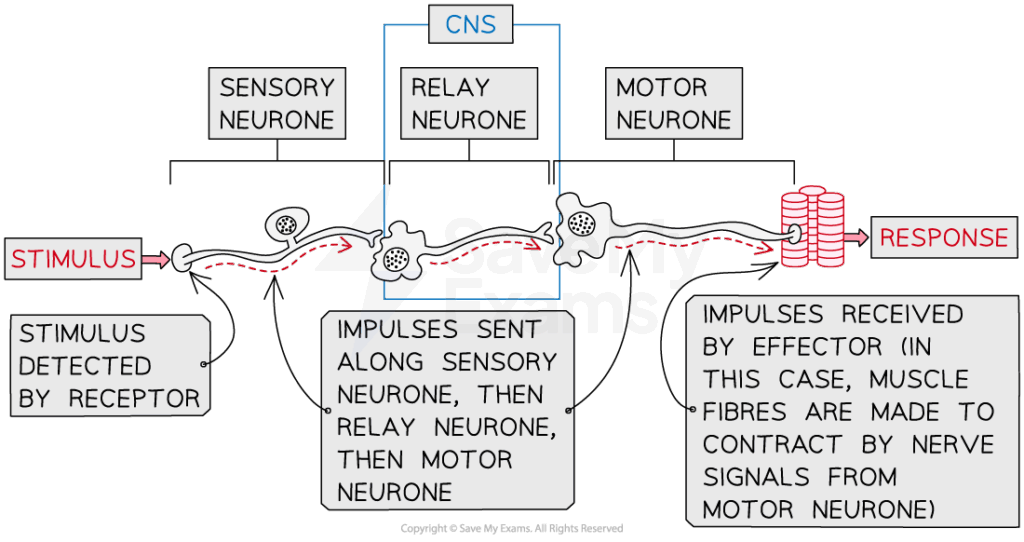
- Involuntary, rapid, protective responses to stimuli.
- Components: receptor → sensory neuron → relay neuron (in spinal cord) → motor neuron → effector.
- Example: knee-jerk reflex, withdrawal reflex from pain.
- Reflexes bypass the brain initially, but the brain may later process the signal for awareness.
🧠 Examiner Tip: Always include all 5 components (receptor, sensory, relay, motor, effector) when drawing/labeling a reflex arc diagram.
📌 Integration in Neural Pathways
- Convergence: allows multiple signals to combine, e.g., rod cells converging onto bipolar cells in retina.
- Divergence: spreads signals to multiple pathways, e.g., spinal cord signals activating both posture and withdrawal reflex.
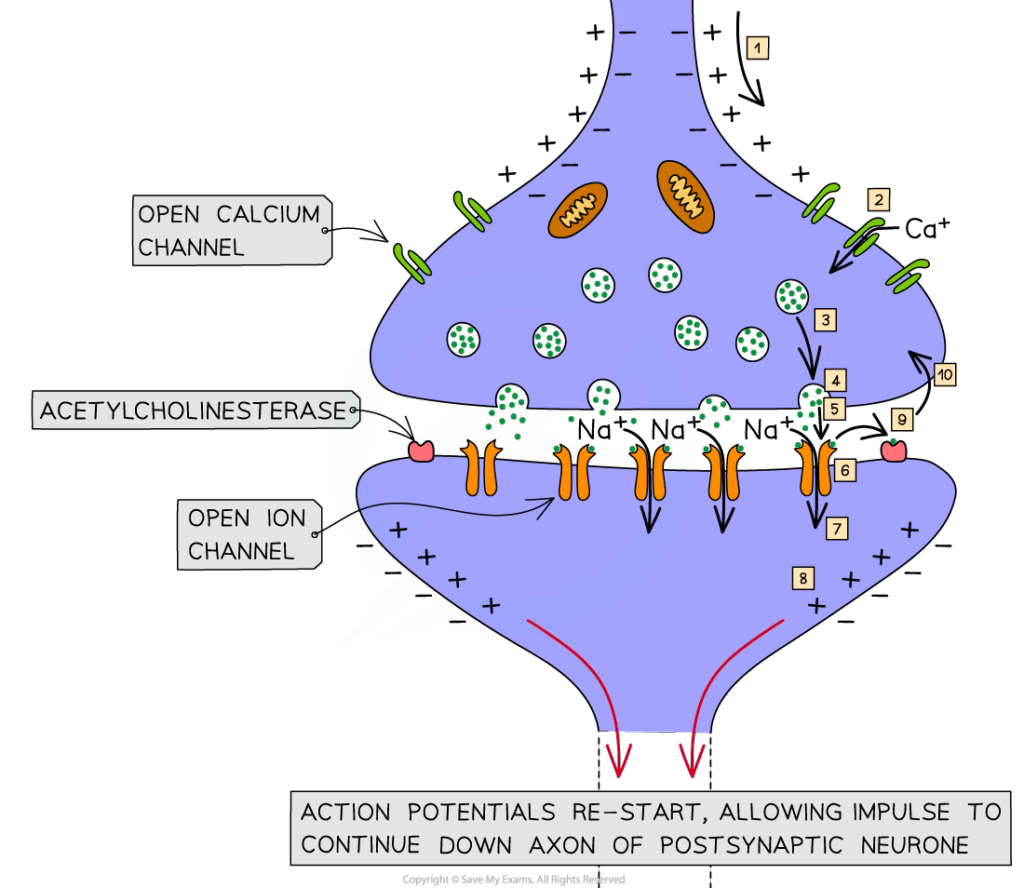
- Summation: balances EPSPs and IPSPs to determine if threshold is reached.
- Ensures flexibility, sensitivity, and coordination of responses.
🧬 IA Tips & Guidance: An IA could test reflex reaction times under different conditions (e.g., fatigue, caffeine, distraction) to explore neural integration and processing speed.
📌 Complex Pathways and Higher Processing
- Reflexes provide basic survival, but higher centers integrate voluntary control.
- Neural circuits underpin memory, learning, and decision-making.
- Inhibitory interneurons prevent excessive or conflicting responses.
🌐 EE Focus: An EE could investigate how neural summation contributes to sensory perception, or compare simple reflexes in invertebrates vs vertebrates as models for nervous system evolution.
📌 Coordination of Reflexes and Conscious Control
- Reflexes may be overridden by conscious control in some cases.
- Brain integrates reflex signals with voluntary movements for coordinated responses.
❤️ CAS Link: Students could create reflex-testing stations (e.g., ruler drop tests) in community health fairs, connecting neuroscience to public awareness of nervous system function.
🌍 Real-World Connection: Reflex testing is widely used in medical exams to assess nervous system integrity. Absent or exaggerated reflexes can indicate spinal cord injury, peripheral nerve damage, or neurological disease.
📌 Neural Circuit Plasticity
- Repeated use strengthens neural pathways (basis of motor learning).
- Reflexes can be conditioned (e.g., Pavlovian learning).
🔍 TOK Perspective: Reflexes are often considered “automatic,” yet experiments show they can be modified by experience. TOK reflection: To what extent can something labeled as “innate” be influenced by learning, and how does this affect our understanding of human behavior?