C2.2.1 STRUCTURE AND FUNCTION OF NEURONS
📌Definition Table
| Term | Definition |
|---|---|
| Neuron | Specialized cell that transmits electrical impulses in the nervous system. |
| Axon | Long fibre conducting impulses away from the cell body. |
| Dendrite | Branching extension that receives impulses from other neurons. |
| Myelin sheath | Insulating layer formed by Schwann cells around the axon, speeding impulse transmission. |
| Node of Ranvier | Gaps in myelin sheath where ion exchange occurs, enabling saltatory conduction. |
| Sensory neuron | Carries impulses from receptors to the CNS. |
| Motor neuron | Carries impulses from the CNS to effectors (muscles/glands). |
| Relay neuron | Connects sensory and motor neurons within the CNS. |
📌Introduction
The nervous system coordinates responses by transmitting electrical impulses along neurons. Neurons are highly specialized for rapid communication, forming complex networks in the central and peripheral nervous systems. Their structural features—long axons, branched dendrites, and insulating myelin—allow rapid and precise transmission of information.
📌 Structure of Neurons
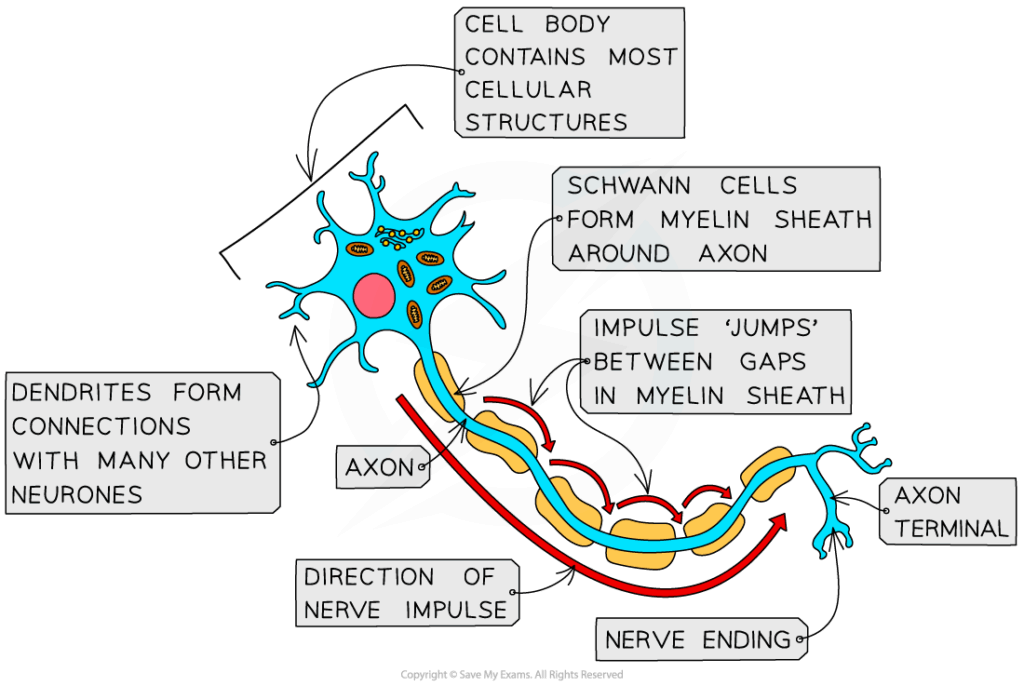
- Cell body (soma): contains nucleus and organelles, supporting metabolic activities.
- Dendrites: provide large surface area for synaptic input, enabling integration of multiple signals.
- Axon: long fibre transmitting impulses away from the soma toward other neurons or effectors.
- Myelin sheath: multilayered lipid covering that insulates axons, preventing current leakage.
- Nodes of Ranvier: unmyelinated gaps where depolarization occurs, allowing saltatory conduction.
- Axon terminals: release neurotransmitters into synaptic clefts for communication.
🧠 Examiner Tip: Always label neuron diagrams with axon, dendrites, cell body, myelin, and nodes. IB markschemes often allocate separate points for each structure.
📌 Types of Neurons
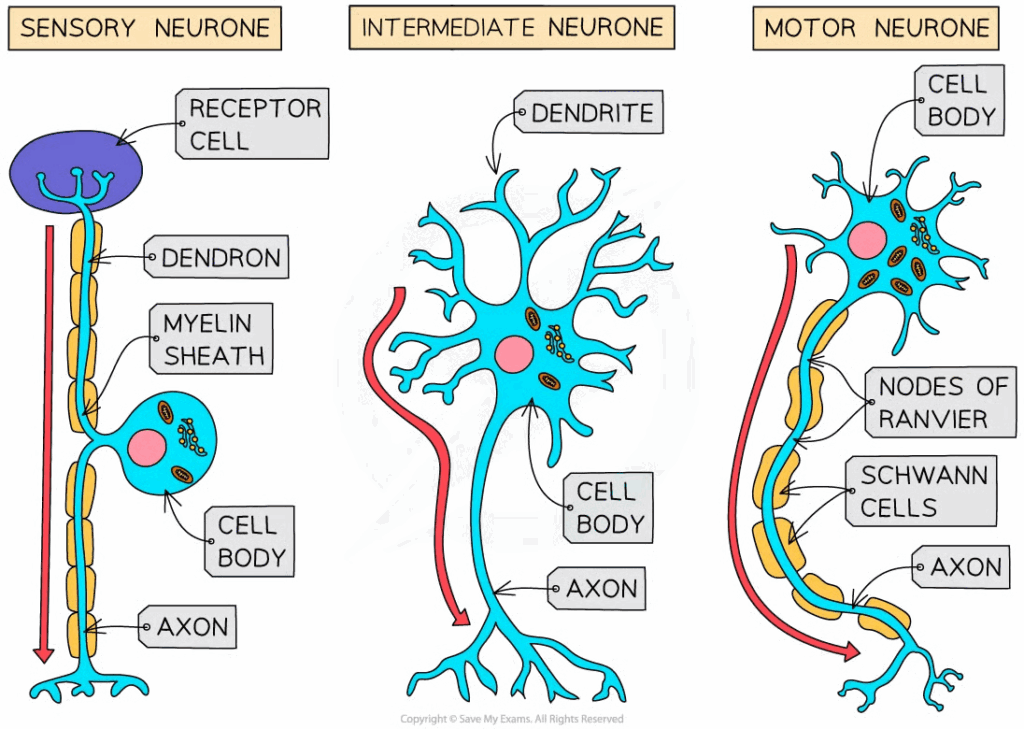
- Sensory neurons: transmit impulses from receptors (e.g., skin, eyes) to CNS.
- Relay neurons: entirely within CNS, connecting sensory and motor neurons.
- Motor neurons: carry impulses from CNS to muscles or glands, triggering responses.
🧬 IA Tips & Guidance: An IA could measure reaction times under different conditions (light vs sound stimuli, dominant vs non-dominant hand), linking to neuron transmission speed and synaptic delay.
📌 Adaptations for Fast Transmission
- Myelination: allows impulses to jump between nodes (saltatory conduction), increasing speed ~50x.
- Large axon diameter: reduces resistance, speeding conduction (e.g., squid giant axon).
- Synaptic connections: dendritic branching allows complex integration of inputs.
🌐 EE Focus: An EE might investigate correlations between axon diameter and conduction velocity, or compare myelinated vs unmyelinated pathways in different organisms.
📌 Functions of Neurons in Nervous System
- Rapid transmission of sensory input to CNS.
- Relay of integrated information within CNS.
- Initiation of motor responses at effectors.
- Support of higher functions like memory, learning, reflexes.
❤️ CAS Link: Students could design interactive models of neuron transmission for school science fairs, helping communities understand nervous system function and health.
🌍 Real-World Connection: Myelin degeneration in multiple sclerosis disrupts impulse conduction, leading to muscle weakness and vision problems. Research on stem cells and remyelination therapies directly applies neuron structure knowledge.
📌 Integration with Nervous System
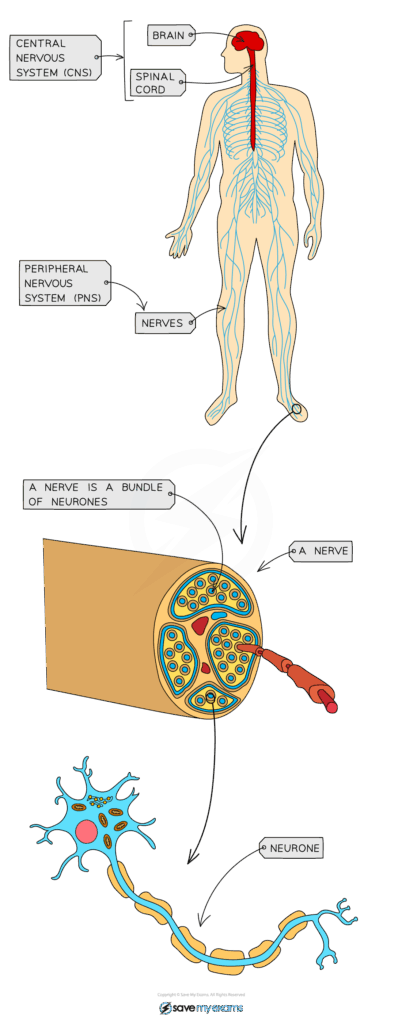
- Neurons work in circuits, converting stimuli into responses.
- CNS neurons act as central processors, PNS neurons as input/output channels.
🔍 TOK Perspective: Neuron structure is inferred from microscopy and electrophysiology. TOK reflection: To what extent can technological limitations shape our knowledge of biological structures, and how might future tools expand it?