C2.1.2 SIGNAL TRANSDUCTION PATHWAYS
📌Definition Table
| Term | Definition |
|---|---|
| Signal transduction | The process by which a cell converts an extracellular signal into a specific cellular response. |
| Receptor | Protein (membrane-bound or intracellular) that binds to a signaling molecule and initiates a response. |
| Second messenger | Small intracellular molecules (e.g., cAMP, IP₃, Ca²⁺) that relay signals from receptors to target proteins. |
| G-protein | A membrane-associated protein that transduces signals from GPCRs to intracellular effectors. |
| Kinase cascade | Sequential activation of protein kinases that amplify signals inside the cell. |
| Amplification | Process where one ligand triggers multiple downstream responses, greatly increasing signal strength. |
📌Introduction
Signal transduction pathways allow cells to sense and respond to external and internal cues. These pathways translate a hormone or signal binding event into biochemical changes that regulate metabolism, gene expression, or cell behavior. By using second messengers and amplification systems, cells ensure that even small signals can produce strong and coordinated responses.
📌 General Steps of Signal Transduction
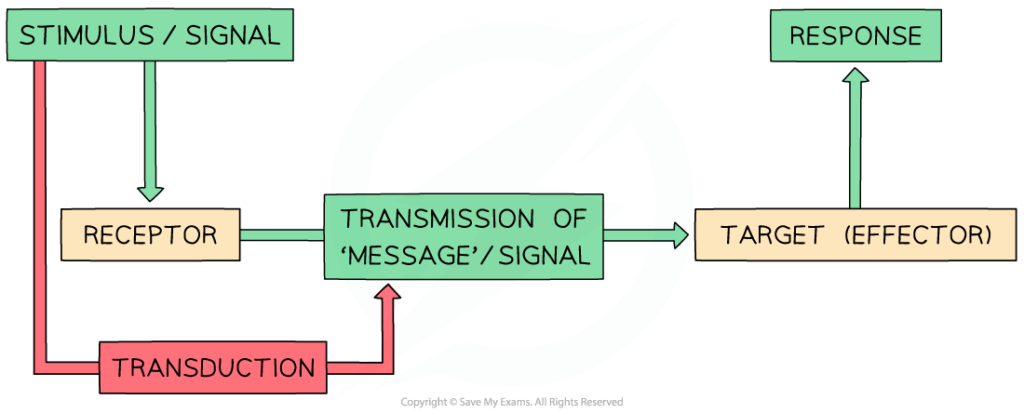
- Reception
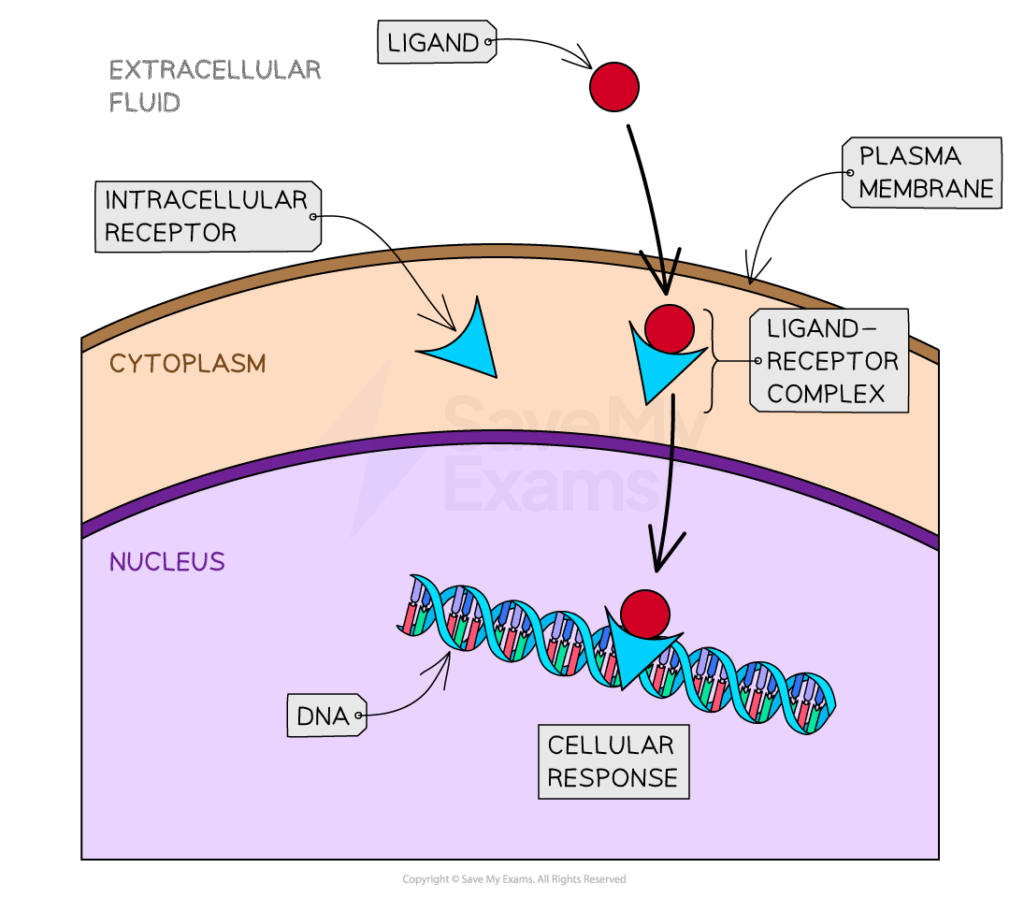
- Signaling molecule (ligand) binds to its receptor.
- Receptors can be membrane-bound (peptide hormones) or intracellular (steroid hormones).
- Transduction
- Binding triggers conformational changes.
- Activates G-proteins, kinase cascades, or second messengers.
- Multiple intermediate steps allow amplification.
- Response
- Changes in enzyme activity, ion channel opening, cytoskeleton, or transcription factor activation.
🧠 Examiner Tip: Always mention the three stages of cell signalling — reception, transduction, and response — as IB mark schemes often award points for this framework.
📌 Examples of Signal Transduction Pathways
- cAMP pathway (e.g., adrenaline):
- Hormone binds GPCR → activates G-protein → activates adenylate cyclase → produces cAMP.
- cAMP activates protein kinase A → phosphorylates enzymes (e.g., glycogen breakdown in liver).
- IP₃/DAG pathway (e.g., ADH, histamine):
- GPCR activates phospholipase C → splits PIP₂ into IP₃ and DAG.
- IP₃ releases Ca²⁺ from ER; DAG activates protein kinase C.
- Leads to smooth muscle contraction or secretion.
- MAP kinase cascade (growth factors):
- Tyrosine kinase receptor activation → phosphorylation cascade.
- Regulates transcription and cell proliferation.
🧬 IA Tips & Guidance: Students could measure enzyme activity (e.g., phosphorylase) under simulated “hormone” conditions, showing how second messengers regulate metabolism. Alternatively, yeast models can demonstrate GPCR responses.
📌 Signal Amplification and Specificity
- One ligand–receptor binding can activate hundreds of second messengers.
- Amplification ensures strong response even at low hormone concentration.
- Specificity achieved through receptor type, downstream effectors, and tissue-specific expression.
🌐 EE Focus: An EE could investigate how mutations in signal transduction pathways (e.g., faulty GPCRs or kinases) contribute to diseases such as cancer or diabetes.
📌 Regulation of Signalling
- Termination ensures signals don’t persist:
- GTP hydrolysis in G-proteins.
- Breakdown of cAMP by phosphodiesterase.
- Receptor internalization and degradation.
- Crosstalk between pathways allows integration of multiple signals.
❤️ CAS Link: Students could develop workshops on how drugs (like asthma inhalers or beta-blockers) work by modifying cell signalling, linking molecular biology to public health.
🌍 Real-World Connection: Pharmaceuticals often target receptors or second messengers in signal transduction. Examples: insulin analogues in diabetes, GPCR-targeting drugs for allergies, kinase inhibitors in cancer therapy.
📌 Integration of Signal Transduction
- Signal pathways connect environmental cues to physiological responses.
- Allow rapid adaptation at cellular and organism level.
🔍 TOK Perspective: Signal transduction pathways are understood largely through models, diagrams, and indirect assays. TOK reflection: How much of our biological knowledge relies on models of invisible processes, and how do we decide whether a model is accurate enough to count as knowledge?