C1.3.3 FACTORS AFFECTING PHOTOSYNTHESIS AND ADAPTATIONS
📌Definition Table
| Term | Definition |
|---|---|
| Limiting factor | The single environmental condition closest to its minimum that directly restricts the rate of photosynthesis. |
| Light compensation point | Light intensity at which photosynthetic CO₂ uptake equals CO₂ release from respiration. |
| Saturation point | Light or CO₂ level beyond which further increases do not raise photosynthetic rate. |
| Photorespiration | Process where Rubisco fixes O₂ instead of CO₂, reducing efficiency of photosynthesis. |
| C₃ plants | Plants that fix CO₂ directly into 3C compound (GP) via Calvin cycle (most plants). |
| C₄ plants | Plants that fix CO₂ into a 4C compound (oxaloacetate), reducing photorespiration and improving efficiency under high light and temperature. |
| CAM plants | Plants adapted to arid environments, fixing CO₂ at night and photosynthesizing during the day to reduce water loss. |
📌Introduction
Photosynthesis is influenced by multiple environmental factors, and its efficiency is often limited by the factor in shortest supply. Understanding these factors is critical in agriculture, ecology, and climate science. Plants have evolved structural and biochemical adaptations (C₃, C₄, CAM pathways) that optimize photosynthesis under different conditions, ensuring survival in diverse environments.
📌 Major Factors Affecting Photosynthesis
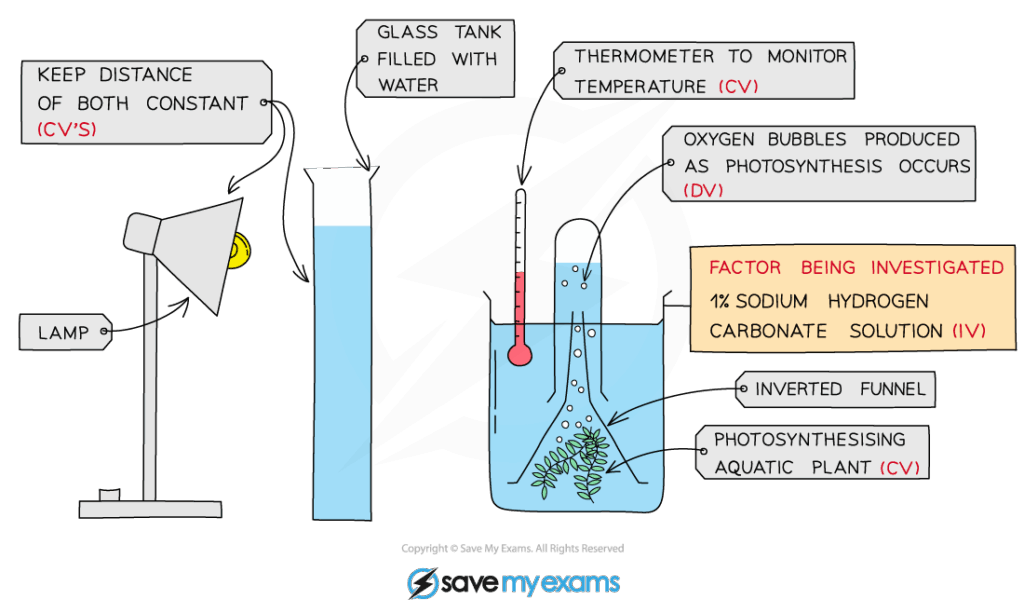
- Light intensity
- Increases the rate up to a point; beyond saturation, no further rise occurs.
- Low light limits ATP and NADPH production.
- Carbon dioxide concentration
- CO₂ is a raw material for Calvin cycle.
- Higher CO₂ increases rate until Rubisco and enzymes become saturated.
- Temperature
- Affects enzyme activity (Rubisco, ATP synthase).
- Low temperature slows reactions; high temperature causes enzyme denaturation and increases photorespiration.
- Water availability
- Indirect factor: water stress causes stomata to close, limiting CO₂ uptake.
🧠 Examiner Tip: In graphs, always identify the limiting factor at different ranges. State clearly when a plateau indicates another factor has become limiting.
📌 Plant Adaptations to Photosynthetic Challenges
- C₃ plants:
- Most common; efficient under moderate light, CO₂, and temperature.
- Disadvantage: prone to photorespiration at high O₂/low CO₂.
- C₄ plants (maize, sugarcane):
- Fix CO₂ into oxaloacetate (4C) in mesophyll cells, then shuttle to bundle-sheath cells for Calvin cycle.
- Adapted to high light, high temperature, low CO₂.
- Reduce photorespiration, enhancing yield.
- CAM plants (cacti, succulents):
- Open stomata at night, store CO₂ as malate, and photosynthesize in the day.
- Adaptation to arid climates, conserving water.
🧬 IA Tips & Guidance: Students can test how light intensity or CO₂ availability affects photosynthetic rate using aquatic plants (e.g., counting oxygen bubbles in Elodea). This provides clear links to limiting factors.
📌 Quantifying Photosynthetic Rate
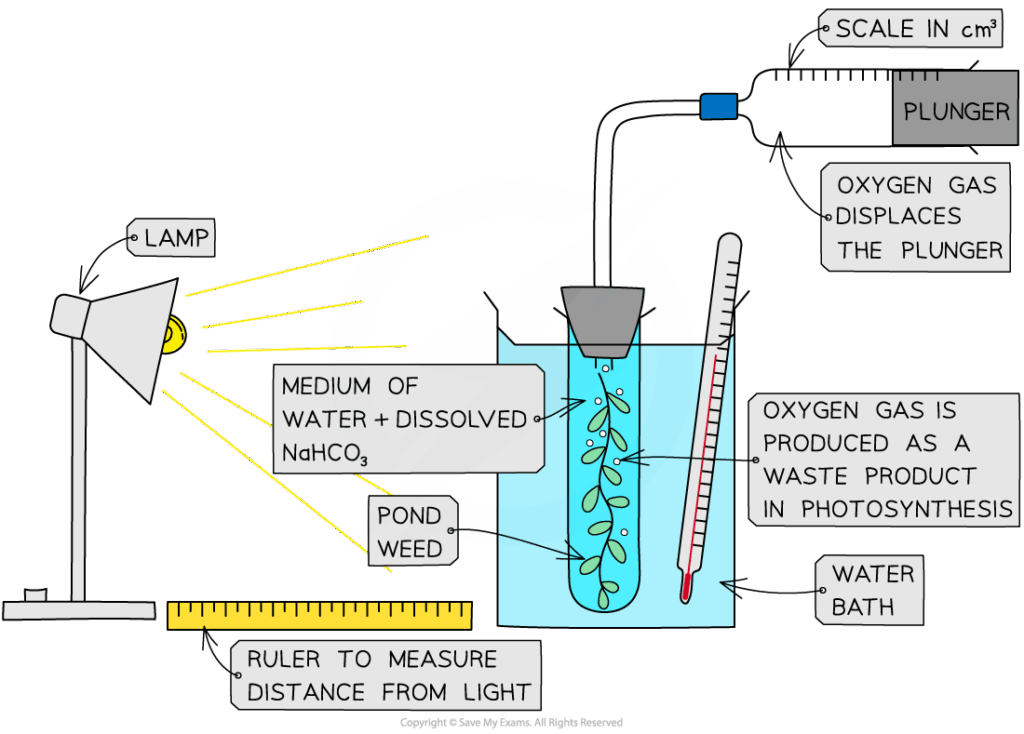
- Oxygen release (aquatic plants, respirometers).
- CO₂ uptake (pH changes in water, gas probes).
- Biomass increase over time.
- Chlorophyll fluorescence to monitor light-use efficiency.
🌐 EE Focus: An EE could investigate the effect of elevated CO₂ on photosynthesis in C₃ vs C₄ plants, or adaptations of CAM plants to drought stress.
📌 Photosynthesis and Global Context
- Photosynthesis underpins primary productivity in ecosystems.
- Limiting factors directly influence agriculture and food security.
- Climate change alters photosynthetic efficiency (e.g., drought stress, temperature extremes).
❤️ CAS Link: Students could run a school gardening project or hydroponics experiment, testing how light, water, or nutrients affect plant growth, linking classroom biology to sustainability.
🌍 Real-World Connection: Greenhouse crop yields are maximized by controlling limiting factors (artificial lighting, CO₂ enrichment, temperature regulation). Global climate models also rely on photosynthesis rates to predict carbon cycling. Biotechnology seeks to engineer crops with C₄ or CAM pathways for higher efficiency.
📌 Integration and Adaptation
- C₃, C₄, and CAM plants illustrate biochemical diversity in solving environmental challenges.
- Adaptations show the balance between maximizing CO₂ fixation and minimizing water loss or photorespiration.
🔍 TOK Perspective: Graphs of photosynthetic rate simplify complex interactions between multiple variables. TOK reflection: How do scientists use simplifications to make complex processes understandable, and what knowledge might be lost in oversimplification?